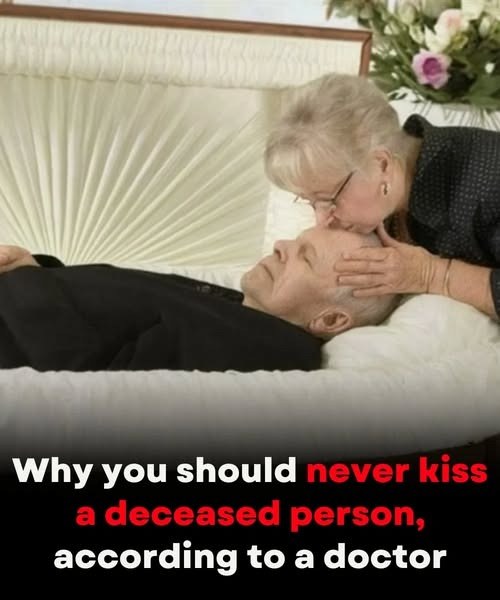
Why do some doctors advise against kissing a deceased loved one?
Why One Doctor Says You Shouldn’t Kiss the Dead — and What It Means for How We Grieve

In a world where grief rituals are deeply personal yet profoundly cultural, a recent video by Dr. Viktor Ivanovik, a physician from Moldova, has stirred passionate debate across social media. With over 300,000 TikTok followers, Dr. Ivanovik used his platform to warn viewers about a delicate but significant issue: the health risks of kissing deceased loved ones. His message, while grounded in medical precaution, quickly became a viral flashpoint—receiving both praise for its candor and criticism for what some saw as an affront to sacred mourning traditions.
🦠 A Doctor’s Warning That Sparked Debate
In the viral clip, Dr. Ivanovik stresses that post-mortem contact can carry health risks, particularly if the deceased suffered from an infectious disease. While such transmission is rare, he explains that bacteria and viruses may remain viable for a time after death, especially in cases involving tuberculosis, hepatitis B or C, meningitis, hemorrhagic fevers, or certain bacterial infections.
His caution wasn’t meant to instill fear, he says, but rather to educate families and caregivers—especially in moments of high emotional vulnerability. “People may not consider the biological state of a body after death,” he notes, “but for medical professionals, the risks—though small—are real and worth addressing.”
💔 A Sacred Goodbye: Why We Kiss the Dead
The backlash was immediate. Many commenters expressed outrage, calling his message cold, disrespectful, or insensitive to human emotion. For countless individuals, touching, holding, or kissing the deceased is not just common—it’s a spiritual act, a final gesture of love. In religious and cultural traditions around the world, it serves as a crucial step in grieving and closure.
-
In Christian funerals, mourners often kiss the forehead or cross placed on the deceased’s chest.
-
In Jewish traditions, washing and preparing the body (Tahara) is done with great reverence, but physical contact from loved ones is minimal.
-
In Islam, family members gently prepare the body for burial, but excessive touching is discouraged.
-
In Hinduism, touching the feet of the deceased is a sign of respect.
For many, these moments of connection help begin the process of letting go. Critics of Ivanovik’s message felt it reduced a deeply human experience to a clinical warning.
⚖️ The Medical Perspective: What Experts Say
So, what does science say? Medical professionals largely agree with Dr. Ivanovik, albeit with nuance. The risk of infection from a deceased person is generally very low—especially when the cause of death is non-infectious, such as cancer or heart disease. However, in specific scenarios, such as deaths involving:
-
Tuberculosis (TB)
-
Severe pneumonia
-
Viral hepatitis
-
Ebola or other hemorrhagic fevers
-
COVID-19
-
Sepsis or bacterial meningitis
—there’s a legitimate biohazard risk. In these cases, funeral homes and healthcare workers follow strict protective protocols, including body containment and limited physical contact.
This is especially relevant during pandemics or outbreaks, when health authorities, such as the WHO or CDC, may advise against traditional rituals involving touch. “It’s not about fear or disrespect,” one infectious disease expert explained. “It’s about balancing compassion with precaution.”
🌹 Rituals That Heal — Without Risk
So how can we say goodbye safely, without sacrificing meaning? Here are alternative mourning rituals endorsed by grief counselors and spiritual leaders:
-
Placing a flower or personal object on the body
-
Writing a letter to be placed in the casket
-
Lighting a candle or incense during a moment of silence
-
Holding a memory circle with photos and shared stories
-
Singing or playing meaningful music
-
Creating a digital tribute through video or social media
These symbolic gestures allow us to express love and grief without increasing health risk. They also help bridge the gap between tradition and safety—especially for those struggling with restricted hospital or funeral access.
❤️ Intention Over Action: The Deeper Message
At its core, the controversy surrounding Dr. Ivanovik’s video isn’t just about public health—it’s about how we, as humans, cope with death. In a moment of overwhelming loss, the need to connect physically—to hold, kiss, or caress the one we’ve lost—feels primal. But his reminder, though clinical, highlights a key truth: the spirit of our farewell isn’t confined to physical contact.
Whether we light a candle or speak a name into the quiet, we honor the dead through our presence, our memories, and our love. As grief evolves and public health challenges persist, perhaps the conversation isn’t about stopping tradition—but about rethinking it with awareness, safety, and sensitivity.
Ultimately, saying goodbye isn’t about one final gesture—it’s about carrying their memory forward, in safe and sacred ways.