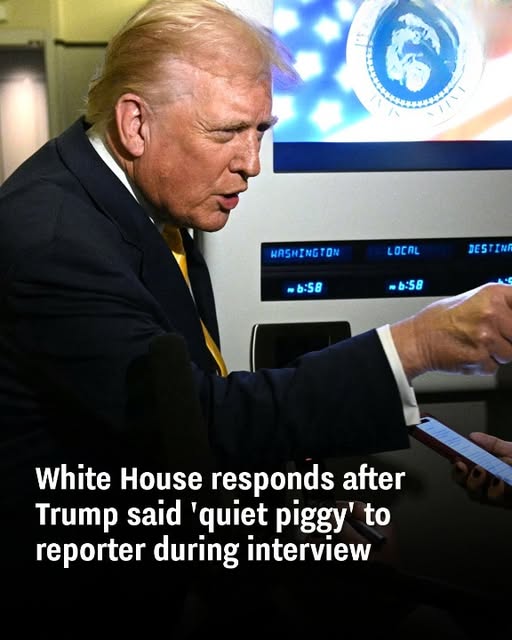
White House responds after Tru
In the hours that followed, the moment aboard Air Force One evolved far beyond a single cutting remark. It shifted into a measure of how a democratic society treats those who attempt to hold power to account. Supporters of the former president shrugged off the uproar and framed the confrontation as another exaggerated reaction fueled by hostile media narratives. Critics interpreted the exchange in a very different light. They saw a direct attack on the idea that elected leaders should answer difficult questions, along with a troubling example of how insults can be weaponized to distract from legitimate scrutiny. For Lucey, colleagues later explained, the encounter felt both wounding and clarifying. The backlash reminded her that challenging those in authority carries real personal risks, yet the incident also reinforced why such questions cannot be abandoned simply because they are unwelcome.

The broader context intensified the moment. The country was already dealing with a relentless cycle of crises, investigations, and politically charged revelations. The Epstein related emails had ignited speculation among commentators, partisans, and internet sleuths who filled the public conversation with theories that blended fact, conjecture, and projection. Instead of addressing the substance directly, the exchange on the plane became a magnet for emotion. Each side projected its own meaning onto the confrontation. Supporters measured loyalty by the willingness to defend the president’s response. Critics measured democratic health by how leaders treat those who challenge them. The moment took on symbolic weight because it unfolded in a setting that represents national power. Air Force One is not merely transportation. It is a flying emblem of the presidency and the authority attached to it. In that enclosed space, with journalists seated feet away, the clash became a live demonstration of how power interacts with accountability.
For people inside the press corps, the aftermath became a case study in resilience. Many reporters spoke privately about the emotional toll of being targeted by public figures, especially in spaces where professional decorum once defined the norms. The line between legitimate criticism and personal degradation has blurred, making it harder to ask sharp questions without becoming part of the story. Lucey’s experience highlighted that tension. Instead of focusing on the content of her inquiry about the emails, much of the coverage revolved around the insult itself. This dynamic, where tone overshadows substance, reflects a growing pattern in modern politics. Spectacle often wins attention while the underlying issue fades from view.
As the news cycle churned, the incident remained a stark portrait of a political era shaped by grievance, performance, and eroding norms of civility. Some observers argued that the exchange would be quickly forgotten once the next controversy emerged. Others insisted that such moments accumulate, slowly reshaping expectations about what leaders can say and how reporters are expected to endure it. Whether the public remembers the precise details of the leaked correspondence or the exact wording of Lucey’s question, one image persists. A president, mid flight and surrounded by staff, turning away from substantive inquiry and responding with a pointed insult.
That image lingers because it communicates something fundamental about press freedom in high stakes environments. The freedom to ask uncomfortable questions remains essential to democratic life, yet its protection often depends on public support rather than legal guarantees alone. Civility is not merely etiquette. It is the framework that allows accountability to function without fear of retribution. When that framework weakens, truth becomes harder to extract, and those who seek it face increasing pressure to stay silent.
The episode will likely be remembered not simply for its sharp words, but for what it revealed about the relationship between authority and transparency in a volatile era. It stands as a reminder that the work of journalism matters most in the moments when it is least welcome.