Secrets Hidden in the Lines of the Hand: Revealers of Destiny
For millennia, humanity has looked to the palm of the hand not just as a tool for labor, but as a manuscript of the soul. The practice of palmistry—the art of interpreting the complex topography of the human hand—is a legacy shared by the world’s most venerable civilizations, from the Vedic traditions of India and the dynastic courts of China to the temples of Egypt and the philosophical hubs of ancient Greece. To the scholars and sages of antiquity, the hand was viewed as a living map of personal destiny, a belief that every line, curve, and subtle marking was a coded message detailing life’s inevitable strengths, struggles, and opportunities. These traditions did not remain static; they migrated across borders, evolving into distinct cultural dialects. In many Asian belief systems, for instance, the “luck line” is often elevated to the same status as the life line, viewed as a critical barometer of one’s fortune. Conversely, European traditions have historically placed a heavier emphasis on the heart line, prioritizing emotional fulfillment and its intersection with material success.

A Mirror of the Self
Even in our era of high-speed data and scientific rigor, the fascination with the hand as a mirror of destiny remains strikingly potent. Across the globe, individuals continue to seek out palm readers, driven by a cocktail of curiosity, hope, and a primal desire for a glimpse of the horizon. The enduring appeal of palmistry lies in its profound intimacy. Unlike the celestial abstractions of a horoscope or the external symbolism of tarot cards, the hand is a part of the self. This physical connection makes a reading feel uniquely personal, transforming a set of skin creases into a deeply meaningful narrative of the individual.
The Scientific Divide
However, this ancient art exists in a state of permanent tension with the modern scientific community. From a clinical perspective, palmistry is firmly classified as a pseudoscience. Researchers maintain that the lines of the hand are the byproduct of genetics, fetal development, and the repetitive mechanical movements of the skin over time. According to the scientific record, there is no measurable or predictive correlation between these dermal folds and one’s future wealth, personality, or lifespan. To skeptics, the “accuracy” of a palm reading is less about fate and more about psychological suggestion and the subjective interpretation of the reader.
Despite these critiques, palmistry refuses to fade into obscurity. For many, the practice has transitioned into a form of sophisticated entertainment or a meditative tool for personal reflection. In this context, it functions less as a literal fortune-telling device and more as a mirror for the subconscious—a way to externalize and explore inner hopes, fears, and aspirations. Contemplating one’s future through these symbols can offer a sense of comfort and emotional clarity in an otherwise chaotic world.
The Symbology of Fortune and Hardship
The personal decision to believe in palmistry often hinges on what an individual seeks from it. For some, it is a mystical art that provides a much-needed compass during times of transition. For others, it is a fascinating cultural artifact, rich in history but devoid of empirical credibility. Yet, regardless of one’s stance, the practice reveals a universal human truth: we possess an inherent need to understand our destiny and exert some semblance of control over the unknown.
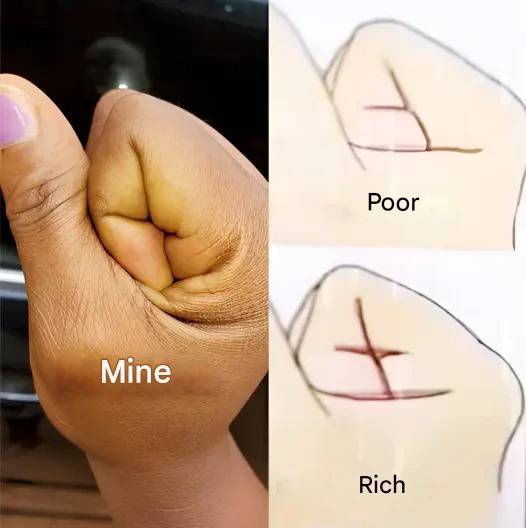
Nowhere is this desire more evident than in the interpretation of financial fortune. Within the lexicon of palmistry, certain configurations are believed to signal economic destiny:
-
The Markings of Hardship: A hand characterized by a dense network of crisscrossing lines near the base is traditionally associated with financial struggle. Practitioners suggest this configuration represents recurring obstacles and limited opportunities—challenges that the individual must consciously work to overcome to achieve stability.
-
The “Rich Hand”: In contrast, a hand destined for prosperity is said to feature a strong, clear cross located near the line of destiny or the life line. A deeply etched, well-defined “fortune line” is interpreted as a harbinger of professional growth, material comfort, and the accumulation of wealth.
Beyond the Ink and Skin
Whether these markings are viewed as prophetic signs or mere biological accidents, they serve as an invitation to reflect on our values and the choices we make. Ultimately, the trajectories of wealth, hardship, and personal fulfillment are shaped not by the creases in our skin, but by our decisions, our perseverance, and the circumstances we navigate. Perhaps the true power of palmistry lies not in its ability to predict a fixed destiny, but in its capacity to inspire us to take the lead in shaping our own lives.