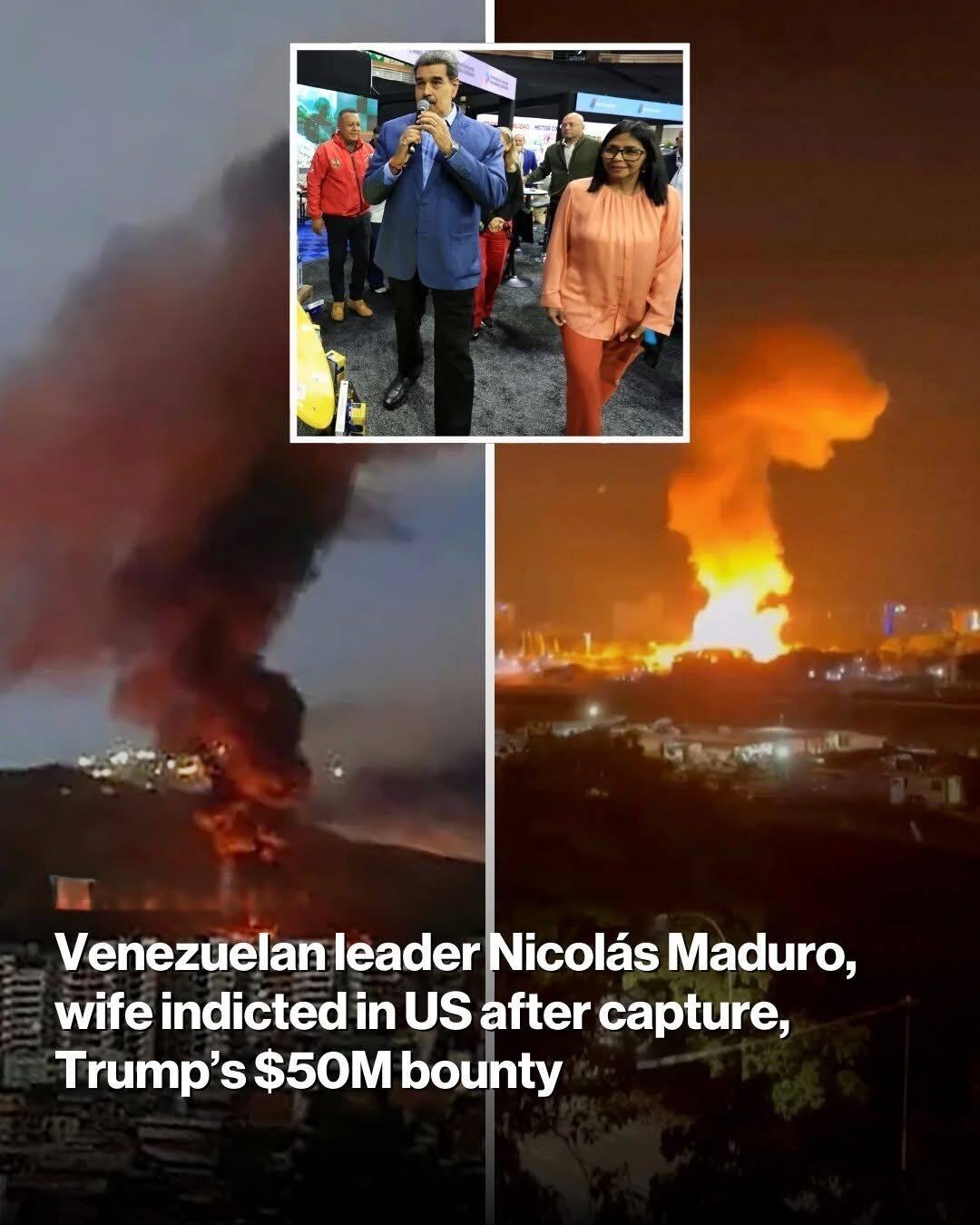
Venezuelan leader Nicolás Maduro and his spouse are facing extensive U.S. legal charges following a major capture operation. President Donald Trump has confirmed the activation of a long-standing $50 million reward, sparking international attention, legal discussions, and diplomatic reactions across Latin America.
In a staggering turn of events that has upended decades of Latin American power dynamics, Nicolás Maduro has reportedly transitioned from the untouchable figurehead of a defiant socialist state to a high-value detainee under U.S. jurisdiction. For more than ten years, Maduro cultivated a carefully manicured image of permanence, weathering a relentless barrage of international sanctions, domestic uprisings, and economic freefall. Today, that facade of invulnerability lies in ruins, replaced by the clinical reality of a U.S. federal indictment. U.S. authorities have unveiled a comprehensive array of charges against the former president, including narco-terrorism, cocaine trafficking, and the coordination of transnational criminal networks. Prosecutors have long alleged that Maduro sat atop a state-backed criminal enterprise, leveraging narcotics profits to grease the wheels of his repressive apparatus and ensure the unwavering loyalty of his security forces.

The New York Indictment: A Symbol of Accountability
The legal implications of a potential trial in a New York courtroom are nothing short of profound. If the proceedings move forward, a man who once addressed the United Nations General Assembly as a head of state will stand before a jury of ordinary citizens, stripped of the immunity and sovereign power he wielded for a decade. U.S. court documents outline years of alleged activity linking senior Venezuelan officials and shadowy business networks directly to drug operations spanning the Caribbean, Latin America, and the United States. For international observers, the symbolism is inescapable: a leader who spent years condemning the “imperialist” American judiciary may now be forced to answer to it.
Shockwaves in Caracas
Inside Venezuela, the atmosphere is a volatile mix of paralysis and strategic maneuver. While state-run media remains predictably defiant—labeling the capture a “foreign abduction” and a violation of national sovereignty—the cracks in the foundation are beginning to show. Sources within the Venezuelan military, speaking under the veil of anonymity, have begun to signal a shift in posture. Some high-ranking officials are stressing their loyalty to the constitution rather than to any specific individual, a subtle but significant departure from the personalistic style of governance that defined the Maduro era. As rumors of internal power struggles and shifting alliances sweep through Caracas, ordinary citizens are caught between the hope for economic reform and the haunting fear of a chaotic power vacuum.
Regional Ripple Effects and Global Reactions
The global response has been divided between those applauding a landmark victory for international justice and those bracing for the fallout. Neighbors like Colombia and Brazil, long the primary recipients of the Venezuelan migration crisis, are carefully weighing the potential for a reduction in cross-border smuggling against the threat of sudden, violent instability. In Washington, officials are framing the operation as the culmination of years of methodical intelligence gathering and inter-agency coordination. They describe the mission as a precise strike designed to minimize collateral damage. However, independent verification remains a hurdle, complicated by state-controlled communications in Venezuela and a deluge of social media misinformation.
The Question of Precedent
Beyond the immediate political fallout, legal scholars are debating the unprecedented nature of this detention. Trying a recently deposed head of state on foreign soil for transnational crimes raises complex questions regarding sovereignty and the future limits of diplomatic immunity. Will Maduro’s removal catalyze a period of democratic renewal and reintegration into global markets? Or will it trigger a period of deeper social upheaval? Analysts caution that the trajectory remains speculative, dependent on the interplay between military loyalty, international pressure, and the resilience of a populace already pushed to the brink by years of scarcity. What is clear, however, is that the perception of permanence has been shattered. The story of Nicolás Maduro has moved from the palace to the precinct, and the final chapter will likely be written not in Caracas, but in a foreign court of law. In the high-stakes theater of global diplomacy, the capture of Nicolás Maduro by U.S. forces has moved from a shocking weekend headline to a grueling endurance test of regional stability. As the dust settles on Operation Absolute Resolve, an undercurrent of profound caution has gripped the international community. Policymakers, while acknowledging the seismic shift in the hemisphere’s power structure, are increasingly preoccupied by the specter of a power vacuum that could destabilize the entire South American continent. The concerns are not merely academic. Analysts are mapping out plausible, albeit speculative, scenarios that include heightened migration surges, the sudden fracturing of regional trade corridors, and a deepening of an already acute humanitarian crisis. Because of Venezuela’s central—and often disruptive—role in regional economics, these projections are being treated as urgent priorities by the White House and neighboring capitals alike.
A Nation in “Suspended Animation”
Inside Venezuela, the landscape of governance is in a state of kinetic uncertainty. Reports are surfacing of a quiet but frantic repositioning among the “Chavista” elite. While Vice President Delcy Rodríguez has assumed the interim presidency—initially condemning the capture as a “cowardly kidnapping” before adopting a more pragmatic tone—the military hierarchy remains the ultimate arbiter. Senior officers are reportedly calibrating their allegiances, weighing the preservation of local authority against the potential for a total institutional collapse. For the ordinary Venezuelan citizen, the political upheaval is filtered through the lens of daily survival. Navigating a reality of hyper-inflation and scarcity, the population remains caught in a mixture of tentative hope and profound fear. Humanitarian organizations are sounding alarms, noting that any prolonged political friction could compound the existing failures in healthcare, food security, and basic services.
The Oil Factor and Economic Rebalancing
Economically, the perception of a weakened or decapitated central authority is a double-edged sword. Venezuela’s oil industry, once a titan of global energy, has languished under years of mismanagement and sanctions. While President Trump has pledged that U.S. oil majors will “fix the badly broken infrastructure,” analysts warn that meaningful recovery is a multi-billion dollar, decade-long project. Transitions in leadership may open pathways for foreign investment, but they could just as easily trigger sabotage or further operational paralysis if the transition turns violent. Local businesses, already operating under extreme constraints, are moving with agonizing caution as they weigh potential regulatory shifts against the immediate risks to physical security.
A Legal Frontier: Immunity on Trial
On the judicial front, the prospect of a federal trial for a head of state in New York presents an unprecedented legal crucible. U.S. courts must now navigate a thicket of issues involving:
-
Sovereignty vs. Accountability: Can a foreign judiciary prosecute a leader for transnational crimes without violating foundational international norms?
-
Diplomatic Protocol: What remains of presidential immunity for a leader the U.S. has labeled illegitimate since 2018?
-
The Specialty Principle: Ensuring Maduro is only tried for the specific charges for which he was apprehended.
This legal battle is being watched by every embattled leader globally, as it threatens to set a new standard for how the international community addresses state-backed criminal enterprises.
The Battle of the Narratives
Meanwhile, the media landscape has become its own theater of war. State-controlled outlets in Caracas continue to frame the capture as an illegal “abduction,” attempting to rally domestic support through the rhetoric of sovereign violation. In contrast, international media focuses on the meticulous, years-long investigation into narco-terrorism and human rights abuses.
Observers emphasize that this duality of messaging is more than just propaganda; it is a tool for influencing public trust and shaping the political dynamic inside the country.
Three Paths Forward
As Venezuela enters this period of uncertainty, analysts have identified three primary trajectories for the coming months:
-
Negotiated Settlement: A political “grand bargain” between opposition figures like Edmundo González and the remaining regime remnants to stabilize governance.
-
Military Consolidation: A scenario where the armed forces maintain order but potentially install a new authoritarian figure to preserve the status quo.
-
Fragmentation: The most dire scenario, where competing factions and regional “warlords” provoke a conflict that exacerbates the humanitarian catastrophe.
The fall of Nicolás Maduro marks both a definitive end to an era of perceived invincibility and the beginning of a complex, high-risk geopolitical calculation. Whether this moment becomes a catalyst for systemic reform or a trigger for prolonged instability will depend on the resilience of the Venezuelan people and the depth of international engagement in the days to follow.