ICE Officer Who Shot a U.S. Citizen Is Considered Immune From Charges Under Federal Law
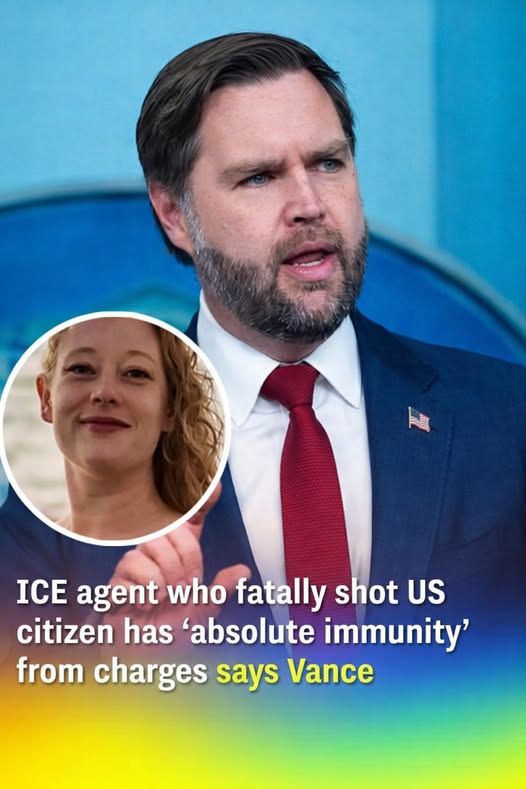
Vice President JD Vance has confirmed that the ICE agent involved in the death of 37-year-old Renee Nicole Good in Minnesota will not face criminal charges, a declaration that has ignited a fierce national debate over federal immunity, law enforcement accountability, and the limits of state authority. Speaking to reporters Thursday, Vance asserted that the agent is protected by what he described as “absolute immunity,” a legal doctrine that shields federal officers from prosecution when actions are taken within the scope of their official duties. Citing established legal precedent, including principles reflected in cases such as Buehler v. Austin, Vance maintained that the agent was “doing his job” during the encounter and dismissed any effort by Minnesota authorities to pursue criminal charges as “preposterous.”

According to Vance, because the operation was conducted under federal law enforcement protocols, jurisdiction rests exclusively with federal authorities, effectively barring the state from intervening. That assertion has intensified scrutiny not only of the incident itself, but of the broader balance of power between federal agencies and state oversight.
The vice president’s comments came amid growing outrage from state officials, civil rights advocates, and members of the public who are demanding transparency and independent review. At the center of the controversy is the Minnesota Bureau of Criminal Apprehension (BCA), the agency typically tasked with investigating serious incidents involving law enforcement within the state.
BCA Superintendent Drew Evans confirmed that state investigators were denied access to key evidence and investigative processes. According to Evans, the U.S. attorney’s office explicitly barred the BCA from participating in the investigation, leaving the Federal Bureau of Investigation with exclusive control.
That restriction, Evans said, prevented state investigators from reviewing surveillance footage, interviewing witnesses, independently collecting physical evidence, or conducting their own assessment of the circumstances surrounding Good’s death. State officials have described the move as unprecedented and warned that it undermines public confidence in the integrity of the investigation.
Federal authorities, however, have stood firmly behind the agent’s actions. The Department of Homeland Security has stated that Renee Nicole Good “weaponized her vehicle,” framing the encounter as a legitimate law enforcement response. Federal officials have gone further, characterizing the incident as an act of domestic terrorism.
President Donald Trump echoed that characterization in public remarks, emphasizing what he described as the threat posed to ICE personnel. The federal framing of the incident—and the legal protections that accompany it—has fueled intense controversy both in Minnesota and across the country.
Advocates for Good, along with local officials and civil rights organizations, strongly dispute that narrative. They argue that federal immunity should not function as a barrier to accountability when a civilian loses their life during a law enforcement operation.
Minneapolis Mayor Jacob Frey has emerged as one of the most vocal critics of the federal response. Frey described the ICE agent’s actions as reckless, questioning whether appropriate caution was exercised and challenging claims that lethal force was justified. He has also stated that the official account portraying Good as the aggressor does not align with eyewitness statements or preliminary evidence.
Frey and other city leaders have called for an independent, transparent review, warning that the lack of state involvement deepens mistrust and exacerbates tensions between local communities and federal authorities.
Beyond the specifics of the case, Good’s death has reopened broader questions about intergovernmental cooperation in law enforcement. Traditionally, state agencies are permitted to participate in investigations involving civilian deaths, even when federal officers are involved. Such collaboration is intended to ensure thorough evidence review, multiple perspectives, and public accountability.
The decision by the U.S. attorney’s office to block state participation has sparked renewed debate over the scope of federal immunity and the precedent this case may set. Critics argue that excluding state investigators creates an appearance of secrecy, potentially eroding trust in both federal law enforcement and the justice system as a whole.
Legal scholars note that “absolute immunity” is a long-standing legal principle designed to protect federal officers acting within the bounds of their duties. However, experts emphasize that the doctrine is not limitless. Immunity generally applies when officers are acting lawfully, following established protocols, and without gross negligence or intentional misconduct.
The Good case has reignited debate over where that line should be drawn—particularly in high-stakes encounters involving lethal force.
Public reaction has been intense and deeply polarized. Advocacy groups, civil liberties organizations, and local residents have expressed outrage over the denial of state investigative access, arguing that accountability requires independent oversight. Others, however, maintain that federal agents routinely face dangerous situations requiring split-second decisions, and that immunity protections are essential to ensure they can perform their duties without fear of constant prosecution.
These competing perspectives reflect broader national tensions surrounding immigration enforcement, policing authority, and civil rights.
The case has also highlighted longstanding friction between federal agencies and state or local governments. In Minnesota, previous federal operations have occasionally sparked disputes over transparency and jurisdiction. While legal precedent clearly grants federal officers certain protections, critics argue that the absence of coordinated oversight risks deepening public mistrust—particularly in communities already wary of federal enforcement.
Vice President Vance’s firm stance on immunity has intensified the political dimension of the case. Minnesota lawmakers and local officials have called for greater transparency, insisting that immunity should not be interpreted as immunity from scrutiny when civilian lives are lost.
At its core, the controversy underscores a fundamental tension in American federalism: federal officers are granted protections to carry out their duties effectively, while state and local governments remain responsible for maintaining public trust and community safety.
As media coverage, public debate, and legal analysis continue, the death of Renee Nicole Good has become more than a single case. It is now a flashpoint in a larger national conversation about power, accountability, and the limits of authority.
For many in Minnesota, the case remains deeply personal. For the nation, it raises enduring questions about how justice is pursued, who oversees those entrusted with force, and how transparency is maintained when federal power intersects with civilian lives.