“He Lived Through Television’s Most Influential Eras”
Long before she became the gold standard for 1980s television glamour, Linda Evans was a product of New England pragmatism and Norwegian resolve. Born Linda Evenstad on November 18, 1942, in Hartford, Connecticut, the woman who would eventually define an era of prime-time soap operas was raised in a household where hard work wasn’t just encouraged—it was expected. It was this foundational upbringing, steeped in the understated values of her heritage, that would later provide the steel beneath the velvet of her most famous characters.  Evans’ journey to the epicenter of the entertainment world began with a cross-country move during her adolescence. When her family relocated to North Hollywood, the transition from the quiet, structured streets of Hartford to the frenetic energy of Los Angeles proved transformative. It was here that her parents, sensing a burgeoning creative spark, nurtured her interest in storytelling. In the shadow of the major studios, Evans enrolled in drama classes where her instructors quickly noted a rare maturity; even as a teenager, she possessed a natural ability to inhabit complex emotional landscapes that eluded many of her peers.

The Big Valley: A Masterclass in Grit
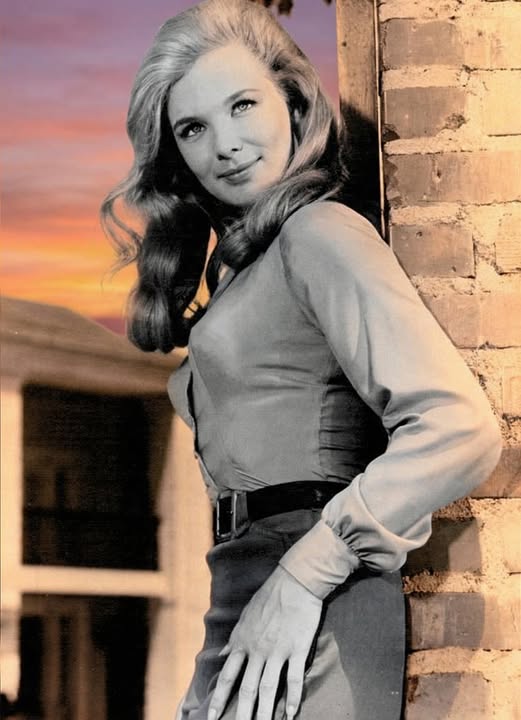
By the early 1960s, Evans had traded community theater stages for professional sets. Her apprenticeship was served in the trenches of episodic television, with guest turns on staples like Bonanza and Wagon Train. However, it was her casting as Audra Barkley in the hit Western The Big Valley (1965–1969) that served as her true arrival.
Playing the youngest daughter of the Barkley clan, Evans found herself in a high-stakes masterclass, working alongside industry titans like Barbara Stanwyck. It was here that Evans’ reputation for meticulous preparation took root. Colleagues from that era recall a young actress who approached every frame with a workmanlike dedication, blending a palpable vulnerability with a burgeoning strength. Audra Barkley wasn’t just a breakout role; it was the crucible that solidified Evans as a dependable pillar of prime-time drama.
As the 1970s dawned, Evans navigated a decade of diversification. While she remained a constant presence in television films and miniseries, she used this period to experiment with genre, moving fluidly between suspense and romance. More importantly, she began to curate a public persona that favored craftsmanship over the hollow allure of celebrity. In an era of rising tabloid culture, Evans remained a steady hand, prioritizing health, personal growth, and a quiet professional discipline.
Dynasty and the Krystle Carrington Phenomenon
The trajectory of Evans’ career—and indeed, the landscape of American television—shifted irrevocably in 1981. Cast as Krystle Carrington in Aaron Spelling’s Dynasty, Evans became the emotional heart of a seismic cultural shift. The show was a heady cocktail of oil wealth, family machinations, and high-fashion melodrama, yet it was Evans’ portrayal of the compassionate, resilient Krystle that anchored the spectacle.
Her performance as the wife of tycoon Blake Carrington earned her a Golden Globe and multiple People’s Choice Awards, but her impact went beyond the trophy mantle. In an era of “excess is best,” Evans imbued Krystle with a sense of authentic humanity. She managed to make a character living in a world of unimaginable wealth feel relatable to millions of viewers. Behind the scenes, the Dynasty set was a grueling environment, yet Evans remained its stabilizing force. Her co-stars frequently lauded her ability to convey deep emotion with a subtle grace—a skill that allowed her to hold her own in the show’s most explosive confrontations.
“She was an emblem of 1980s glamour, but more importantly, she was a standard-bearer for the multidimensional female lead,” says one industry historian. “She could command respect without ever sacrificing her compassion.”
A Legacy of Grace Under Pressure
Throughout the height of Dynasty-mania, Evans performed a delicate balancing act. While the show drew tens of millions of viewers weekly, she maintained a rigorous boundary between her public duties and her private life. She navigated the “white-hot” glare of international fame without succumbing to the destructive pressures that claimed many of her contemporaries.
Even as the decade closed and Dynasty concluded its run in 1989, Evans’ influence remained. She had helped redefine the portrayal of women in serialized drama, proving that resilience and elegance were not mutually exclusive. From the disciplined young girl in Hartford to the icon of a global television phenomenon, Linda Evans’ career remains a testament to the power of preparation, the importance of heritage, and the enduring appeal of a performer who treats her craft with the utmost dignity.
In an industry often fueled by the volatile combustion of scandal and sudden disappearance, Linda Evans remains a rare case study in intentionality. While the 1980s saw many of her contemporaries consumed by the very fame that created them, Evans utilized a strategy of dignified restraint. By prioritizing privacy over the relentless churn of the tabloid cycle, she didn’t just survive the “Dynasty” era—she curated a reputation that remains untarnished decades later.
A Cultural Iconography of Strength
The accolades Evans collected during her tenure as Krystle Carrington—including a Golden Globe and multiple People’s Choice Awards—were more than just industry trophies. They were affirmations of a performance that bridged a difficult gap: portraying a woman who possessed profound vulnerability without ever compromising her core strength.
Industry insiders have long noted that Evans’ portrayal of Krystle was a watershed moment for television. She was one of the first prime-time leads to embody both the “soft power” of domestic life and the “strategic acumen” required to navigate a world of corporate and familial intrigue. Her influence rippled through the fashion world, as Krystle’s wardrobe became a global aesthetic benchmark, but Evans handled this international icon status with a trademark humility that kept her grounded.
The Great Pivot: Choosing Growth Over Glare
When Dynasty took its final bow in 1989, Evans did something few stars at the peak of their powers dare to do: she stepped back. Choosing the quietude of personal well-being over the pursuit of more roles, she performed a deliberate withdrawal from the Hollywood spotlight. This wasn’t a retreat, but rather a calculated pivot toward a life of balance and family.
During this period of introspection, Evans explored new avenues of connection:
-
Literary Reflections: She authored Recipes for Life, a memoir that bypassed traditional Hollywood gossip in favor of sharing wisdom on resilience and the value of a rich private life.
-
A Culinary Triumph: In 2009, she reminded the public of her competitive edge, winning Hell’s Kitchen UK. The victory served as a late-career testament to her adaptability and her ability to perform under high-octane pressure.
The Pacific Northwest: A Life of Intentionality
Today, Evans finds her sanctuary in the Pacific Northwest. Far from the “frenetic energy” of Los Angeles, she has cultivated a life centered on mindfulness, physical health, and genuine social connection. In rare recent interviews, she speaks not of past glories, but of gratitude—an evolution that reflects a woman who has successfully transitioned from the high-stakes drama of the 1980s to a life defined by peace.
Television historians and contemporary actors alike point to Evans as a blueprint for professional longevity. She remains a central figure in retrospectives of the medium, cited as a model for how to handle public scrutiny with unwavering grace. Her ability to contextualize her career within the larger history of television offers a roadmap for the next generation of performers navigating the complexities of modern fame.

“Linda Evans demonstrates that a career defined by impact and integrity can coexist with a private, balanced life—a lesson increasingly vital in today’s era of constant digital exposure.”
An Enduring Testament
From the dust of The Big Valley to the opulence of Dynasty, and finally to the serene landscapes of her current life, Linda Evans’ trajectory is a masterclass in resilience. Her story is one of a woman who understood that true success is not just about the heights one reaches, but the integrity one maintains while standing there.
Through decades of professional excellence and personal reflection, Evans remains an indelible mark on American culture—a testament to the enduring power of grace, intelligence, and the courage to choose one’s own path.