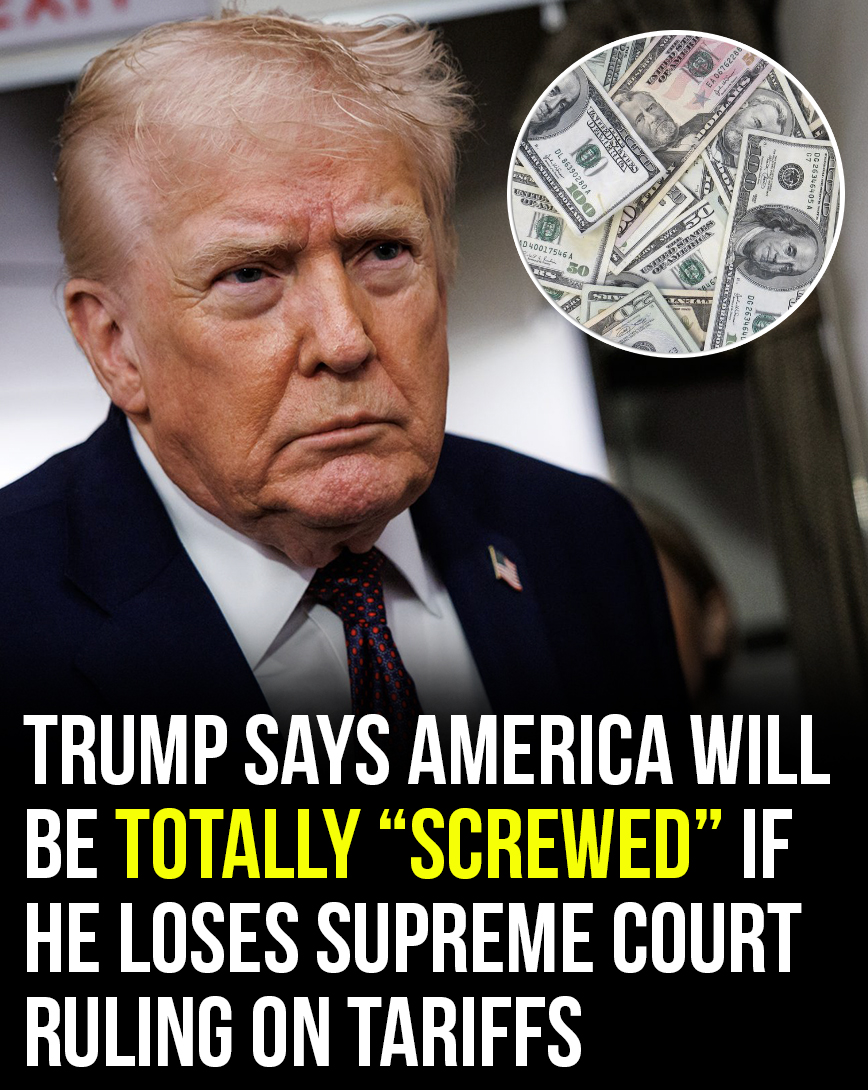
Trump warns U.S. will be “screwed” if Supreme Court strikes down on his tariffs
President Donald Trump has issued a blistering ultimatum to the nation’s highest court, warning that a looming ruling against his signature trade policy would trigger a “complete mess” and leave the United States financially paralyzed. The high-stakes legal battle, which could see a decision as early as this week, centers on the president’s unprecedented use of the 1977 International Emergency Economic Powers Act (IEEPA) to bypass Congress and impose sweeping global tariffs. For Trump, the policy is more than a trade maneuver; it is the cornerstone of his second-term economic agenda—one he claims is essential for national security and the funding of direct $2,000 “dividend” checks for most Americans. But as the Supreme Court prepares to hand down its verdict, the president is signaling that a loss would not only gut his platform but also force a catastrophic “payback” to foreign nations and domestic corporations.

The Trillion-Dollar “Mess”
In a characteristic flurry of Truth Social posts on Monday, January 12, the president laid out a grim balance sheet of the fallout he expects if the Court strikes down his “Liberation Day” tariffs.
”The actual numbers that we would have to pay back… would be many Hundreds of Billions of Dollars,” Trump wrote, referring to the potential for massive refunds to importers. He further argued that the liability would balloon into the “trillions” when accounting for the “payback” that countries and companies would demand for investments they made in U.S. infrastructure specifically to avoid his duties.
”It would be a complete mess, and almost impossible for our Country to pay,” Trump warned, directly challenging the narrative that his executive overreach can be easily unwound.
The Legal Tightrope: Can a President Tax?
At the heart of the crisis is a fundamental constitutional question: Does the power to “regulate” international commerce—granted to the president during emergencies under IEEPA—include the power to “tax”?
Since February 2025, the administration has used the 1977 law to slap duties of 10% to 50% on more than $150 billion in goods from partners including China, India, Canada, and the EU. Lower courts, however, have been skeptical.
-
May 2025: The U.S. Court of International Trade ruled the tariffs unlawful.
-
August 2025: The Federal Circuit upheld that decision, with judges noting that “tariffs are a core Congressional power” and that the word “regulate” is not a synonym for “tax.”
The Supreme Court took up the case (Learning Resources, Inc. v. Trump) on an expedited schedule. During oral arguments in November, even the Court’s conservative wing appeared uneasy with the idea of a president wielding such unbounded economic power without a clear mandate from Capitol Hill.
A New Front: The “Iran Tax”
Unfazed by the judicial pushback, the president opened a fresh front in his trade war this Monday. He announced a 25% tariff on any country maintaining commercial ties with Iran, citing the regime’s brutal crackdown on domestic protesters.
”Effective immediately, any Country doing business with the Islamic Republic of Iran will pay a Tariff of 25%,” Trump declared. While the order is aimed at further isolating Tehran, it threatens to blow a hole in the trade relationships of major U.S. partners like China, Turkey, and the United Arab Emirates.
Critics argue this latest move underscores the exact “unpredictability” that has led to over 1,000 lawsuits from U.S. importers. They contend that while Iran may feel the squeeze, American consumers are the ones left holding the bill in the form of higher prices for food and consumer goods.
The $2,000 Promise at Risk
For many Americans, the most tangible part of this fight is the “Tariff Dividend.” Trump has repeatedly promised to use the revenue—which his administration claims reached $309 billion by late 2025—to send checks of “at least $2,000” to low- and middle-income citizens.
However, analysts at the Tax Foundation and the Committee for a Responsible Federal Budget have warned that the math only works if the tariffs remain in place and unchallenged. If the Supreme Court rules the tariffs illegal, the “dividend” money could instead be redirected to satisfy the “hundreds of billions” in legal refunds owed to corporations.
“WE’RE SCREWED!”
As the nation waits for the 10:00 a.m. opinion release session, the president’s rhetoric has reached a fever pitch. He has dismissed those who say a transition away from his tariffs would be simple, calling such answers “false” and “misunderstood.”
Trump concluded his Monday missive with a blunt assessment of the stakes for his “National Security bonanza.”
”Remember, when America shines brightly, the World shines brightly,” he wrote. “In other words, if the Supreme Court rules against the United States of America… WE’RE SCREWED!”