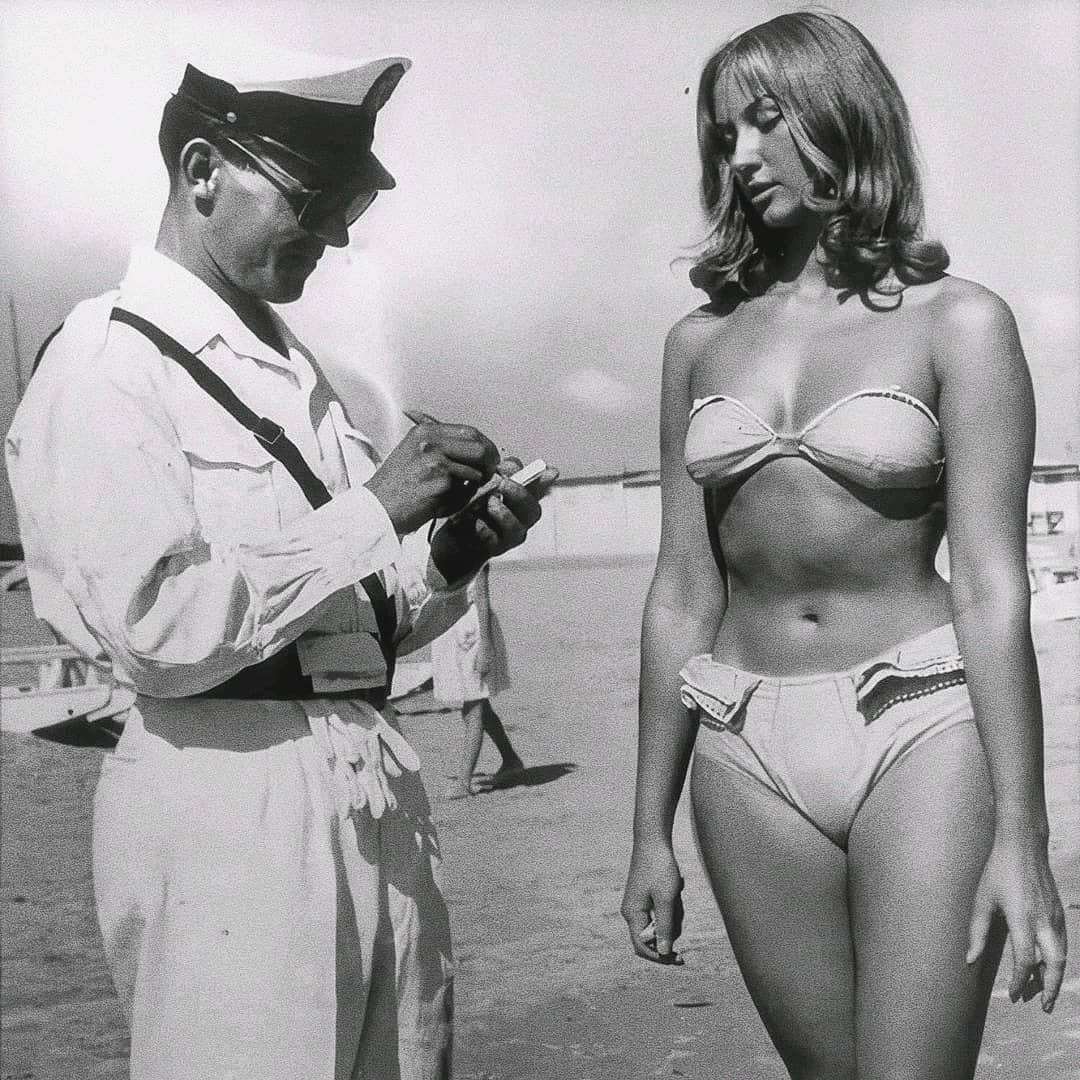
At first glance, it looks like a harmless photo of a woman on the beach, Look closer, though, and you will see the hidden detail that caused this picture to go viral!
The history of the bikini is far more than a timeline of fashion; it is a storied chronicle of the friction between individual liberty and social control. Today, a photograph of a woman on a sun-drenched beach might seem unremarkable, but less than a century ago, a single square foot of fabric was enough to incite international indignation, papal decrees, and police intervention. The bikini, as we know it, emerged not just as a garment, but as the victor in a decades-long struggle over the female body, changing the rules of public space with every daring look.

At the turn of the 20th century, the concept of “swimwear” was rooted firmly in the Victorian ideals of modesty rather than the practicalities of swimming. Early bathing suits were cumbersome, multi-layered ensembles often crafted from heavy wool. These suits were designed to conceal as much skin as possible, frequently featuring long sleeves, bloomers, and even black stockings to ensure that “dimpled knees” remained hidden from public view. The beach was a place of strict surveillance. In 1915, at places like Coney Island and Chicago’s Clarendon Beach, authorities employed “beach censors” and tailors to enforce modesty codes. It was not uncommon to see police officers patrolling the shoreline with tape measures, ensuring that the distance between a woman’s hemline and her knee did not violate local ordinances.
The first cracks in this rigid facade appeared thanks to the defiance of individuals like Annette Kellerman. An Australian professional swimmer and performer known as the “Australian Mermaid,” Kellerman revolutionized the sport by advocating for functional attire. In 1907, she famously traded the traditional, heavy pantaloons for a sleek, one-piece suit that exposed her arms and legs to allow for better movement in the water. While Kellerman claimed she was arrested for indecency on a Boston beach, the ensuing scandal served as a catalyst for change. Her “Annette Kellerman” line of one-piece suits became a sensation, proving that women were eager to trade restrictive modesty for the freedom to actually swim.
By the 1920s, the “Roaring” spirit of the decade reached the shoreline. A group of Californian rebels known as the “Skirts Be Hanged Girls” led a revolutionary movement to strip away the unnecessary fabric of previous generations. Their goal was simple: practicality. Swimwear became more form-fitting and athletic, prioritizing mobility over moral policing. While these suits were still modest by modern standards, they signaled a shift in the cultural landscape. Women were beginning to reclaim their right to inhabit their bodies without the constant interference of Victorian “decency” laws.
However, the most explosive moment in swimwear history occurred in July 1946. Just days after the United States conducted atomic tests at Bikini Atoll in the Pacific, French engineer Louis Réard introduced a garment he believed would have an equally “explosive” impact. Composed of just four triangles of fabric, the bikini was so scandalous that Réard could not find a professional model willing to wear it; he eventually hired Micheline Bernardini, a nude dancer from the Casino de Paris, to debut the look. The bikini was the first commercial swimsuit to expose the navel—a boundary that many believed should never be crossed in public.
The backlash was swift and global. Pope Pius XII declared the garment “wicked,” leading to statewide bans in Catholic strongholds like Italy, Spain, and Portugal. In the United States, the bikini was prohibited on many public beaches, viewed as an emblem of moral decay. Even as late as the 1950s, the tension remained palpable. A famous viral photograph from 1957 often resurfaces on social media, purportedly showing an Italian police officer in Rimini issuing a ticket to a young woman simply for wearing a bikini. While historians debate whether that specific image was a staged publicity stunt or a genuine arrest, the context behind it is indisputably real. Italian laws from 1932 regarding “indecent swimwear” remained on the books for decades, and women who dared to wear the two-piece often found themselves in “hot water” with local authorities.
The tide finally began to turn in the 1960s, largely due to the overwhelming influence of cinema and celebrity culture. Hollywood stars like Marilyn Monroe and Brigitte Bardot became the faces of the bikini revolution. Bardot, in particular, transformed the garment into a cultural statement. In her breakout film, The Girl in the Bikini, she didn’t just wear the suit; she embodied a new era of effortless, sun-kissed confidence. Across the Atlantic, the 1962 Bond film Dr. No featured Ursula Andress emerging from the Caribbean waves in a white bikini with a diving knife strapped to her hip. This image redefined the bikini as a symbol of strength and fearless femininity rather than mere scandal.
By the 1970s, the bikini had achieved mainstream acceptance, and the “modesty” of the early century was a fading memory. The arrival of the string bikini and eventually the thong pushed the boundaries of exposure even further, while men’s swimwear followed suit by becoming smaller and more athletic. The garment had successfully transitioned from a prohibited item of “moral decay” to a standard staple of the global summer wardrobe.
In the 21st century, the conversation has evolved yet again. We have moved beyond the era of policing “decency” and into an era focused on body positivity and inclusivity. The modern swimwear market is a vast spectrum of diversity, catering to every body type, gender identity, and personal preference. Whether a person chooses a full-coverage burkini, a classic one-piece, or a daring thong, the choice is now—rightfully—their own. The decades-long battle over the bikini was never truly about the fabric itself; it was about the right to self-expression and the freedom to exist in public spaces without shame.
Today, when we look at the evolution of these designs, we see the reflection of a society that has fought for the right to be seen. The path from the heavy wool suits of the 1910s to the diverse silhouettes of today represents a journey toward a more inclusive and accepting world. The next time you visit the beach, remember that the freedom to choose your attire was a hard-won victory. The bikini did not just change what we wear; it changed how we view the human body and the limits of the law.