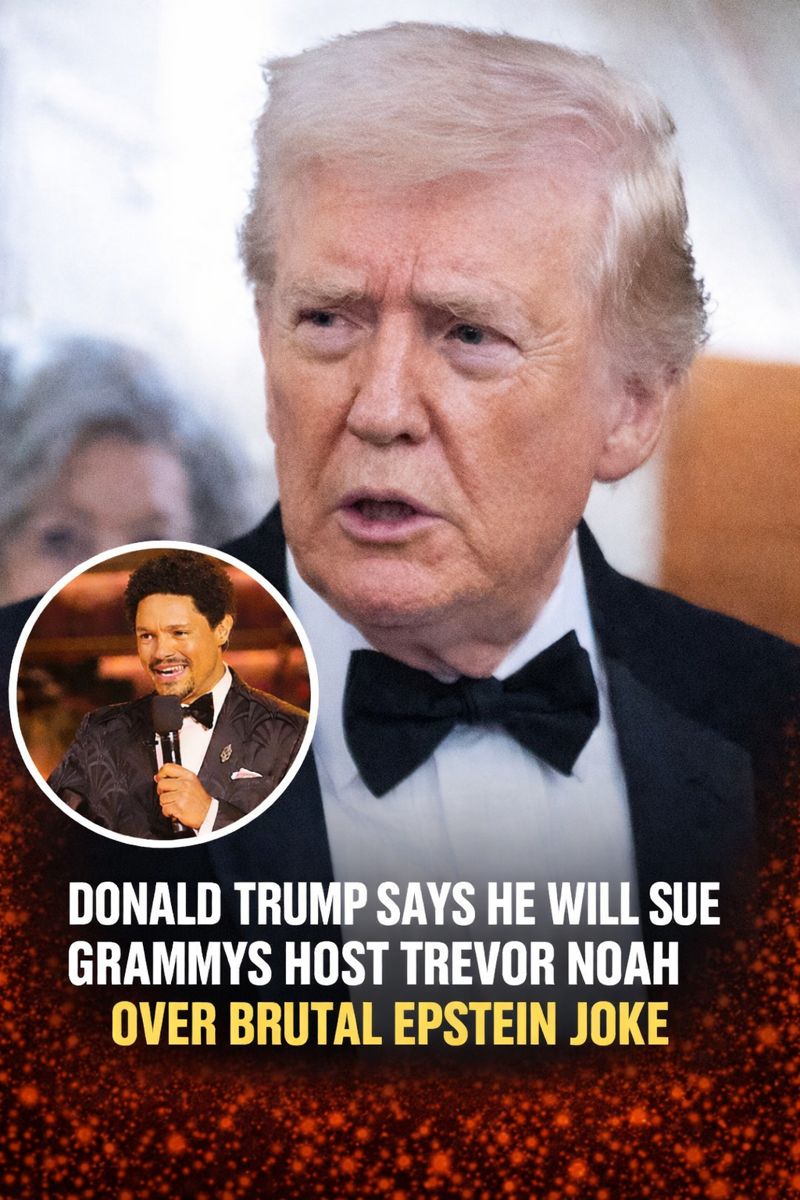
Donald Trump says he will sue Grammys host Trevor Noah!
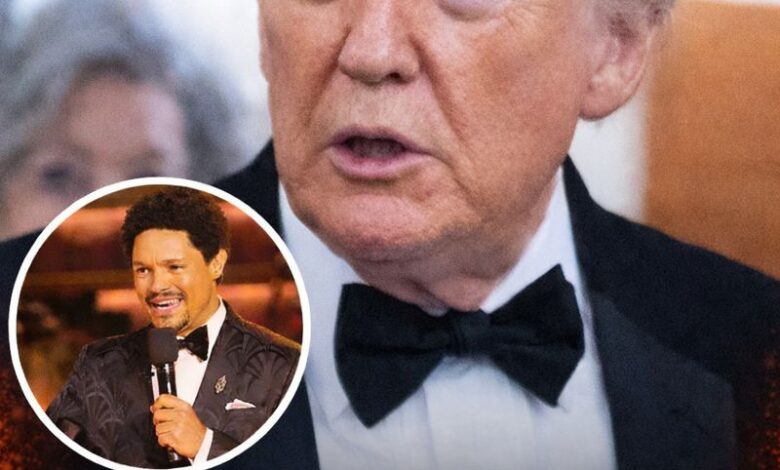
The latest clash between Donald Trump and Trevor Noah did not begin in a courtroom or on a campaign trail. It began under stage lights, with a microphone, a carefully timed pause, and a joke that landed like a spark in dry grass.

During his turn as host of the Grammy Awards, Noah delivered a line that instantly cut through the room’s applause and into the political bloodstream. Referencing renewed public attention around the Jeffrey Epstein scandal, he quipped that Trump might “need a new island.” The joke lasted seconds. The reaction has lasted days—and counting.
Trump’s response was swift and furious. Within hours, he blasted the remark as “false and defamatory,” declaring that he intended to sue Noah and those responsible for the broadcast for “plenty$.” It was a familiar posture: aggressive, absolutist, and framed as a counterattack against what he described as malicious lies disguised as humor.
But this was not merely a celebrity spat or a thin-skinned reaction to a late-night punchline. The timing is what turned a throwaway joke into a political flashpoint.
The comment landed just as renewed attention surged around thousands of recently unsealed Epstein-related documents. While many of the names and references in those files have been known, debated, and litigated for years, the sheer volume of material reignited public speculation. Social media platforms flooded with half-read excerpts, screenshots stripped of context, and sweeping accusations presented as conclusions.
Against that backdrop, Noah’s joke hit a nerve. Comedy, after all, does not operate in a vacuum. A line that might once have registered as generic satire suddenly felt, to Trump and his supporters, like a deliberate insinuation delivered at a moment of maximum vulnerability.
Trump’s camp insists there is no ambiguity here. He has repeatedly denied any wrongdoing related to Epstein and has pointed to statements from federal authorities indicating that certain claims circulating online are unsupported. From his perspective, the joke crossed a bright line: it took an unresolved, emotionally charged topic and used it to imply guilt on one of the most visible stages in American entertainment.
In Trump’s telling, this was not comedy. It was character assassination.
Yet the Grammys have never been a neutral space. For decades, the ceremony has doubled as a cultural pressure valve, a place where artists, hosts, and performers test the boundaries of what can be said about power. From anti-war speeches to racial justice statements to blunt political criticism, the stage has long been used to provoke, unsettle, and force conversation.
Trevor Noah is no stranger to that tradition. As a comedian who built a global profile by blending politics with satire, he operates on the assumption that powerful figures are fair game. In comedy’s internal logic, status invites scrutiny, and outrage is often treated as proof that the joke landed where it was supposed to.
From that angle, Trump’s threat to sue becomes part of the performance itself—a powerful figure responding to mockery with legal firepower, reinforcing the very imbalance comedians often claim to challenge.
But the real tension here lies in the gray zone between satire and slander.
In American law, defamation hinges on false statements presented as fact that cause reputational harm. Jokes complicate that standard. Courts have historically given wide latitude to satire, especially when the context clearly signals humor rather than assertion. Awards shows, late-night monologues, and comedy specials are generally understood by audiences as exaggerated, interpretive, and symbolic—not evidentiary.
That said, context matters. When jokes reference real allegations, real investigations, and real harm, the line becomes thinner. What sounds like a metaphor to one audience can sound like an accusation to another. And when reputations are already under siege, even implication feels intolerable.
Trump’s promise to sue reflects more than anger at Noah. It reflects a broader strategy he has used repeatedly: confront criticism not just rhetorically, but legally, framing himself as the victim of coordinated defamation rather than a public figure subject to commentary. Whether such a lawsuit would ever be filed—or succeed—is another question entirely. Historically, similar threats have often functioned more as warnings than as actual legal campaigns.
Still, the threat alone sends a message. It tells entertainers, networks, and sponsors that jokes come with potential costs. It pressures institutions to weigh laughs against lawsuits, commentary against caution.
For Noah, the silence since the incident has been notable. He has not issued a retraction or apology, nor has he escalated the exchange. That restraint may be strategic. In moments like this, comedians often let the controversy breathe, allowing the public to argue the point on their behalf.
And argue they have.
Supporters of Trump see the joke as reckless, unfair, and emblematic of what they view as an entertainment industry hostile to him regardless of facts. To them, it reinforces the belief that insinuation has replaced evidence in the court of public opinion.
Critics of Trump see his reaction as predictably thin-skinned, another example of a powerful man trying to silence speech he dislikes by threatening legal consequences. They argue that if public figures want immunity from satire, they are asking for a privilege no democracy can afford.
Caught between those camps is the broader public, watching yet another collision of politics and entertainment play out in real time. Many are less interested in the joke itself than in what the reaction reveals: a country where comedy, litigation, and unresolved trauma from past scandals are tangled so tightly that even humor feels radioactive.
The Department of Justice, for its part, has maintained that some of the most explosive narratives circulating online are unsupported. But official statements rarely quiet public imagination once it has been ignited. In the digital age, speculation travels faster than clarification, and jokes often spread further than footnotes.
That is the uncomfortable reality this episode exposes. A single line, delivered for laughs, can become a proxy battlefield for unresolved questions, mistrust in institutions, and deep political polarization. A lawsuit threat becomes less about winning in court and more about staking territory in the cultural war.
Whether Trump follows through with legal action remains to be seen. Whether Noah addresses the backlash directly is equally uncertain. What is clear is that the Grammys once again proved that entertainment stages are no longer just about music or celebration. They are arenas where power, reputation, and narrative collide in front of millions.
In the end, this is not simply a story about a joke or a lawsuit threat. It is a snapshot of a moment in American life where satire feels dangerous, outrage feels inevitable, and every word spoken into a microphone carries consequences far beyond the applause that follows.