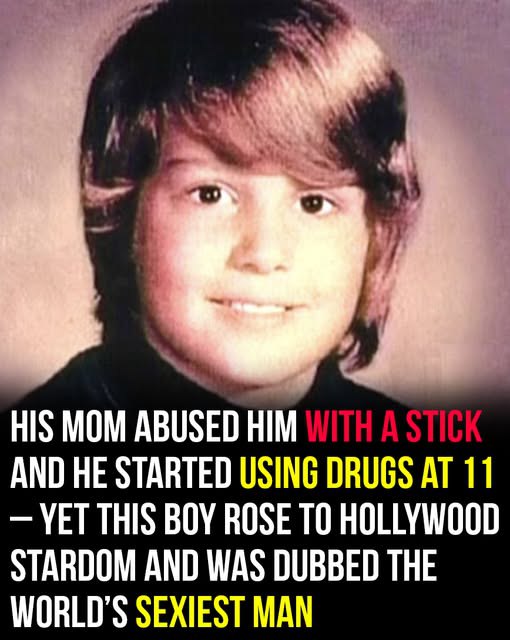
The dark side of stardom! A superstars childhood of pain
There are movie stars, and then there are figures so embedded in popular culture that their presence alone defines an era. Johnny Depp belongs firmly in the latter category. He has headlined global franchises, reshaped the image of the male leading actor, and been named Sexiest Man Alive twice. Yet behind the spectacle of fame lies a childhood marked not by privilege or safety, but by fear, violence, and instability.

Long before the red carpets and box-office dominance, Depp was a child growing up in an environment he has repeatedly described as unsafe and chaotic. Born in Kentucky as the youngest of four children, he was raised by a waitress mother and a civil engineer father. The family moved frequently during his early years, eventually settling in Miramar, Florida, in 1970. What should have been a period of stability instead became the backdrop for daily trauma.
Inside the home, violence was routine. Depp has spoken candidly about the physical abuse he endured at the hands of his mother, Betty Sue Palmer. Objects became weapons without warning—ashtrays, telephones, high-heeled shoes. There was no predictability, no sense of security. Pain was arbitrary, delivered whenever anger surfaced.
As brutal as the physical violence was, Depp has said the psychological abuse cut deeper. Words lingered longer than bruises. The beatings caused pain that eventually faded; the emotional damage reshaped how he understood fear, authority, and survival. In that household, safety simply did not exist.
His father, by contrast, embodied a quiet endurance that left a lasting impression. Depp recalled watching his mother berate and humiliate his father in front of the children while the man stood silently, absorbing the verbal assaults without retaliation. He never raised his voice. He never struck back. On rare occasions, the anger surfaced only indirectly—once punching a concrete wall so hard that he shattered his own hand. Even then, he never turned that violence toward his wife.
As a child, Depp could not understand why his father stayed. He wondered why a man would endure that kind of treatment without leaving. Years later, he came to see that endurance as a form of strength, and his father as a fundamentally decent man trying to protect his children the only way he knew how.
Eventually, even that endurance reached its limit. When Depp was 15, his father left the family, telling his son he could no longer live that way. At the time, Depp viewed the departure as abandonment. With distance and age, he recognized it as a necessary act of survival.
After the divorce, his mother’s mental health deteriorated further. She fell into a deep depression and attempted suicide by overdosing on pills. Though she survived, she was never the same. She became physically frail, emotionally distant, and largely confined to the couch. The household continued to unravel.
It was during this period that Depp’s relationship with substances began. He has testified that he started taking his mother’s prescription “nerve pills” at just 11 years old. By 12, he was smoking. By 14, he had experimented with nearly every drug available to him. What began as curiosity quickly became self-medication—a way to numb fear, anxiety, and emotional pain that had no other outlet.
Depp has never framed this part of his life as rebellion. He has described it as coping. Drugs and alcohol were not about thrill-seeking; they were about survival. In a home without safety or comfort, intoxication offered a brief sense of control.
His mother died in 2016. Reflecting on their relationship years later, Depp expressed gratitude—but not in a conventional way. He said she taught him how not to raise children. Her example became a blueprint for avoidance, a set of behaviors he vowed never to repeat.
After dropping out of high school in 1979, Depp joined a band called The Kids and moved to Los Angeles. Acting was not a childhood dream or calculated career move. By his own admission, it happened by accident. A friend, Nicolas Cage, encouraged him to pursue acting and introduced him to an agent. Auditions followed. Then came his first major role in A Nightmare on Elm Street.
In the late 1980s and early 1990s, Depp became a teenage heartthrob, though he openly resisted the label. Rather than leaning into conventional leading-man roles, he gravitated toward eccentric, emotionally complex characters. This resistance became central to his career, allowing him to redefine masculinity on screen.
His global superstardom arrived with Pirates of the Caribbean, where his portrayal of Captain Jack Sparrow transformed a theme-park adaptation into a cultural phenomenon. The role earned him multiple Academy Award nominations and cemented his status as one of Hollywood’s most recognizable figures.
While his professional life soared, his personal life followed a more complicated path. His first marriage to Lori Anne Depp ended in the mid-1980s. Later relationships included high-profile romances with Winona Ryder and Jennifer Grey. He eventually built a family with Vanessa Paradis, with whom he shared two children. Their relationship lasted 14 years.
As a father, Depp was deliberate in rejecting the parenting style he grew up with. He avoided yelling, avoided threats, and avoided authoritarian control. He believed in conversation, explanation, and trust. Discipline, in his view, did not require fear.
That philosophy, he has said, was shaped entirely by his childhood. He wanted his children to feel safe, heard, and respected—things he never experienced himself.
After his relationship with Paradis ended, Depp married Amber Heard. Their relationship collapsed publicly and violently into one of the most scrutinized legal battles of the decade. Depp sued Heard for defamation following a 2018 op-ed in which she implied she was a victim of domestic abuse. He denied the allegations. In 2022, a jury ruled largely in his favor, awarding him more than $10 million.
During the trial, details of Depp’s childhood, substance abuse, and emotional scars were laid bare. He testified that his early drug use stemmed from growing up in a home that was “not particularly stable or safe.” Substances, he said, were the only way he knew how to numb the pain.
Looking back in 2025, Depp explained why he chose to pursue the case publicly despite the personal cost. He said he could not allow false narratives to follow him—and his children—forever. Speaking the truth, he believed, was the only option.
Today, Depp reportedly lives a quieter life in the English countryside, far removed from Hollywood’s constant glare. He has returned to work selectively, choosing projects that interest him rather than chasing relevance. Upcoming roles include a collaboration with Penélope Cruz and a new interpretation of Ebenezer Scrooge.
His life, viewed in full, is a study in contradiction: immense success born from profound damage, creativity shaped by chaos, and resilience forged through suffering. The glamour of stardom never erased the pain of his early years—but it did give him the tools to transform it into something lasting.
Johnny Depp’s story is not one of escape, but of survival. And for all the spectacle surrounding his name, that truth remains at the core of who he is.