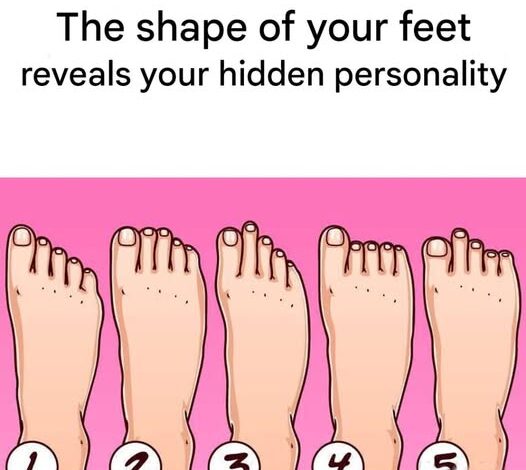
There are 5 types of feet! each indicating a particular personality type
In the nuanced study of morphopsychology, the human body is viewed as an intricate map of the subconscious. The foundational principle suggests that the physical contours of our faces, hands, and even our feet are not merely the products of genetics and environment, but rather outward reflections of deeply buried character traits and psychological predispositions. While mainstream science often categorizes these observations as lighthearted curiosities, the ancient art of “pedomancy”—the reading of foot shapes—suggests that the alignment of our toes can offer a surprising window into how we navigate the world, handle conflict, and process emotion. By examining the five most common foot structures, we can gain a unique perspective on the hidden architecture of the self.

The most common shape observed globally is the Egyptian foot. This structure is defined by a clean, sloping symmetry where the hallux, or big toe, is the longest digit, followed by a gradual and even descent in length toward the pinky toe. In the realm of personality analysis, the Egyptian foot is synonymous with a “sovereign” temperament. Individuals with this foot type are often seen as the anchors of their social circles—balanced, approachable, and remarkably sociable. They possess an insatiable appetite for culture and discovery, often defining their lives by the stamps in their passports and the new experiences they gather from distant lands.
However, the defining characteristic of the Egyptian foot personality is profound empathy. These individuals are the quintessential listeners of the world; they possess an intuitive ability to sense the emotional undercurrents of others without judgment. They are the peacemakers who avoid the friction of unnecessary conflict, seeking harmony in both their personal and professional spheres. Yet, this deep well of compassion can be a double-edged sword. In a competitive, often harsh world, their empathy is frequently mistaken for weakness. Many with this foot shape find themselves burdened by the weight of other people’s suffering, leading to a quiet internal struggle where they occasionally regret their own sensitivity, viewing it as a source of personal exhaustion rather than a gift.
In sharp contrast to the balanced Egyptian foot is the Greek foot, often referred to as the “Flame Foot” or “Morton’s Toe.” This shape is distinguished by a second toe that is noticeably longer than the big toe. This physical protrusion is often a marker of high energy, creativity, and a relentless drive for innovation. Those with the Greek foot are the visionaries and the instigators; they are the people who birth new ideas and push the boundaries of the status quo. They possess a natural charisma and a contagious motivation that can inspire others to action.
Yet, the “flame” that fuels their creativity can also lead to impulsivity. The Greek foot personality is prone to making snap decisions that, while bold, are not always thoroughly vetted. This tendency often leads to a cycle of permanent stress, as they frequently find themselves navigating the consequences of thoughtless choices. Furthermore, this foot type is associated with a highly changeable mood. Observers might find their behavior erratic or occasionally unpleasant, but these shifts are rarely born of malice. Instead, they are often the echoes of a fundamentally difficult past. For many with the Greek foot, their life story is one marked by early disappointments and betrayals. Their current impulsivity and mood swings are often defensive mechanisms—scars from a past where they had to fight for their place in the world, leaving them with a restless spirit that finds it difficult to trust the stability of the present.
The third type is the Roman foot, also known as the “Square Foot.” In this configuration, the first three toes are nearly identical in length, creating a straight, blocky appearance. This physical solidity is mirrored in the personality: these individuals are the “thinkers” and “logicians” of the human family. They are known for their analytical prowess and their unwavering reliability. A person with a Roman foot is unlikely to be swayed by emotional appeals; they require data, structure, and a clear rationale before committing to a course of action. While they may not be as “adventurous” as their Egyptian-footed counterparts, they are the ones you want at the helm during a crisis. Their loyalty is absolute, and their worldview is built on the pillars of tradition and pragmatism.
The fourth category involves the “Peasant Foot,” a variant where all five toes are of virtually equal length. This is perhaps the rarest of the shapes and indicates a personality rooted in profound humility and a tireless work ethic. These are the individuals who prefer the shadows to the spotlight. They are the “doers” who find fulfillment in the tangible results of their labor. There is a specific kind of quiet resilience associated with the Peasant foot—a refusal to quit and a stoic acceptance of life’s hardships. They are often the unsung heroes of their communities, providing the foundational support that allows others to thrive, all while asking for nothing in return.
Finally, we find the “Stretched Foot,” characterized by toes that appear spread apart or elongated, with a significant gap between the big toe and the rest of the digits. This physical separation indicates a fiercely independent spirit—someone who requires vast amounts of personal space and intellectual freedom. These individuals are often the “misfits” or the “outsiders” by choice. They have a difficult time conforming to societal expectations and are highly resistant to being told what to do. Their path is uniquely their own, and they possess a rare courage to walk it alone if necessary.
While the study of foot shapes—much like palmistry or phrenology—falls into the category of alternative insight, there is an undeniable charm in the idea that our bodies carry the record of our temperaments. Whether your toes slope like an Egyptian staircase or flare with the impulsive energy of a Greek flame, these physical traits serve as a reminder that we are each a unique blend of heritage and history. By paying attention to these small, often ignored parts of our anatomy, we can foster a greater sense of self-awareness. At the very least, looking down at our feet allows us a moment of reflection—a pause to consider how our past experiences have shaped our present strides and how our inherent traits might guide our future path.