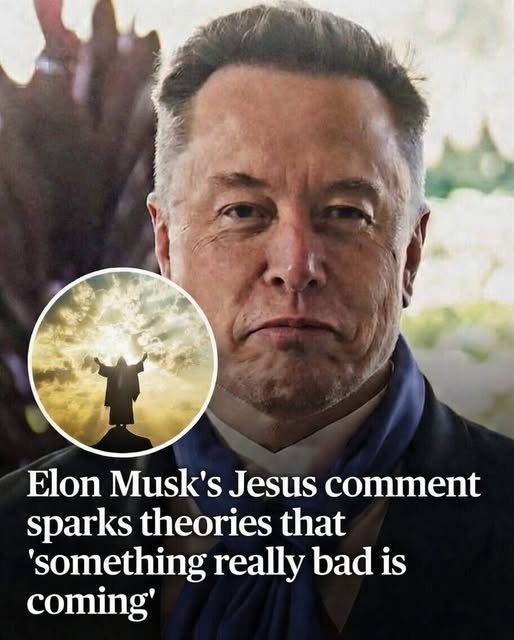
Elon Musk’s Remarks on Jesus Spark Broader Conversation About Faith and Public Identity
Introduction
Public figures often find their words amplified far beyond their original context. A brief remark, a social media post, or a short interview response can quickly become the subject of widespread analysis. Recently, comments made by Elon Musk regarding Jesus and the ethical teachings associated with Christianity have prompted renewed public discussion.

Rather than providing a clear declaration of belief or disbelief, Musk’s reflections appeared nuanced. He spoke in a way that acknowledged respect for certain moral principles traditionally associated with Jesus—such as forgiveness, compassion, and restraint—without formally aligning himself with organized religion.
In a cultural climate that often seeks definitive labels—believer or skeptic, religious or secular—this middle ground can feel unfamiliar. Yet Musk’s position reflects a broader societal shift: many individuals today engage with faith traditions in complex, individualized ways.
This article explores the context of Musk’s remarks, the cultural response, and the deeper questions his comments raise about belief, ethics, and identity in the modern world.
The Cultural Expectation of Certainty
In today’s digital landscape, public discourse frequently favors clarity and categorization. Social media platforms encourage concise declarations. Audiences often expect public figures to state their positions plainly and consistently.
When someone with global influence like Elon Musk discusses religion—even briefly—interpretations can multiply quickly. Some observers look for confirmation of conversion or endorsement. Others anticipate skepticism or rejection.
However, personal belief systems rarely fit neatly into predefined boxes. Faith, doubt, admiration, and inquiry can coexist within the same individual. Musk’s comments appeared to reflect that complexity rather than offering a binary answer.
This reaction underscores a broader cultural tendency: many societies prefer certainty, even when human belief systems are inherently nuanced.
Musk’s Intellectual Journey
Elon Musk has previously described questioning religious concepts during his youth. Like many intellectually curious adolescents, he reportedly sought rational explanations for existential questions—why suffering exists, how the universe began, and what gives life meaning.
For some individuals, such questioning leads to firm religious commitment. For others, it results in skepticism or secular humanism. For still others, it creates a lifelong process of exploration that resists fixed labels.
Musk’s recent comments suggest that, while he may not identify with formal worship practices, he recognizes value in certain ethical teachings associated with Jesus. This perspective focuses less on institutional affiliation and more on moral principles.
Such an approach is increasingly common among people who describe themselves as “spiritual but not religious,” valuing ethical frameworks without necessarily embracing formal doctrine.
Respect for Ethical Teachings
In his remarks, Musk highlighted qualities traditionally associated with Jesus—mercy, forgiveness, compassion, and restraint. These values are not only central to Christian theology but are also echoed across many philosophical and ethical systems worldwide.
The idea that strength can coexist with compassion resonates beyond religious contexts. Leadership rooted in empathy has become a topic of interest in business, politics, and community development.
By expressing admiration for these ethical ideals, Musk contributed to a larger conversation about how moral frameworks influence behavior. The focus shifts from theological allegiance to lived conduct.
This distinction—between identifying with an institution and adopting ethical principles—lies at the heart of much contemporary spiritual discourse.
Public Reaction and Speculation
Because Musk is one of the most widely followed entrepreneurs globally, even subtle statements attract significant attention. His comments quickly generated varied interpretations.
Some commentators speculated that his remarks signaled a shift toward personal faith. Others argued that he was simply acknowledging the cultural impact of religious teachings. Still others viewed the conversation as a broader philosophical reflection rather than a theological statement.
Such speculation reflects society’s fascination with the private beliefs of public figures. When influential individuals discuss religion, observers often interpret those comments as signals about future decisions or ideological alignments.
Yet it is possible that the remark was simply an acknowledgment of ethical admiration without broader implications.
Faith as Identity vs. Faith as Practice
One of the most compelling questions raised by Musk’s comments is whether faith is primarily an identity label or a lived practice.
For many people, religious identity is deeply rooted in community, tradition, and formal belief structures. For others, faith is less about affiliation and more about personal conduct—choosing compassion, pursuing justice, and extending forgiveness.
This distinction is increasingly visible in global surveys on religion. While formal religious participation may decline in certain regions, interest in spirituality and ethical reflection remains strong.
Musk’s position appears to align with this pattern: appreciation for moral philosophy without explicit institutional commitment.
The Role of Public Figures in Religious Discourse
When entrepreneurs, artists, or political leaders speak about faith, their words often carry weight beyond personal reflection. Public figures can shape conversations, intentionally or not.
However, it is important to recognize that personal belief is complex. Public statements may reflect evolving thoughts rather than fixed conclusions.
In democratic societies, freedom of belief includes the freedom to explore, question, and reinterpret. Musk’s remarks highlight how religious discourse continues to evolve in a pluralistic environment.
Rather than signaling a definitive shift, his comments may simply illustrate openness to ethical dialogue.
The Intersection of Technology and Spiritual Inquiry
As a technology entrepreneur known for ambitious projects, Musk often engages with questions about humanity’s future—space exploration, artificial intelligence, and sustainability.
These endeavors frequently raise philosophical questions about purpose, responsibility, and ethical decision-making. Conversations about morality naturally intersect with technological advancement.
In this context, reflecting on ethical teachings—religious or otherwise—can be seen as part of a broader inquiry into how power should be exercised responsibly.
The principle of choosing compassion over dominance, for example, has implications for leadership and innovation alike.
The Appeal of Ethical Universality
One reason Musk’s remarks resonated widely is that the virtues he referenced—mercy, forgiveness, compassion—are broadly admired across cultures.
These principles appear in multiple faith traditions and philosophical schools of thought. Humanistic ethics, for example, emphasize empathy and cooperation without necessarily grounding them in religious doctrine.
By focusing on conduct rather than dogma, the conversation shifts toward universal values that many people share regardless of formal affiliation.
This universality may explain why his comment sparked discussion beyond strictly religious audiences.
Navigating Belief in a Polarized Era
Modern discourse often gravitates toward polarization. Complex perspectives can be reduced to simplified narratives. In religious conversations, this can manifest as pressure to declare firm allegiance or opposition.
However, belief systems evolve. Many individuals move through phases of skepticism, curiosity, and renewed interest throughout their lives.
Musk’s apparent comfort with occupying an “in-between” space reflects a broader societal trend toward individualized belief systems. Rather than aligning strictly with institutional categories, many people construct personal frameworks that blend philosophy, science, and spirituality.
This trend challenges traditional expectations but reflects the diversity of contemporary thought.
The Ethics of Leadership
Another dimension of this conversation involves leadership ethics. Business leaders, particularly those overseeing influential companies, are often scrutinized for how their personal values shape corporate culture.
Ethical leadership emphasizes fairness, responsibility, and long-term vision. Principles such as forgiveness and compassion can influence workplace dynamics and decision-making processes.
While Musk’s specific corporate strategies are separate from his personal reflections, the broader discussion highlights how moral philosophy intersects with leadership.
Public curiosity about his beliefs may stem partly from a desire to understand the values guiding influential decision-makers.
A Broader Reflection on Personal Conviction
Beyond the individual, this moment invites reflection on how society interprets belief. Is faith measured by affiliation, ritual practice, or consistent ethical conduct?
Many spiritual traditions teach that actions speak louder than declarations. Living out values of kindness and integrity may hold more significance than publicly identifying with a particular label.
Musk’s remarks seem to emphasize conduct over classification. Whether or not he adopts formal religious identity, the focus on ethical behavior underscores a timeless principle: values are demonstrated through choices.
Media Amplification and Interpretation
In the age of instant communication, brief statements can become headline narratives. Context sometimes becomes secondary to speculation.
This phenomenon is not unique to Musk. Public figures across industries experience similar amplification when discussing personal topics.
Understanding this dynamic encourages a measured approach to interpretation. Rather than drawing sweeping conclusions, observers may benefit from recognizing that public remarks often represent snapshots of ongoing thought processes.
The Continuing Conversation
Ultimately, Musk’s comments serve as a catalyst for broader dialogue rather than a definitive statement about his personal faith journey.
They invite questions about how individuals reconcile science and spirituality, how ethical teachings transcend institutional boundaries, and how belief influences behavior.
For many people, exploring these questions is an ongoing process rather than a single decision point.
Conclusion
Elon Musk’s recent reflections on Jesus and associated ethical principles have sparked widespread conversation—not because they provided certainty, but because they resisted it.
In a culture that often demands clear labels, his nuanced perspective highlights a growing trend: engaging with moral teachings without necessarily embracing formal institutional identity.
Whether one interprets his remarks as philosophical admiration, personal exploration, or simple acknowledgment of ethical influence, the broader takeaway remains consistent. The most meaningful expression of belief—religious or secular—is often found not in declarations, but in conduct.
In the end, public curiosity may fade. What endures is the larger question his comment surfaces for everyone: are our values defined by labels, or by the choices we make each day?