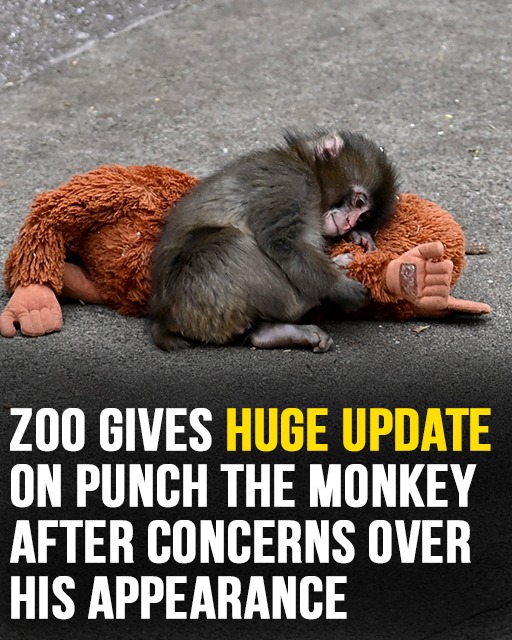
Zoo Shares New Update on Baby Monkey “Punch” After Online Concerns
In recent weeks, a young macaque named Punch has become the focus of widespread public attention. Images of the baby monkey, small and vulnerable, sparked an outpouring of emotion across social media platforms. Viewers expressed concern, compassion, and a desire for transparency regarding his well-being. In response, the zoo caring for Punch has shared a detailed update on his condition, progress, and the thoughtful approach guiding his rehabilitation.

Punch’s story is one of early hardship, steady recovery, and the careful balance required when humans step in to support wildlife. His journey also highlights broader questions about animal welfare, conservation practices, and the responsibilities zoos carry in the modern era.
A Difficult Start to Life
Punch’s earliest days were marked by separation from his mother. For primates such as macaques, maternal care is central to healthy development. A mother provides not only nutrition but also warmth, social learning, and emotional security. Without that foundation, young primates can face significant challenges.
Recognizing Punch’s vulnerability, the zoo’s veterinary and animal care teams intervened quickly. He was placed in a temperature-controlled environment to ensure stability and was fed with specially formulated nutrition appropriate for infant primates. Caregivers worked in shifts to provide consistent attention and monitoring, carefully tracking his weight, hydration levels, and behavioral responses.
To provide comfort, staff introduced a soft plush toy resembling a larger primate. While it cannot replace maternal contact, such items are sometimes used in wildlife rehabilitation settings to provide a source of tactile reassurance during critical early stages.
Public Reaction and Online Discussion
When photos of Punch surfaced online, they were met with strong emotional reactions. Some viewers felt protective and empathetic, while others questioned whether his care was adequate or whether the situation reflected deeper welfare concerns.
In today’s digital age, images can travel quickly, sometimes detached from context. The zoo acknowledged that while public engagement is valuable, snapshots alone cannot convey the full scope of an animal’s care plan or long-term strategy.
In its official update, the zoo emphasized transparency. It explained the medical and developmental considerations involved in caring for orphaned primates and outlined the steps being taken to prioritize Punch’s health and social integration.
The Challenges of Raising an Orphaned Macaque
Macaques are highly social animals. In the wild, they live in complex troop structures with defined social hierarchies. Young macaques learn by observing and interacting with older group members. Play, grooming, and shared space are all essential components of development.
When a young macaque loses maternal care, caregivers must carefully balance two goals:
-
Providing immediate physical support
-
Encouraging long-term social independence
Too much human interaction can risk imprinting, where the animal becomes overly dependent on human presence. Too little support can lead to developmental setbacks. The process requires patience, specialized expertise, and continuous evaluation.
The zoo reported that Punch’s caregivers are gradually reducing direct contact as he grows stronger. This approach encourages self-reliance and natural behaviors while still ensuring safety.
Social Introductions: A Critical Milestone
One of the most closely watched aspects of Punch’s recovery has been his introduction to other macaques. Social integration is rarely immediate or seamless. Even in natural troop dynamics, young animals must learn boundaries, signals, and appropriate responses.
Observers noted moments where Punch appeared startled or hesitant when interacting with other macaques. However, animal behavior specialists explain that such reactions are not unusual. Young primates often test social limits and retreat before building confidence.
According to the zoo’s update, Punch has begun to show encouraging signs:
-
Initiating short periods of play
-
Remaining near other macaques for longer durations
-
Exploring shared spaces independently
-
Displaying improved feeding behaviors
These developments suggest that he is gradually adapting to group life, an essential step toward long-term well-being.
Nutrition and Physical Development
Beyond social growth, Punch’s physical health has been steadily improving. In his early days, feeding required careful monitoring to ensure adequate nutrient intake. Over time, he has transitioned from bottle feeding to more independent eating patterns.
The zoo reported consistent weight gain and improvements in coat condition. For primates, fur quality can reflect overall health status. Caregivers have observed that Punch’s coat is becoming thicker and more uniform as his nutritional stability improves.