The Quiet Tower by the Road: A Simple Structure with a Powerful Purpose
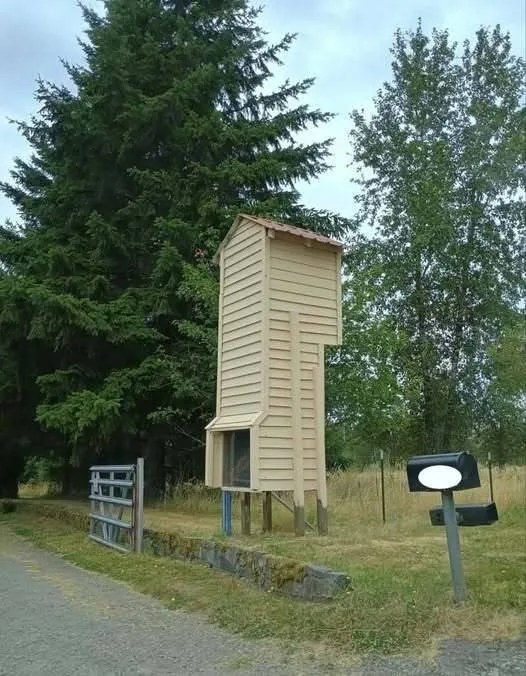
Drivers unfamiliar with the road often slow down the moment they notice it. Rising about fifteen feet into the air, a slender beige tower stands at the edge of a modest driveway. Its wooden frame, faded slightly by years of sunlight and changing seasons, gives it a weathered but steady appearance. There are no flashing lights, no cables running down its sides, no company branding stamped across its surface. At first glance, it may look unusual — perhaps even decorative. But the longer you observe it, the clearer its purpose becomes.

This unassuming structure wasn’t built for attention. It was built for safety.
From a distance, it might resemble a piece of roadside art or a leftover construction project. Yet as vehicles approach the curve nearby, something subtle happens: drivers instinctively ease off the accelerator. They become more alert. Their curiosity turns into understanding. The tower isn’t decorative at all. It’s functional. Thoughtful. Intentional.
Locals sometimes refer to it as a “driveway periscope.” And that name fits. Rather than relying on advanced electronics or complex digital systems, this tower uses a remarkably straightforward principle: reflection. Carefully positioned mirrors inside the structure redirect light from around a blind corner, allowing drivers to see oncoming traffic before pulling onto the road.
It doesn’t require internet access. It doesn’t store data. It doesn’t rely on batteries or sensors. It simply uses angles, light, and positioning to expand visibility where it matters most.
In an age where technology often feels layered, automated, and remote, there is something refreshing about a solution you can understand at a glance. The tower does one job — and it does it well. It improves sightlines in a place where visibility is limited.
Anyone who has navigated a blind driveway or tight curve understands the hesitation it creates. There’s that small moment of uncertainty before entering the road. You inch forward, trying to see past trees, fences, or hills. You listen for approaching vehicles. You hope for clear timing.
This structure reduces that uncertainty.
By extending the line of sight through reflection, it provides an additional layer of awareness. Drivers no longer rely solely on guesswork. Instead, they gain a visual preview of the roadway before committing to a turn.
The brilliance of the design lies in its restraint. Two angled mirrors, enclosed within a simple wooden housing, accomplish what many modern systems attempt through far more complicated means. There are no alerts to interpret. No settings to adjust. No maintenance subscriptions to renew.
Just physics.
Light travels. Mirrors reflect. Drivers see.
Over the years, the tower has endured wind, rain, frost, and summer heat. The wood shows signs of age. The paint may chip at the edges. Occasionally, the mirrors need cleaning to remove condensation or dust. Yet the structure continues to serve its purpose reliably.
Its durability reflects another quiet truth: thoughtful engineering doesn’t always require large budgets or elaborate infrastructure. Sometimes it begins with observation. Someone noticed a challenge — limited visibility at a curve — and asked a simple question: “How can this be improved?”
Instead of waiting for a large-scale road redesign or complex installation, they explored what could be done with accessible materials and practical thinking. The result is both humble and effective.
The tower also has a subtle psychological impact. Even before drivers fully understand its function, its presence signals caution. It stands tall and slightly unexpected, drawing attention to the curve itself. That pause — that brief shift in focus — encourages slower speeds and greater attentiveness.
In this way, the structure contributes to safety in two ways: by expanding visibility and by gently influencing behavior.
There’s something admirable about a solution that benefits not just its builder, but everyone who passes by. Every driver approaching that curve gains the same advantage. The reflection doesn’t discriminate. It offers information equally to residents, visitors, delivery trucks, and cyclists alike.
That universality adds to its quiet charm.
The human story behind the tower is perhaps the most compelling aspect. Imagine living at the end of that driveway. Imagine pulling out day after day, aware of the limited sightline. Instead of accepting the risk, someone decided to act. With basic tools and thoughtful planning, they created a structure that transformed a moment of uncertainty into one of clarity.
No corporate backing. No marketing campaign. No public announcement.
Just initiative.
The tower reminds us that innovation doesn’t always arrive through grand gestures. Often, it begins with careful attention to a local problem and a willingness to experiment with practical solutions.
In today’s world, many systems are designed to be complex. They rely on updates, connectivity, and specialized maintenance. While such advancements certainly have their place, the driveway periscope offers a different lesson. Sometimes the most sustainable solutions are those that can be understood, maintained, and repaired without specialized equipment.