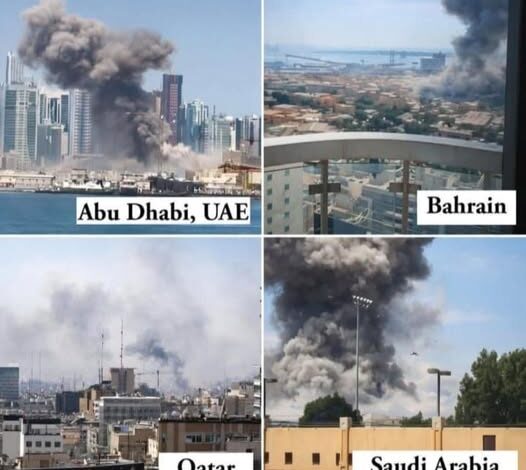
BREAKING NEWS – 4 countries join forces to atta!
The geopolitical stability of the Persian Gulf has been shattered by a series of coordinated Iranian ballistic missile strikes, marking an unprecedented escalation that threatens to ignite a general regional war. In the early hours of March 1, 2026, Iranian state media confirmed that the military had officially sanctioned a multi-pronged offensive against United States military installations scattered across several Gulf nations. This direct state-on-state aggression has transformed the region’s long-standing “gray zone” conflicts into a visible, high-intensity battlefield, forcing local governments to shutter airspaces and order millions of citizens into immediate lockdown.

The scale of the offensive suggests a high level of strategic planning, with synchronized strikes reported across the United Arab Emirates, Bahrain, Qatar, and Kuwait. One of the most severe impacts was recorded in Abu Dhabi, where Reuters and local eyewitnesses reported massive explosions illuminating the night sky. The primary target in the UAE appears to have been the Al Dhafra Air Base, a critical hub for U.S. and allied aerial operations. Following the impact of several ballistic missiles, the Emirati government took the drastic step of closing its national airspace, effectively grounding one of the world’s busiest aviation crossroads and signaling the severity of the security breach.
Simultaneously, the Kingdom of Bahrain found itself in the crosshairs. In the Al Jufair district of Manama—the home of the U.S. Navy’s Fifth Fleet—acrid black smoke began to billow from facilities linked to the American naval command. The Fifth Fleet is the linchpin of maritime security for the Strait of Hormuz, and a direct hit on its headquarters represents a symbolic and tactical strike at the heart of Western naval power in the Middle East. While initial reports from Manama focused on structural damage and smoke plumes, the psychological toll on the capital was immediate, as the government urged residents to stay clear of military zones and prepare for further hostilities.
In Qatar, the Al Udeid Air Base—which hosts the forward headquarters of U.S. Central Command (CENTCOM)—became a theater of high-stakes missile defense. Qatar’s Interior Ministry issued an urgent “shelter-in-place” order for all residents as Patriot missile batteries engaged incoming Iranian projectiles over the desert. At least one missile was reportedly intercepted in mid-air, a success confirmed by the Qatari Defense Ministry, which stated that its forces had successfully repelled several prongs of the attack. Despite this defensive victory, the nation remains on high alert, with all civilian flights suspended and the sovereign airspace locked down until further notice.
The reach of the Iranian barrage extended as far as Kuwait, where Al Jazeera reported powerful tremors from explosions that could be felt in the capital’s suburbs. Kuwaiti authorities, prioritizing civilian safety above all else, issued a nationwide directive for citizens to remain in their homes. Public offices and private businesses were told to suspend operations, effectively freezing the country’s economy as the military moved to its highest state of readiness. The directive was clear: stay home, stay away from windows, and avoid all areas of military significance.
This regional conflagration follows months of deteriorating relations and a major joint U.S.–Israeli operation aimed at degrading Iranian military infrastructure. However, the sheer breadth of Iran’s response suggests that the deterrent effect of previous Western actions has evaporated. By striking four different nations simultaneously, Tehran is sending a definitive message to the “host countries” of American bases: there is no safety in neutrality, and the presence of U.S. forces now carries a direct risk to national sovereignty and civilian life.
The international community has reacted with profound alarm. A coalition of thirteen nations is reportedly in the early stages of forming a unified military response, but the speed of the escalation has outpaced traditional diplomatic channels. Oil markets have already begun to reflect the chaos, with crude prices spiking as traders fear a total closure of the Persian Gulf’s shipping lanes. If the Strait of Hormuz becomes an active combat zone, the global energy supply could face a disruption not seen since the 1970s.
For the personnel stationed at these bases, the situation is one of harrowing uncertainty. At Al Dhafra and Al Udeid, thousands of American service members are currently operating under “Condition Black,” the highest state of alert, as they work to assess damage to runways and hangars while remaining prepared for a second wave of strikes. The technical sophistication of the Iranian missiles—many of which are believed to feature maneuverable reentry vehicles designed to bypass missile defense systems—has changed the calculus for base commanders who once felt secure behind layers of air defense.
On the civilian front, the streets of Manama, Abu Dhabi, and Kuwait City, usually vibrant and bustling, have been rendered ghost towns. The call to “avoid military areas” is a difficult one in these nations, where urban sprawl has often grown to surround historical base perimeters. The smoke rising over Al Jufair and the explosions at Al Dhafra are not distant events for these populations; they are occurring within earshot of shopping malls and residential towers. This proximity has heightened the fear that a miscalculation or a stray missile could result in catastrophic civilian casualties.
As of this afternoon, the situation is still evolving. Iranian television continues to broadcast nationalist rhetoric, framing the strikes as a “heroic defense of the oppressed” and a necessary response to “Western bullying.” Meanwhile, the U.S. Department of Defense has yet to release a full casualty report, though it has confirmed that it is working closely with regional partners to stabilize the situation. The closure of multiple national airspaces has left tens of thousands of international travelers stranded, creating a logistical nightmare that mirrors the strategic one.
The coming 24 hours will be the most critical in modern Middle Eastern history. If the United States and its new thirteen-nation coalition launch a massive retaliatory strike on the Iranian mainland, the cycle of violence could spiral into a conflict that draws in global powers. If they show restraint, they risk emboldening Tehran and signaling the end of American hegemony in the Gulf. For now, the world watches the “black smoke” over Bahrain and the closed skies of the UAE, waiting to see if the dawn brings a path to de-escalation or the start of a new, devastating war.