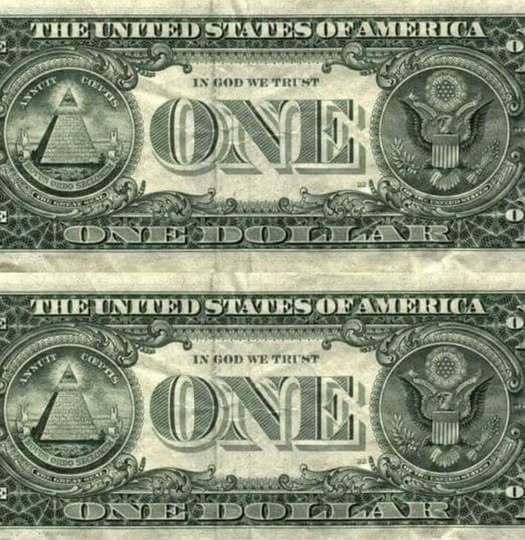
The $1 Bill to Keep an Eye Out For: How an Ordinary Dollar Could Be Worth Hundreds
If you were to reach into your wallet right now, chances are you would find at least one $1 bill tucked between credit cards, receipts, or larger denominations. For most people, the $1 bill is the most ordinary piece of currency in circulation. It passes from hand to hand without a second thought—used for tipping, vending machines, parking meters, or small everyday purchases.

In today’s economy, one dollar doesn’t stretch very far. It can’t buy a specialty coffee, a fast-food combo, or even a gallon of gas. Because of this, many people treat $1 bills as nearly insignificant. They crumple them into pockets, stash them in glove compartments, or toss them into tip jars without hesitation.
But here’s the surprising truth: some $1 bills are worth far more than their face value.
The secret doesn’t lie in hidden ink, secret codes, or rare printing errors—although those can also increase value. Instead, it often comes down to something printed plainly on every bill: the serial number.
Let’s take a closer look at how something so small and overlooked can transform an ordinary dollar into a collector’s treasure.
Understanding the Serial Number on U.S. Currency
Every Federal Reserve note printed in the United States carries a unique serial number. This number serves as an identifier, ensuring that each bill can be tracked and authenticated.
The $1 bill is issued by the Federal Reserve System and printed by the Bureau of Engraving and Printing. Each bill includes:
-
A combination of letters and numbers
-
A Federal Reserve district indicator
-
A unique eight-digit serial number
Most serial numbers are random. But occasionally, patterns appear—and that’s where collectors get interested.
In the world of currency collecting (known as numismatics), certain serial number patterns are considered rare and highly desirable. These bills are often referred to as “fancy serial numbers.”
Why Do Serial Number Patterns Matter?
At first glance, numbers might seem meaningless. After all, they’re just digits in sequence. But in collecting communities, rarity and uniqueness drive value.
Think of it like rare sports cards or limited-edition prints. The fewer that exist, the more collectors are willing to pay.
The same principle applies to $1 bills. When a serial number displays a special pattern—especially one that is statistically rare—it becomes more than just money. It becomes a collectible item.
And sometimes, that collectible can be worth hundreds—or even thousands—of dollars.
1. “Seven Repeating Digits” – The Near Solid
One of the most sought-after patterns is the “seven-of-a-kind” serial number.
This occurs when seven out of the eight digits are the same, such as:
-
09999999
-
18888888
-
19999999
These are incredibly rare because the odds of seven digits aligning like that in random printing are extremely low.
Collectors love these numbers for their visual impact. They’re bold, easy to recognize, and statistically uncommon.
While not quite as rare as a “solid” serial number (like 11111111), seven-of-a-kind bills can sell for significant premiums—especially if they are in uncirculated condition.
2. Solid Serial Numbers – The Holy Grail
Although extremely rare, solid serial numbers—where all eight digits are identical—are among the most valuable of all.
Examples include:
-
11111111
-
88888888
-
00000000
Because there are so few possible combinations like this, collectors consider them prized finds.
If a crisp $1 bill with a solid serial number enters the market, bidding can become competitive quickly.
3. Super Radars – Perfect Palindromes
Another fascinating category is known as “super radars.”
These are serial numbers that read the same forwards and backwards—true numeric palindromes. Examples include:
-
01111110
-
10000001
-
80000008
The symmetry makes them visually appealing. Humans naturally gravitate toward balanced patterns, and collectors are no exception.
The rarity increases when the palindrome includes repeating digits or additional patterns within the sequence.
Condition plays a major role here. A super radar bill with no folds, tears, or stains can command much higher prices than one that has been heavily circulated.
4. Super Repeaters – Rhythmic Patterns
Super repeaters are serial numbers that alternate in a repeating pattern, such as:
-
67676767
-
45454545
-
12121212
These create a rhythmic visual effect that makes them stand out instantly.
Unlike random serial numbers, super repeaters are easy to spot once you know what to look for. They often attract collectors who appreciate both mathematical symmetry and aesthetic appeal.
Though less rare than solids, they can still sell for impressive sums—particularly when found on crisp, uncirculated $1 bills.
5. Double Quads – Four and Four
“Double quads” refer to serial numbers where four identical digits are followed by another four identical digits.
Examples include:
-
11110000
-
44440000
-
88880000
The appeal lies in the clear block division and visual strength of the number grouping.
Collectors often describe these bills as satisfying to look at—balanced and bold.
Because of their rarity, well-preserved double quad $1 bills can command strong resale value.
6. Low Serial Numbers – Early Print Appeal
Another highly collectible feature is a low serial number.
Bills with serial numbers like:
-
00000025
-
00000100
-
00000234
are often considered valuable because they were printed early in a production run.
The lower the number, the better—especially if it is under 100.
Low serial numbers combined with pristine condition can significantly increase value in auctions and private sales.
7. Ladder Serial Numbers – Perfect Sequences
“Ladders” are serial numbers that run in perfect ascending or descending order, such as:
-
12345678
-
87654321
These are extremely rare and highly desirable.
Even partial ladders—like 23456789—can attract attention from collectors.
Because there are so few possible perfect sequences, these bills are often considered elite finds in the currency world.
The Role of Condition
While serial numbers matter, condition can make or break a bill’s value.
Collectors grade bills based on:
-
Crispness
-
Sharp corners
-
Absence of folds
-
Lack of stains or ink marks
-
Overall paper integrity
A bill in “uncirculated” condition—meaning it has never been folded or significantly handled—will command far more than the same serial number in worn condition.
For example, a seven-of-a-kind serial number in perfect condition might sell for several hundred dollars. The same bill, heavily wrinkled and creased, might only fetch a modest premium.
How to Check Your $1 Bills
If you’re curious whether you might be carrying hidden value in your wallet, here’s what to do:
-
Pull out your $1 bills.
-
Look at the eight-digit serial number on the front.
-
Scan for repeating digits, symmetry, or unusual patterns.
-
Set aside any bills that look visually distinct or patterned.
If you believe you’ve found something special, consider:
-
Comparing recent sales on collector marketplaces
-
Consulting a reputable currency dealer
-
Having the bill professionally graded
Be cautious when selling. The market fluctuates based on demand, condition, and collector interest.
Where These Bills Are Bought and Sold
Fancy serial number bills are often sold through:
-
Online auction platforms
-
Currency dealer websites
-
Numismatic conventions
-
Private collector groups
The value can vary widely depending on:
-
Rarity of the pattern
-
Bill condition
-
Series year
-
Federal Reserve district
While not every patterned bill will bring life-changing money, some have sold for hundreds or thousands of dollars.
Why the Fascination?
The appeal of fancy serial numbers combines mathematics, probability, and aesthetics.
There’s something captivating about finding order within randomness. Serial numbers are meant to be functional identifiers—but when patterns emerge, they feel special.
It’s similar to spotting a rare license plate number or a perfectly symmetrical date on a calendar. Humans naturally appreciate patterns.
And when those patterns are rare, they become valuable.
A Word of Realistic Caution
It’s important to stay realistic. The vast majority of $1 bills in circulation are worth exactly $1.
Not every repeated digit increases value. Minor patterns might only add a small premium.
Additionally:
-
Heavy wear reduces desirability.
-
Market demand can fluctuate.
-
Counterfeit or altered bills have no collectible value.
Always ensure authenticity before assuming worth.
The Hidden Treasure in Your Wallet
The beauty of this phenomenon is that it requires no investment to participate. You don’t need to purchase rare coins or attend auctions.
All you need to do is pay attention.
That $1 bill you were about to use for a vending machine snack could, in rare cases, be worth far more than you think.
So the next time you receive change at a store or empty your wallet onto the table, take a moment to check the serial numbers.
You might discover:
-
A near-solid
-
A palindrome
-
A perfect ladder
-
Or even a rare double quad
What appears to be an ordinary piece of currency could be a small collectible treasure hiding in plain sight.
In a world where we often overlook the everyday, sometimes value is waiting in the smallest details.
And occasionally, it’s printed right there on a $1 bill.