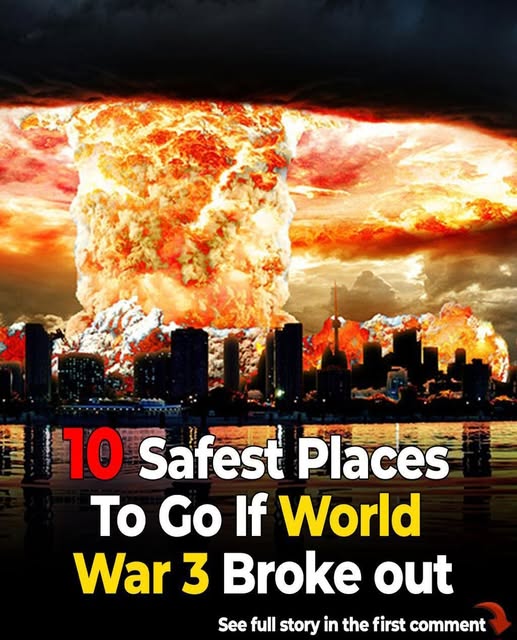
Top 10 Safest Places if World War 3 Broke Out (Hypothetical Scenario)
If a hypothetical World War III were to erupt, the concept of “safety” would take on an entirely new meaning. In a modern global conflict—especially one involving nuclear weapons, cyber warfare, and long-range missile systems—no place on Earth could be considered completely immune from consequences.

However, some regions are often viewed as relatively safer due to geographic isolation, political neutrality, limited military infrastructure, and low strategic importance. Below is a realistic, analytical look at 10 locations frequently mentioned in discussions about potential safe havens during a global war scenario.
Important: This is a speculative discussion based on geography and geopolitics—not a prediction.
1. Antarctica
Antarctica consistently ranks at the top of theoretical safety lists.
Why?
-
No permanent civilian population
-
No native military installations
-
Extreme climate deters strategic occupation
-
Protected under the Antarctic Treaty
The continent’s brutal environment makes it one of the least strategically attractive locations in a conventional war. However, survival there without significant preparation would be nearly impossible.
2. New Zealand
New Zealand is frequently cited as one of the most geographically isolated developed nations in the world.
Advantages:
-
Remote South Pacific location
-
Stable political system
-
Strong agricultural self-sufficiency
-
Small military footprint
Distance from major military power centers reduces the likelihood of it being a primary target.
3. Iceland
Iceland has no standing army and maintains a small population.
Key factors:
-
Geographic isolation in the North Atlantic
-
Limited strategic infrastructure
-
Strong renewable energy resources
While it hosts NATO-related facilities, it remains far removed from densely populated war theaters.
4. Greenland
Greenland’s vast landmass and sparse population make it one of the most remote inhabited places on Earth.
Why it’s considered safer:
-
Low population density
-
Harsh climate
-
Minimal urban concentration
Its isolation reduces direct exposure, though it does hold some strategic value in Arctic geopolitics.
5. Southern Patagonia – Patagonia (Argentina & Chile)
The southern regions of:
-
Argentina
-
Chile
…are often considered viable due to:
-
Sparse population
-
Distance from major military hubs
-
Access to freshwater and farmland
-
Mild geopolitical tensions compared to other regions
Long-term survival would depend heavily on local infrastructure and supply chains.
6. Switzerland
Switzerland stands out for a different reason: preparation.
Why Switzerland is unique:
-
Long-standing neutrality
-
Extensive civil defense infrastructure
-
Hundreds of thousands of nuclear fallout shelters
-
Mountainous terrain
Despite being in Europe, its defensive readiness makes it one of the most resilient nations in a nuclear conflict scenario.
7. Mauritius
Located in the Indian Ocean, Mauritius benefits from:
-
Political stability
-
Geographic remoteness
-
Limited military significance
Small island states with minimal strategic value may be less likely to be direct targets.
8. Fiji
Fiji, along with other small Pacific island nations, is often cited because of:
-
Isolation
-
Small military presence
-
Low geopolitical involvement
However, supply chain dependence would be a major factor in long-term resilience.
9. Tuvalu
Tuvalu is one of the least strategically significant countries in the world.
Advantages:
-
Minimal military infrastructure
-
Remote Pacific location
However, vulnerability to climate change and limited resources present other long-term challenges.
10. Remote Areas of Canada
Northern and rural regions of Canada are sometimes considered safer due to:
-
Low population density
-
Abundant freshwater
-
Vast wilderness
However, Canada is a NATO member, which increases its strategic significance compared to isolated neutral states.
Factors That Would Determine Safety
Even in remote areas, survival would depend on several critical elements:
1. Nuclear Fallout Patterns
Wind direction and atmospheric currents would determine radioactive spread.
2. Food and Water Access
Regions with agricultural independence and freshwater resources would fare better.
3. Political Neutrality
Neutral nations may be less likely to become primary targets.
4. Military Infrastructure Presence
Countries hosting major bases, missile systems, or naval fleets would face higher risk.
5. Cyber and Economic Warfare
Modern war extends beyond bombs:
-
Financial systems
-
Power grids
-
Supply chains
-
Communication networks
Even remote countries would feel economic ripple effects.
The Reality: Nowhere Is Fully Safe
A true global war—particularly one involving nuclear weapons—would produce:
-
Nuclear fallout
-
Economic collapse
-
Disrupted global trade
-
Food shortages
-
Climate effects (possible nuclear winter)
Geographic distance reduces direct impact, but secondary consequences would reach nearly every corner of the planet.
Final Perspective
While it can be intellectually interesting to analyze geography and neutrality in theoretical global conflict scenarios, the ultimate truth remains:
Modern war has global consequences.
In 2026, international tensions may rise and fall, but diplomacy, cooperation, and de-escalation remain the most powerful safeguards against catastrophe.
Instead of searching for the safest place to hide, the global priority continues to be preventing such a conflict from ever occurring.
Because in a world connected by trade, technology, and shared climate systems, true safety is collective—not geographic.