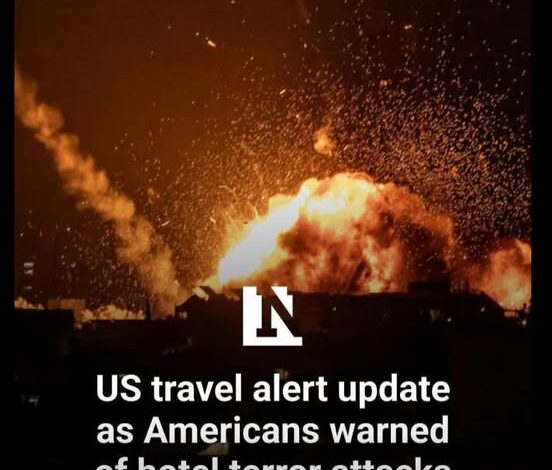
US Travel Alert Update As Americans Warned of Hotel Terror Attacks!
The global security landscape has shifted into a state of acute volatility following the onset of a direct military confrontation between the United States, Israel, and Iran. As of early March 2026, the Department of State has issued a series of urgent travel advisories that transcend the typical bureaucratic warnings, signaling a period of heightened peril for Americans traveling or residing abroad. At the center of this burgeoning crisis is a specific and credible warning regarding the vulnerability of international hotels—long considered sanctuaries for global travelers—which have now been identified as primary targets for retaliatory terror attacks.

This escalation began in late February 2026 with a series of coordinated strikes on Iranian soil, an operation that has since spiraled into a multi-front regional conflict. In response, U.S. officials have warned that the Iranian regime and its network of regional proxies are likely to pivot toward “soft targets” to maximize the psychological impact of their retaliation. While military installations and diplomatic compounds remain under heavy guard, the hospitality sector presents a more porous and accessible target. For the millions of Americans who move through international hotel chains annually, the “Worldwide Caution” issued this week serves as a sobering reminder that their nationality itself has become a risk factor in this expanding war zone.
The threat is particularly concentrated in the Middle East and the Gulf Cooperation Council (GCC) states. Countries that were previously viewed as stable hubs for business and tourism—such as the United Arab Emirates, Qatar, and Bahrain—are now facing an unprecedented security environment. In Dubai and Abu Dhabi, where luxury hotels are the cornerstone of the economy, the risk of drone and missile strikes has already become a reality. Reports from earlier this week indicate that Iranian-led retaliatory efforts have already impacted civilian infrastructure, including several high-profile hotel districts. This shift in strategy aims to disrupt the regional economy and pressure U.S. allies to distance themselves from American military objectives.
For Americans currently in the region, the official directive from the State Department is no longer to “exercise caution,” but in many cases, to “depart now.” This Level 4 advisory applies to at least 16 countries, reflecting the total collapse of traditional safety protocols. The logic behind the targeting of hotels is both strategic and symbolic; these venues represent Western influence and economic power. By striking a hotel, an adversary can affect citizens from dozens of nations simultaneously, garnering global media attention and creating a sense of omnipresent danger that military-on-military engagement lacks.
The logistical reality of this travel alert is complicating the lives of thousands of stranded citizens. As major international carriers like Emirates, Qatar Airways, and Air Canada suspend services due to airspace closures over the Persian Gulf and the Levant, the windows for departure are narrowing. Those who remain are being instructed to adopt “shelter-in-place” protocols, which involves staying within the most secure parts of their current residences or hotels, avoiding windows, and maintaining a state of constant readiness for a “red alert” siren. The advisory emphasizes that travelers should not rely on the U.S. government for evacuation, urging them instead to utilize any remaining commercial options while they are still viable.
In addition to the physical threat of kinetic strikes, the travel alert highlights a secondary layer of danger: the rise of civil unrest and targeted kidnappings. In countries like Pakistan, the State Department has authorized the departure of non-emergency personnel and their families, citing a surge in extremist violence. Here, the warning specifically mentions that terrorists may strike without warning in public markets, malls, and notably, hotels. The fluid security environment means that an area deemed safe in the morning could become a combat zone by evening, leaving travelers with little time to react.
The psychological toll on the American expatriate community is profound. For decades, the blue passport was seen as a shield, but in the current climate, it is increasingly viewed as a liability. U.S. citizens are being advised to “maintain a low profile,” which includes avoiding clothing or behaviors that signal their nationality and varying their daily routines to avoid predictability. This “invisible” approach to travel is a far cry from the open, globalized movement that defined the early 21st century. It marks a return to a Cold War-era level of paranoia, where every lobby, restaurant, and airport terminal is viewed through the lens of tactical vulnerability.
Furthermore, the economic repercussions of these hotel-focused warnings are beginning to ripple through the global market. Shares in major travel and hospitality companies have plummeted as the “hospitality sanctuary” model is challenged by the reality of regional warfare. The insurance industry has also responded, with many major providers canceling war-risk coverage for the Persian Gulf, making it prohibitively expensive for businesses to operate in high-risk zones. This withdrawal of support services creates a vacuum where safety is no longer a guaranteed commodity, but a luxury that few can afford to maintain.
As the conflict enters its second week, the rhetoric from the White House suggests that the “hardest hits” are yet to come, implying that the cycle of retaliation is far from over. For the American traveler, this means that the hotel warnings are unlikely to be lifted in the near future. Instead, the focus has shifted toward long-term resilience and the hardening of civilian infrastructure. Security experts are now advising hotels in the region to implement military-grade screening processes and to establish reinforced “safe rooms” for guests—a stark departure from the traditional emphasis on comfort and luxury.
The current State Department alert is a landmark document in the history of American travel. It codifies the end of an era of relatively safe global movement and introduces a new period where the lines between the battlefield and the boardroom have been permanently blurred. For those Americans still abroad, the message is clear: the safety once afforded by the walls of a five-star hotel has been compromised by the cold calculus of modern warfare. Vigilance is no longer a suggestion; it is a requirement for survival in a region where the unthinkable has become the everyday.
The path forward remains obscured by the smoke of ongoing strikes and the fog of a rapidly evolving war. Until a ceasefire or a significant de-escalation is achieved, the American traveler remains a high-value target in a game of global proportions. The recommendation to enroll in the Smart Traveler Enrollment Program (STEP) and to maintain a “communication plan” with loved ones is the final, sobering advice for those caught in the crossfire of history.