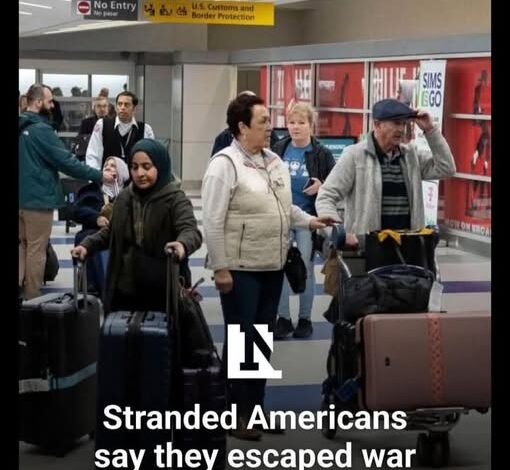
Stranded Americans Say They Escaped War Zone With Little Us!
The dream of a globalized, hyper-connected world has collided violently with the harsh realities of 21st-century warfare. As of March 2026, thousands of Americans and foreign nationals find themselves caught in a terrifying limbo across the Middle East, a week after joint U.S.-Israeli strikes on Iran ignited a regional conflagration that has entangled more than a dozen neighboring countries. What began as a targeted military operation has rapidly devolved into a humanitarian crisis of immense proportions, leaving travelers and expatriates to navigate a crumbling infrastructure of closed airports, canceled flights, and a growing sense of abandonment by their own government.

The stories emerging from the region are defined by a singular, haunting theme: the disparity in national response. While the United States government has issued increasingly alarming guidance—largely advising its citizens to “shelter in place” or find commercial means of escape—other nations have moved with decisive speed. Poland, Australia, and France, among several others, have already dispatched military transport aircraft and chartered civilian planes to extract their populations from the escalating war zone. For Americans watching French or Australian citizens board organized evacuation flights, the frustration has boiled over into a mix of anger and existential dread.
The logistical nightmare began almost immediately after the first strikes. Major transit hubs in Dubai, Doha, and Istanbul—the literal crossroads of the world—saw their flight boards turn red with cancellations as airspace was shuttered to civilian traffic. For many Americans, the initial response was a frantic rush to the nearest airport, only to find terminal doors locked and security personnel overwhelmed. Unlike the early days of previous conflicts, where “commercial availability” was a viable metric, the 2026 crisis has seen a total systemic failure of the private travel industry in the region.
U.S. citizens trapped in cities like Amman, Beirut, and Kuwait City describe a breakdown in communication that has left them feeling like secondary priorities in a geopolitical chess match. The State Department’s “Smart Traveler Enrollment Program” (STEP) has been inundated, with many users reporting that the automated alerts they receive are vague and offer little in the way of actionable survival strategies. The official stance—that Americans should not expect a government-led evacuation—is a standard diplomatic boilerplate that feels increasingly insufficient as the conflict spreads into countries that were, until last week, considered stable partners.
In contrast, the Australian government’s rapid deployment of Royal Australian Air Force (RAAF) transport planes to Cyprus and Jordan has set a benchmark that many Americans are using to criticize their own administration’s perceived inertia. French military flights have already evacuated hundreds from the Levant, prioritizing the elderly and families with young children. This “evacuation gap” has led to a growing sentiment among the stranded that the size and power of the U.S. military are not being leveraged to protect its most vulnerable assets: its people.
The psychological toll of being “stranded” in a war zone is compounded by the speed at which the conflict has expanded. What was initially an exchange between three primary actors has now touched nearly every capital in the Middle East. Prevailing winds carrying the threat of fallout and the constant hum of unmanned aerial vehicles (UAVs) have turned luxury hotels and expatriate enclaves into high-stress fortresses. In Istanbul, American business travelers described the surreal experience of watching from their windows as the city’s skyline was periodically illuminated by anti-aircraft fire, all while receiving emails from their airlines stating that their rebooked flights had been canceled “indefinitely.”
The crisis also highlights a fundamental shift in how modern states view their duty of care. For smaller nations like Poland or Australia, the extraction of their citizens is a manageable, highly visible goal that signals national strength and compassion. For the United States, with an estimated hundreds of thousands of citizens scattered across the Middle East for business, education, and tourism, the scale of a total evacuation is a logistical impossibility that the government seems hesitant to even attempt. This creates a “lottery of birth,” where having a passport from a mid-sized, neutral, or highly organized European nation might currently be more valuable than carrying a blue U.S. passport.
Furthermore, the “alarming guidance” mentioned by travelers often refers to the shift from diplomatic assistance to self-preservation. Some citizens have reported receiving notices suggesting they prepare “go-bags” and identify overland routes to “safer” borders, such as those leading into Saudi Arabia or toward the Mediterranean coast. However, with fuel shortages reported in multiple countries and border crossings becoming bottlenecked by millions of local refugees, these “self-help” suggestions feel detached from the reality on the ground.
The economic and social status of those stranded has also created a tiered experience of the crisis. While wealthy expatriates in high-security compounds have access to private security and stockpiled resources, the average American tourist or student is often left to fend for themselves in unfamiliar urban environments. The closure of the Strait of Hormuz and the subsequent spike in oil prices have further crippled the local ability to provide transport, making even a short trip to a potential extraction point a costly and dangerous gamble.
As the second week of the conflict looms, the window for a safe, organized departure is closing. The intensity of the aerial campaigns has made the risk to civilian aircraft—even those on humanitarian missions—too high for many commercial pilots to accept. This leaves the U.S. military as the only entity with the capability to perform large-scale extractions under fire, a move that the administration has so far resisted for fear of further escalating tensions or exposing assets to Iranian retaliation.
The stories of those who managed to escape are fraught with harrowing details of “gray-market” transport—paying thousands of dollars for seats on private buses or small maritime vessels to reach safe havens like Cyprus or Greece. For those still left behind, the sight of empty skies where commercial jets once flew is a constant reminder of their isolation. The “frustrations and growing fear” cited by authorities are no longer just emotions; they are the precursors to a major political fallout at home, as families of the stranded begin to demand why the world’s most powerful nation is being outpaced by its allies in the race to save its own.
In the final analysis, the 2026 stranded citizen crisis serves as a grim case study in the limitations of national power. It reveals that in a truly “entangled” regional war, the safety of the individual is often the first thing sacrificed at the altar of strategic necessity. As Poland and France celebrate the return of their citizens, the silence from the American hangers and tarmac is deafening to those still huddled in the shadows of a region on fire.