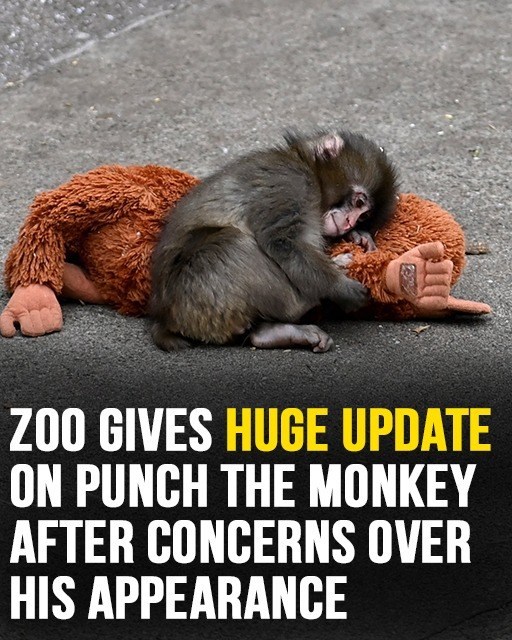
The video of punch broke the hearts of millions online!
The digital age has a unique capacity for turning individual suffering into a global spectator sport, but rarely has a story captured the collective psyche quite like that of Punch. He is a macaque whose life began not with the warm embrace of a maternal bond, but with the sterile coldness of rejection and the glaring light of viral fame. The video that circulated across social media platforms in early March 2026 was not the typical, sanitized content usually associated with animal rescues. It was raw, brutal, and deeply unsettling, depicting a newborn primate clutched to a stuffed orangutan as if it were a physical lifeline. This image broke the hearts of millions, sparking a firestorm of debate regarding the ethics of wildlife care, the fragility of social animals, and the often-ugly process of rebuilding a life from scratch.

Punch’s early days were defined by a profound and haunting absence. For a social primate, the first few hours of life are supposed to be an intensive period of mirroring and physical contact. Without a mother to cling to, Punch was cast into a psychological void. Into this vacuum stepped human caregivers armed with high-tech incubators, specialized formula, and the now-famous plush orangutan. While the toy was intended as a surrogate for physical comfort, the world saw it as a heartbreaking symbol of what was missing. The public reaction was immediate and visceral—a chaotic mix of protective anger and overwhelming tenderness. People rushed to assign blame and demand immediate solutions, often moving faster than their understanding of the complex biological realities involved in primate rehabilitation.
The process of reintegrating a rejected infant into a social group is far from the cinematic, heartwarming montage that audiences have come to expect from nature documentaries. It is a slow, often violent-looking, and deeply stressful endeavor. As Punch began his first supervised meetings with other macaques, every interaction was scrutinized by a global audience. When a larger juvenile tugged at his fur or when Punch retreated in a startled panic, the digital comments sections erupted with accusations of cruelty. However, within that uncomfortable and often misunderstood space, Punch was performing the most difficult tasks a social animal can undertake. He was learning the language of his own kind—the subtle cues of dominance, the nuances of grooming, and the vital importance of persistence.
True resilience rarely looks beautiful while it is being constructed. For Punch, progress was measured in small, quiet victories that lacked the dramatic flair of a viral video. It was the first time he took a step away from his caregivers without looking back. It was the afternoon he sat alone in a sunbeam, peeling a piece of fruit without human assistance. Most significantly, it was the day he finally left his plush orangutan behind, choosing instead to reach out to a living, breathing member of his troop. These moments represent a fundamental shift in his internal architecture—the movement from a state of total dependency to one of emerging autonomy.
The story of Punch also highlights the “observer effect” in modern wildlife conservation. The millions of people watching his progress through a screen were not just passive witnesses; their collective pressure influenced the transparency and pacing of the rescue operation. This digital oversight creates a double-edged sword for caregivers. On one hand, the outpouring of support provides the necessary resources for high-level medical care and enrichment. On the other, the demand for “cute” or “positive” updates can clash with the messy, regressive reality of animal behavior. Care is an imperfect science, and the road to recovery for an animal like Punch is often two steps forward and one step back.
As his physical health stabilized, the focus shifted toward his psychological fortification. A macaque that grows up too close to humans risks becoming a “social misfit,” unable to survive in the complex hierarchy of a troop. Therefore, the caregivers had to perform the hardest act of love: they had to withdraw. They had to allow Punch to feel the minor stings of social rejection from his peers so that he could learn how to navigate them. They had to let him be “just an animal” again. In 2026, as his fur begins to thicken and his gait becomes more confident, the marks of his early trauma are fading, replaced by the rugged scars of experience.
The quieter truth revealed by Punch’s journey is that survival is a gritty, unglamorous business. His story resonated so deeply because it touched on a universal fear of abandonment and the equally universal hope for a second chance. We saw in Punch a reflection of our own vulnerabilities—the need for a “lifeline” during our darkest moments and the slow, painful process of eventually letting that lifeline go. His success is not a miracle; it is the result of tireless, often criticized work by specialists who understood that Punch needed more than just a stuffed toy; he needed a future where he didn’t need one.
Looking toward the latter half of 2026, Punch is expected to be fully integrated into a stable social group. The cameras will eventually stop following him, and his name will fade from the trending lists. This, ironically, will be the ultimate sign of success. When he is no longer a “heartbreaking video” but just another macaque navigating the social politics of his enclosure or habitat, the mission will be complete. He will have moved from being a symbol of human pity to a living example of primate resilience.
In conclusion, the saga of Punch serves as a powerful reminder that our emotional responses to nature are often filtered through a very human lens. While we focused on the “cuteness” of the toy or the “brutality” of the rejection, Punch was focused on the far more important task of existing. His story teaches us that compassion must be patient and that the most profound transformations happen in the quiet intervals between the viral clips. Resilience is built in the tugs, the retreats, and the lonely meals, eventually leading to a life that is no longer defined by what was lost, but by what was found in the aftermath.