How a Single Misunderstanding Brought Us Closer Than Ever!
The fingerprints of our upbringing are pressed into the glass of every window through which we view the world. Long before we possess the vocabulary to describe our values, the rituals of our childhood have already hardened into internal laws. They are the silent architects of our reality, quietly defining what feels “right,” what feels “wrong,” and what feels strangely, inexplicably unsettling. We carry these invisible rules like heirlooms, tucked away in the pockets of our subconscious. When we eventually choose to build a life with someone else—merging two different sets of shadows and lights under a single roof—those rules follow us. They dictate the cadence of our speech, the intensity of our reactions, and the heartbreaking ease with which we can misunderstand the person we love most.

One Tuesday morning, the world outside was still wrapped in the bruised, pale blue light of pre-dawn. Mira had woken an hour before the alarm, a choice made out of a quiet, domestic devotion. She cherished these early hours; they were predictable and peaceful, a private sanctuary before the demands of the day began to roar. In the soft glow of the stovetop light, she began the rhythmic process of making breakfast for Evan. It was meant to be a gesture of grace, a way to say “I value you” without having to find the words before coffee. She cracked several eggs directly into a cast-iron pan, the sharp, percussive sound echoing softly against the subway tile of their kitchen.
Evan wandered into the room minutes later, the very picture of morning disorientation. His hair was tousled, his eyes were still half-lidded, and he carried the warmth of sleep with him like a heavy blanket. He leaned his weight against the marble counter, watching the steam rise from the pan with a distant, sleepy fascination.
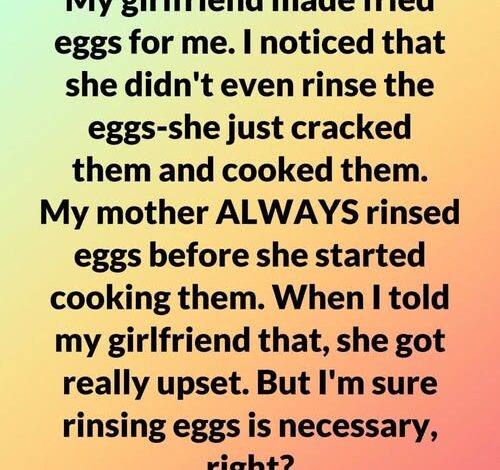
“Shouldn’t you rinse the shells first?” he asked casually, his voice raspy from disuse. “My mom always did that before she cracked them.”
To Evan, the remark was a mere phantom of a memory—a neutral observation tossed into the morning air. In his childhood home, a drafty farmhouse where “cleanliness was next to godliness” was a literal commandment, rinsing eggs was simply the “proper” way things were done. He wasn’t interrogating Mira’s competence, nor was he issuing a directive. He was simply reaching back into the library of his past and pulling out a familiar volume.
But inside Mira, the air suddenly felt thin.
The shift was instantaneous. Something deep within her tightened, a defensive coil springing into place. In the logic of her own upbringing, where criticism was often veiled as “helpful advice,” Evan’s comment didn’t sound like a memory. It sounded like an indictment. She had sacrificed her sleep to do something thoughtful, and in return, she felt as though she had been measured against an impossible standard and found wanting. An invisible measuring stick—one held by a woman she had never truly known—had entered the sanctuary of her kitchen.
Her movements, previously fluid and rhythmic, became stiff and clinical. She flipped the eggs with a sudden, sharp precision. The warmth she had felt just moments before, watching the butter bubble in the pan, evaporated, replaced by a cold, radiating prickle of resentment. She didn’t say a word, but the silence she projected was heavy, vibrating with an unspoken hurt.
Evan, sensitive to the emotional barometer of the room even in his half-asleep state, sensed the change immediately. He watched her back, his brow furrowed in genuine confusion. He had expected a smile or a sleepy “good morning,” and instead, he felt as though he had accidentally stepped on a landmine buried beneath the kitchen rug. For a few minutes, the only sound was the sizzling of the eggs—a sound that now felt aggressive rather than appetizing.
It wasn’t until later that evening, when the sharp edges of the day had been blunted by the setting sun and a shared glass of wine, that the moment finally softened enough to be dissected. They sat on their small velvet sofa, the low light of the living room creating a space where honesty felt safe.
“I’m sorry about the egg thing this morning,” Evan said, his voice quiet and sincere. He explained the ritual of his mother’s kitchen—how she believed that even the smallest impurity on a shell could ruin a meal. He confessed that it wasn’t a rule he actually believed in, just a habit stitched so deeply into his memory that it had slipped out of his mouth without thought. He hadn’t meant to criticize her; he had just been thinking out loud about a ghost.
Mira took a long breath, letting the last of the morning’s tension leave her shoulders. She admitted her own truth: it hadn’t actually been about the eggs. It hadn’t even really been about his mother. It was about the fundamental human desire to have one’s effort seen and validated. When he had questioned her method, she had felt the labor of her love being dismissed. She had felt invisible in her own gesture.
They spent the rest of the evening talking about the other inherited rituals they carried—the strange, irrational ways they folded towels, the specific temperatures they kept the house, the “correct” way to load a dishwasher. They laughed at the absurdity of these domestic dogmas and the strange, disproportionate power they wield over our adult lives. They realized that most of their arguments weren’t about the present moment at all, but were actually skirmishes between two different pasts trying to occupy the same space.
Later that night, long after the wine was finished, they found themselves back in the kitchen. They decided to make a late-night snack, a second round of the breakfast that had gone so wrong that morning. This time, they worked together in a synchronized dance of shared effort. Evan reached for the eggs, and Mira watched him. He paused, looking at the carton, then at her, a playful glint in his eye.
He cracked the eggs directly into the pan without even glancing toward the sink.
As they watched the whites turn opaque and the yolks shimmer in the light, they realized that nothing had gone wrong. The world didn’t end because a shell wasn’t rinsed; the meal wasn’t ruined because a childhood rule was broken. In fact, it tasted better.
This small, mundane misunderstanding became a cornerstone of their relationship. It taught them that when a partner reacts with unexpected intensity to a trivial comment, they aren’t usually reacting to the comment itself—they are reacting to a fingerprint left by someone else, years ago. It’s rarely about the eggs. It’s about the constant, beautiful, and difficult work of building new rituals together—rituals that aren’t dictated by the ghosts of our parents’ kitchens, but are shaped by the understanding, patience, and love we choose to offer one another every single morning. They learned that the most important thing you can “clean” in a kitchen isn’t an eggshell; it’s the space between two people who are trying their best to love one another in the present tense.