Popes unsettling one-word message!
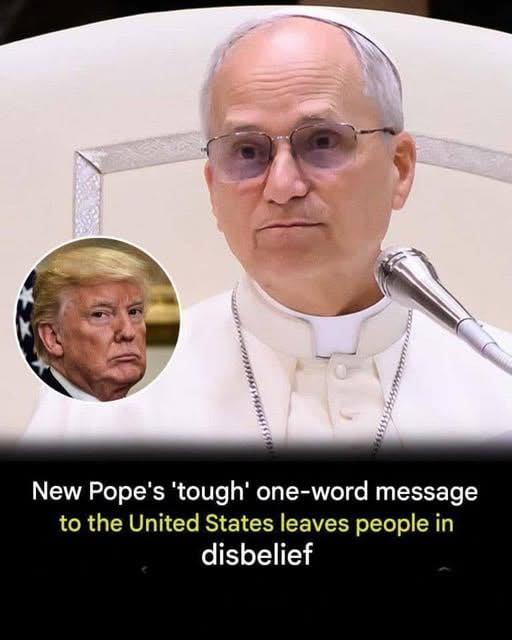
In the rapidly accelerating landscape of digital communication, where political and religious leaders often resort to exhaustive rhetoric to manage their public image, Pope Leo XIV recently demonstrated the profound power of brevity. With a single, viral, one-word response—”Many”—the pontiff ignited a global conversation that transcended traditional media boundaries. This concise interaction was not merely a social media anomaly; it was a masterclass in theological provocation and a signal of the intentional, sharp-edged pastoral style that is beginning to define his papacy. By refusing to over-explain or retreat into the safe harbor of platitudes, Leo XIV has positioned himself as a leader who understands that in a world of noise, a whisper can carry the weight of a mountain.

To understand the impact of this moment, one must look at the man behind the title. Formerly known as Cardinal Robert Francis Prevost, Pope Leo XIV ascended to the Chair of St. Peter with a well-established reputation for vocal advocacy. His history is one of deep engagement with the most friction-filled issues of our time, from the complexities of global migration to the urgent demands of social justice. Unlike many who seek to harmonize with every audience, Leo XIV has shown a consistent willingness to confront political power directly, regardless of the ideological camp it occupies. His past criticisms of restrictive immigration policies and his staunch defense of migrant dignity have often placed him in direct opposition to various political administrations, yet he remains unbowed, driven by a consistent moral framework rather than partisan convenience.
The word “Many” was delivered in a context that suggested a deep, albeit weary, awareness of the socio-political challenges currently facing the United States and the broader West. It was an answer that functioned as both a subtle rebuke and an invitation to deeper introspection. By choosing such an economical response, the Pope avoided the trap of becoming a “soundbite” for any specific political party. Instead, he forced the observer to fill in the blanks, turning the interaction into a mirror for the reader’s own concerns and convictions. It was a theological gesture grounded in intentional ambiguity—a way of acknowledging suffering, complexity, and systemic failure without reducing them to a campaign slogan.
Leo XIV is a figure who resists the modern impulse toward simple ideological labels. While he has frequently challenged the rhetoric of the political right regarding the treatment of the vulnerable, he has been equally uncompromising in his critiques of the political left. He has remained a vocal opponent of policies that undermine the sanctity of life and has consistently targeted economic systems that prioritize profit over the dignity of the laborer. In this way, he follows in the intellectual footsteps of his namesake, Pope Leo XIII, the author of the landmark 1891 encyclical Rerum Novarum. Just as Leo XIII navigated the industrial revolution by balancing the rights of labor with the ethics of personal ownership, Leo XIV is navigating the digital and geopolitical revolutions with a nuanced, deeply Catholic approach to social ethics.
This papacy is signaling that it will be one of “engagement without entanglement.” The choice of the word “Many” told the world that the Vatican is paying close attention to the fractures in modern society, but it will not be confined by the expectations of the secular political machine. It was an opening to a dialogue that Leo XIV intends to lead on his own terms—pastoral in its concern for the individual, yet provocative in its challenge to the structures that perpetuate inequality. He is proving that the papacy can still be a force to be reckoned with, not by shouting the loudest, but by speaking with a clarity that cuts through the static of 24-hour news cycles.
The ripple effects of this single word were felt immediately across social media platforms and in the halls of power. Analysts scrambled to decipher the specific “many” the Pope referred to: Many challenges? Many victims? Many failures? The brilliance of the response lies in its inclusivity. It allowed the Pope to validate the anxieties of a global population while maintaining the mystery and authority of his office. It was a reminder that the church’s role is not to provide easy answers to difficult questions, but to provide a moral anchor in an age of uncertainty.
Furthermore, this interaction highlights a shift in how the Vatican approaches the digital age. Under Leo XIV, the papacy is not merely participating in social media; it is subverting it. By using the tools of brevity and viral reach to deliver messages of substance, the Pope is reaching a demographic that is often alienated by long-form ecclesiastical documents. He is meeting the world where it is, using the language of the present to point toward timeless truths. “Many” was a signal that this administration will be characterized by a certain “holy unpredictable” nature—a willingness to disrupt the status quo in favor of a more authentic, albeit more challenging, religious discourse.
As we look forward, it is clear that Pope Leo XIV intends to be a force of “constructive tension.” He is a leader who is comfortable in the middle of the storm, using his platform to advocate for the marginalized while simultaneously calling all sides to a higher standard of conduct. His focus remains on human dignity as the ultimate measuring stick for any policy or movement. Whether he is discussing the ethics of artificial intelligence, the realities of climate change, or the preservation of the family unit, his approach is marked by a refusal to settle for the “least common denominator.”
In the end, “Many” was more than just a word; it was a manifesto of presence. It was a declaration that the Pope is not a distant figurehead locked away in a gilded palace, but a participant in the modern struggle. It was a whisper with weight, a signal that this papacy will be impossible to ignore and even harder to categorize. Pope Leo XIV has arrived on the global stage not with a roar, but with a single, sharp insight that has left the world leaning in to hear what he might say next. He has demonstrated that in the hands of a skilled communicator, the shortest answer can be the one that starts the longest conversation.