Woman raises 900k for 78-year-old DoorDash driver who took job to pay for wifes medication!
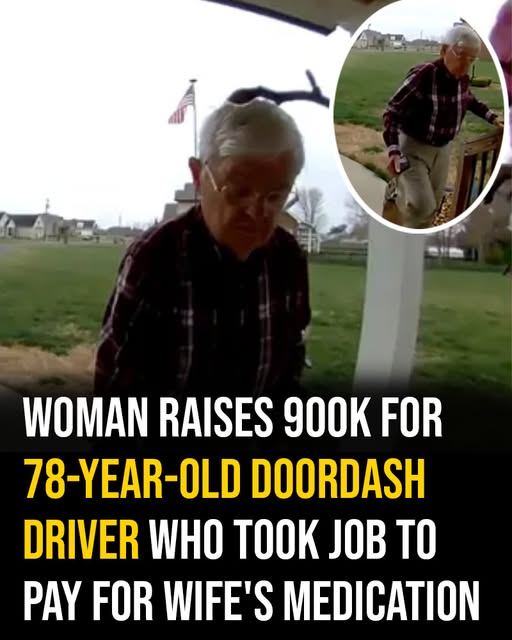
The digital grainy footage of a Ring doorbell camera usually captures the mundane—packages dropped on porches, solicitors checking their watches, or the wind rattling a screen door. But on a quiet Tuesday in Manchester, Tennessee, Brittany Smith looked at her phone and saw something that stopped her heart. It wasn’t a threat, but a revelation of a quiet, exhausting struggle.

The man on the screen was Richard. At seventy-eight years old, an age when the world expects a man to be resting in a comfortable chair with a book or a grandchild, Richard was hunched over, his breath visible in the air as he navigated the steep wooden steps of Brittany’s home. In his hand was a single Starbucks bag—a treat ordered for Brittany’s daughter. Brittany had initially felt a flash of irritation; her daughter’s father, a quadriplegic who relied on delivery services for things he could not physically retrieve, had ordered the expensive coffee for the third time that week. She viewed it as an unnecessary indulgence until she saw the person tasked with bringing it to her door.
The contrast was staggering. Here was a “very capable” young girl waiting for a luxury drink, and there was a “little old man,” as Brittany described him, trembling under the weight of a task that his body had long ago earned the right to refuse. It was a snapshot of a broken equilibrium.
Brittany’s first instinct was practical: she wanted to increase his tip. She knew the meager delivery fees offered by apps like DoorDash barely covered the gas, let alone the physical toll on a septuagenarian. However, the app’s rigid interface made adjusting the gratuity a frustration. Driven by a cocktail of guilt, empathy, and a sudden, sharp need to help, Brittany took to social media. She posted a twenty-second clip of Richard’s ascent up her stairs, not to shame him, but to find him.
The internet, so often a place of division, shifted its massive weight toward kindness. Within hours, the video surged across platforms. A local resident recognized Richard—he was a familiar face at her office, a man who delivered lunches with a quiet, persistent dignity. Armed with his name and a general sense of where he lived, Brittany set out on a mission. She drove through the neighborhood until she spotted the modest delivery car from the video parked in a driveway.
When she knocked on his door, she wasn’t just carrying a $200 cash tip; she was carrying the curiosity of thousands of people who wanted to know why.
Richard’s response was a masterclass in the quiet humility of his generation. Before he would even touch the money Brittany offered, he looked her in the eye and asked if she would be “OK” if he accepted it. He was more concerned about her financial well-being than his own. Once assured, the story began to pour out—a narrative of systemic cracks and personal devotion.
Richard hadn’t chosen to spend his twilight years sitting in drive-thrus and navigating unfamiliar porches because he enjoyed the hustle. He was there because life had delivered a series of blows that his retirement savings couldn’t withstand. His wife had recently lost her job through no fault of her own, and with that job went their stability. They were trapped in a common, cruel American paradox: after paying for their mortgage, utilities, and basic necessities, there was nothing left to cover her “very expensive” medications. For Richard, the choice wasn’t between working and resting; it was between working and watching his wife’s health decline. So, he put on his coat, logged into an app he barely understood, and started driving.
Brittany returned home, but the momentum of the story had moved beyond her driveway. The TikTok community was clamoring for a way to intervene. They didn’t just want to buy Richard a tank of gas; they wanted to buy him his life back. Brittany launched a GoFundMe titled “Give Richard a chance to rest again.” Her plea was simple: “By the time they pay their monthly expenses plus purchase their medication there is nothing left. Let’s help Richard go back into retirement.”
The goal was modest at first, perhaps enough to cover a few months of bills. But the story of the man on the porch had touched a nerve. It represented a collective anxiety about aging, a communal respect for a man who refused to abandon his post, and a shared desire to right a visible wrong. The numbers on the screen began to spin with dizzying speed.
By March 17, 2026, the fundraiser had shattered every expectation. It didn’t stop at ten thousand or fifty thousand. It climbed past half a million, then surged toward the nearly unthinkable sum of $930,000. For a man who had been struggling to find an extra $200 for medicine, the figure was astronomical. It was more than a windfall; it was a total erasure of every financial shadow that had loomed over his household.
The emotional impact on Richard was profound. Brittany reported that the man who had been so steady on her doorstep hadn’t slept in two days—not out of stress, but because he couldn’t stop watching the total climb. He sat in front of his computer, witnessing a global outpouring of love from strangers who had seen twenty seconds of his struggle and decided he had done enough.
The transformation of Richard’s life is a testament to the power of seen reality. We often speak of “essential workers” in the abstract, but Richard became the face of a hidden workforce—the seniors who fill the gaps in our service economy out of sheer necessity. His story shifted the backyard conversation from one of frustration over a Starbucks order to one of profound communal responsibility.
Richard is no longer climbing stairs for pennies. He is no longer calculating the cost of a pill against the cost of a gallon of milk. Because of a Ring camera and a woman who refused to look away, he has been gifted the one thing that money is actually good for: time. He has been given back his mornings, his dignity, and the ability to sit beside his wife without the weight of an impending delivery shift hanging over his head.
In the end, Richard’s story isn’t just about a large sum of money. It is about the moment when a community decided that a seventy-eight-year-old man shouldn’t have to be a “hero” just to survive. It is about the beauty of a retirement finally earned, the warmth of a medicine cabinet finally filled, and the simple, radiant fact that sometimes, when we see someone struggling up the steps, we have the power to lift them the rest of the way.