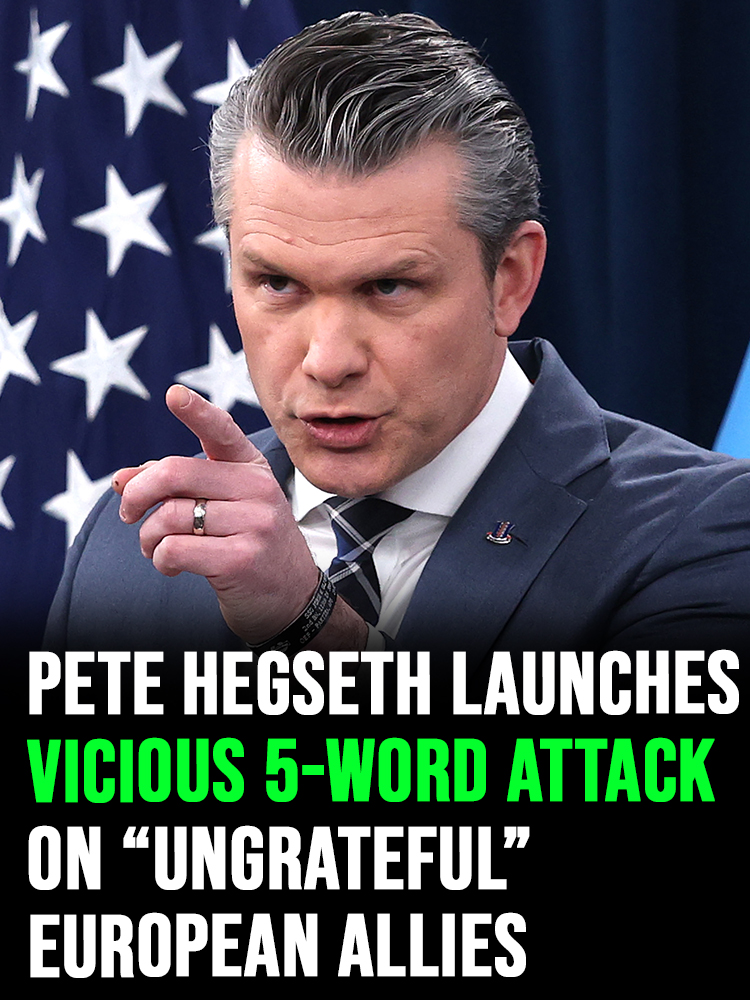
Pete Hegseth’s vicious 5-word attack on “ungrateful” European allies
The escalating conflict in Iran has triggered a profound diplomatic fracture between the United States and its traditional European partners, as several key allies flatly refuse to join the American military campaign. On Thursday, U.S. Secretary of War Pete Hegseth responded to this resistance with a blistering critique, accusing European leadership of failing to show gratitude for American intervention.

The coalition of the unwilling is substantial and growing. Major powers including France, the United Kingdom, Spain, Germany, and the Netherlands have all formally declined to participate in the ongoing U.S. military operations against Tehran. This collective hesitation has fundamentally challenged the administration’s efforts to present a unified Western front.
A Tense Confrontation at the Pentagon
The friction reached a boiling point during a charged press briefing at the Pentagon. Secretary Hegseth, representing an administration that has been consistently critical of European policy since taking office last year, made it clear that the United States has no intention of pausing its offensive.
While European leaders have voiced grave concerns regarding the current U.S. strategy—warning that the conflict is at risk of spiraling into an uncontrollable regional conflagration—Hegseth dismissed these anxieties as a lack of resolve. According to the Secretary, the U.S. is currently carrying the burden of global security alone while those he described as “ungrateful” allies offer little more than criticism from the sidelines.
“Thank You, President Trump”
In a statement that underscored the deteriorating state of transatlantic relations, Hegseth framed the war as a defense of Western civilization itself, casting Iran’s nuclear ambitions as an existential threat that transcends regional borders.
“A regime like that refusing to abandon its nuclear ambitions is not just a regional problem; it’s a direct threat to America, to freedom, and to civilization in the world, the Middle East, and our ungrateful allies in Europe,” Hegseth told reporters.
He did not reserve his frustrations for foreign leaders alone, pivoting to target domestic critics as well. “Even segments of our own press should be saying one thing to President Trump: ‘Thank you.’”
Defining the Mission
Despite the lack of international consensus, Hegseth maintained that the military operation remains focused on a singular goal: the systematic degradation of Iranian military capabilities. He insisted that the U.S. would not be deterred by a lack of foreign support.
“Our objectives have not changed,” Hegseth continued. “We will defend our interests, we will defend our allies, and we will stop Iran from becoming a greater threat.”
The rhetoric coming out of the Pentagon suggests a “go-it-alone” posture that could redefine the NATO alliance for years to come. As the military campaign continues to unfold without the backing of Europe’s largest economies, the question of long-term regional stability remains unanswered.
What is your perspective on this developing rift? Do you believe the U.S. is right to demand more from its allies, or are European concerns about escalation justified? Please share your thoughts in the comment section below.