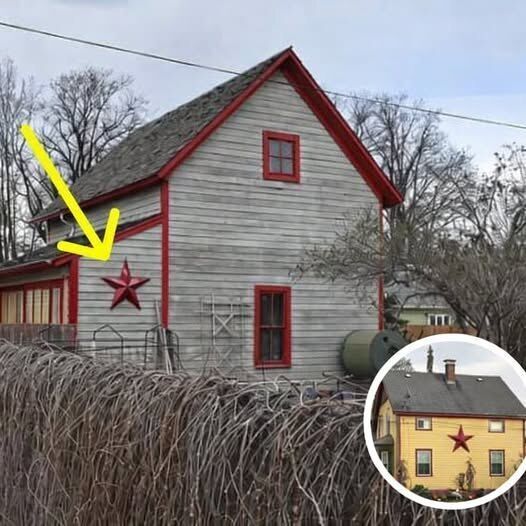
The Quiet Symbol Painted Across Pennsylvania Barns: The Hidden Story of Barn Stars
Travel through the countryside of Pennsylvania, and one detail begins to repeat itself in a way that slowly demands attention. On the broad wooden sides of old barns, large geometric stars appear—bold yet quiet, simple yet unmistakable. At first glance, they seem like nothing more than rural decoration, an aesthetic choice meant to break the monotony of weathered wood and farmland horizons. But the longer you look, the more they begin to feel like something deeper—something rooted in memory, identity, and tradition carried across generations.

These symbols are commonly known as barn stars or Pennsylvania stars, and they are far more than decorative patterns. Their presence across the landscape reflects a cultural history that has endured for centuries, quietly preserved in paint, wood, and metal rather than written records.
What Barn Stars Represent
Barn stars come in many variations. Some have five points, others six or eight, and a few are shaped in more complex, wheel-like forms. Despite their differences, they share a consistent visual language: symmetry, balance, and intentional design. They are often painted in bold colors or constructed from materials that allow them to stand out against the wooden backdrop of barns and rural homes.
While they add character to buildings, their placement was never random or purely ornamental. Each star was positioned with care, reflecting both craftsmanship and meaning rooted in the communities that created them.
Origins in Early Immigrant Life
The tradition of barn stars traces back to early European settlers who arrived in Pennsylvania during the 17th and 18th centuries. Many of these settlers came from German-speaking regions, seeking religious freedom, farmland, and a stable place to build new lives. Among them were groups such as the Amish, Mennonites, and other communities often collectively referred to as the Pennsylvania Dutch.
These settlers brought with them not only farming knowledge and religious traditions, but also a strong visual culture. In their homelands, geometric patterns—stars, floral shapes, and symmetrical designs—were commonly used in architecture, furniture, and household objects. These designs were not meant to be extravagant; instead, they reflected order, discipline, and a connection to heritage.
When these communities settled in Pennsylvania, they carried these artistic traditions with them and adapted them to their new environment. Barns, being central to agricultural life, became natural canvases for expression.
By the 19th century, painted stars had become a recognizable feature across rural Pennsylvania. They appeared consistently on barns, houses, and outbuildings, forming a quiet visual identity for entire regions.
How They Were Created
Originally, barn stars were hand-painted directly onto wooden surfaces. This required skill, patience, and a steady hand, as the geometry had to remain precise even on large and uneven barn walls. The paints used were often made from natural pigments, chosen for both durability and visibility.
As time passed and materials evolved, barn stars began to take on new forms. Instead of being painted, some were crafted from wood and mounted onto structures. Later, metal versions appeared, allowing for greater durability against weather and time.
Despite these changes in materials and technique, the intention behind them remained consistent. Each star represented care in construction, attention to detail, and a desire to leave something lasting behind. They were not made for temporary display—they were designed to endure.
Meaning Beyond Decoration
Over the years, many interpretations have been attached to barn stars. Some people believe they offer protection to the household or bring good fortune. Others associate them with agricultural success or spiritual symbolism. While these meanings have developed over time, historical evidence suggests that their original purpose was more practical and cultural than mystical.
At their core, barn stars represented identity. They reflected the values of the communities that made them: discipline, craftsmanship, and a sense of belonging. They were quiet declarations of presence—marking not wealth or status, but continuity and care.
Unlike symbols meant to demand attention, barn stars do the opposite. They do not announce themselves loudly. Instead, they exist steadily in the background, becoming more meaningful the longer they are observed.
Why They Still Exist Today
Despite centuries of change, barn stars have not disappeared. They still appear across Pennsylvania’s countryside, on barns that have stood for generations, and even on modern homes inspired by traditional design.
In many cases, their use today is no longer tied strictly to cultural heritage. People install them because they appreciate their simplicity, their symmetry, or their connection to rural history. Yet even in modern settings, they continue to carry echoes of their origins.
What makes barn stars remarkable is not just their appearance, but their persistence. They bridge past and present without needing to evolve into something entirely new. Their meaning has not been lost—it has simply expanded over time.
A Symbol of Continuity
Ultimately, barn stars endure because they represent something universal: the desire to create something meaningful that lasts. They remind us that not all symbols need to be loud or complex to hold significance. Some of the most enduring expressions of culture are the quietest ones—built into the structures people live and work in every day.
They stand as reminders that intention matters. That craftsmanship leaves traces. And that even in a changing world, certain forms of expression remain steady, carried forward not through explanation, but through presence itself.
In the end, a barn star is more than a shape on wood or metal. It is a small, lasting connection between generations—painted, crafted, and preserved not to demand attention, but simply to remain.