These Are The Absolute Most Dangerous US States To Avoid If World War 3 Suddenly Explodes Into A Nuclear Conflict
As geopolitical tensions continue to rapidly escalate across the globe, a deeply unsettling question has begun to firmly grip the consciousness of millions of everyday citizens: if a massive international conflict ever escalated into a full-scale World War 3, which specific regions would actually be the safest to seek shelter in, and which ones would face immediate destruction? Public anxiety regarding the terrifying possibility of a wider global war has reached a historic fever pitch, aggressively fueled by ongoing localized violence unfolding throughout the Middle East and the highly volatile, shifting alliances of nuclear-armed superpowers. With multiple international flashpoints threatening to collapse into a singular, catastrophic global event, researchers, military analysts, and defense strategists have spent years meticulously examining geographical data to determine exactly how a modern international conflict would physically impact domestic soil.

During an extensive and highly publicized interview with TIME, President Donald Trump addressed these growing public fears regarding the possibility of aggressive retaliatory attacks taking place directly inside the United States. When asked point-blank whether the American populace should be genuinely worried about imminent foreign strikes on domestic targets, the president offered a remarkably blunt and sobering assessment of modern warfare. He acknowledged that military planners and federal defense agencies think about, prepare for, and strategize against these catastrophic scenarios constantly, but emphasized that in the brutal reality of a large-scale war, some people will inevitably die. These stark, unvarnished comments from the commander-in-chief have only intensified the public’s underlying dread, forcing citizens to confront the grim reality that a modern global conflict would not be confined to distant foreign shores.
This pervasive sense of impending instability is actively shared by prominent world leaders who openly believe that the international community may be vastly closer to a third world war than the general public truly realizes. Ukrainian President Volodymyr Zelensky recently stated during a high-profile broadcast that the widespread conflict sparked by the ongoing invasion of his country may already represent the definitive, foundational beginning stages of a much larger international war. According to comprehensive public opinion data collected by YouGov across several European nations and the United States, a staggering percentage of citizens share this exact dark outlook, with roughly 45 percent of Americans explicitly stating their belief that a devastating global war could realistically break out within the next decade. Even more alarming, the vast majority of survey respondents firmly believe that catastrophic nuclear weapons would almost certainly be deployed by opposing nations if such a massive international conflict ever erupted.
Because of these persistent, apocalyptic fears, strategic defense researchers have identified a profound geographical divide within the United States regarding potential survival rates. According to specialized geopolitical research, some defense experts believe that certain states located along the East Coast and throughout the deep Southeast may actually be considered less immediate, primary targets during an initial, highly coordinated nuclear first-strike scenario. These theoretically less vulnerable regions include states such as Maine, Vermont, Massachusetts, Pennsylvania, Virginia, North Carolina, South Carolina, Georgia, and Florida. Additionally, several rural Midwestern agricultural regions are occasionally viewed by analysts as being relatively less susceptible to immediate annihilation, simply because they are not directly tied to the nation’s primary, high-priority offensive military infrastructure.
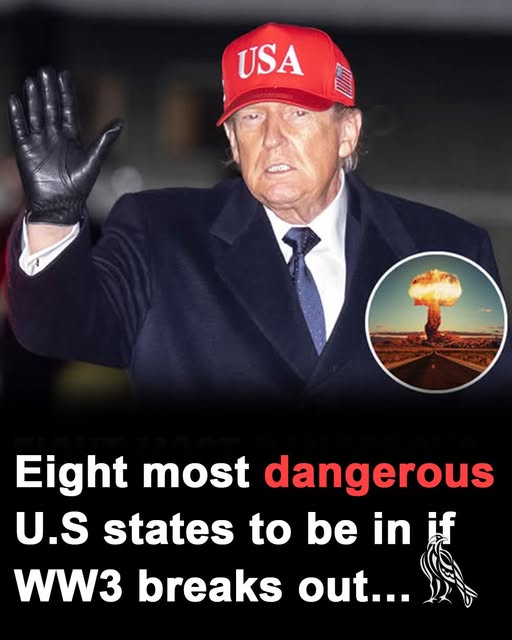
In sharp contrast to these relatively lower-risk areas, military specialists issue a terrifying and urgent warning regarding the extreme danger facing the central and northern interior of the United States. A specific cluster of states including Montana, Wyoming, Colorado, Nebraska, North Dakota, South Dakota, Iowa, and Minnesota are officially classified by defense analysts as absolute maximum-risk zones that would face immediate, overwhelming devastation in the opening minutes of a nuclear war. The reason for this localized vulnerability is entirely strategic: these specific central states happen to sit directly on top of America’s primary Intercontinental Ballistic Missile silo networks, which form the absolute backbone of the nation’s nuclear defense and retaliatory capabilities. In the event of an all-out nuclear exchange, enemy nations would prioritize these exact locations above all else, raining down an absolute firestorm of preemptive warheads in a desperate, calculated attempt to completely destroy the missile silos early and effectively limit the United States’ physical ability to launch a devastating retaliatory strike.
However, modern warfare specialists repeatedly and firmly stress that simple geography alone offers absolutely no guarantee of survival in the 21st century. A large-scale global conflict would target vastly more than just isolated military installations and reinforced missile silos. In a total war scenario, opposing forces would aggressively target major metropolitan population centers, critical transportation hubs, vulnerable regional power grids, essential satellite communication networks, major deep-water ports, and vital industrial infrastructure to completely paralyze the nation’s economy. With thousands of highly advanced, immensely destructive nuclear weapons currently existing in active global stockpiles, experts caution that no singular location on earth could truly be considered completely safe from the cascading horrors of a full-scale nuclear exchange.
The ultimate reality is that any discussion regarding safe places in the context of World War 3 is entirely relative rather than absolute. While certain remote geographic areas might avoid the immediate, blinding blast radius of an initial missile strike, the subsequent global consequences of a massive nuclear conflict would inevitably find and destroy everyone, regardless of where they choose to hide. The inescapable secondary effects, including total global economic collapse, catastrophic food and supply shortages, widespread radioactive fallout drifting on atmospheric winds, and severe, long-term environmental degradation would fundamentally alter the planet’s biosphere, making survival a daily struggle for the remaining population. For now, leading international analysts emphasize that aggressive diplomatic solutions, rigorous communication channels, and active de-escalation remain the absolute most critical path forward for humanity as global flashpoints continue to burn.