Single Father Gives Home to Girl with Down Syndrome After 20 Families Turned Her Away
In a world that often measures worth by perfection and family by tradition, the story of Alba and Luca Trapanese stands as a radical defiance of both. It is a narrative that began with a series of staggering rejections and evolved into an international symbol of the transformative power of unconventional love. Alba, a young girl born with Down syndrome, entered the world facing a future that seemed destined for the shadows of institutional care. Her birth mother, unable to cope with her diagnosis, relinquished her almost immediately. In the weeks that followed, the infant was presented to 20 separate prospective adoptive families. Twenty times, the answer was “no.” For these families, the complexities of her condition outweighed the potential of her life.

Then came Luca Trapanese.
At 41, Trapanese was not the “traditional” candidate Italian social services typically sought. He was a single, homosexual man in a country where adoption laws and societal expectations have historically been anchored in the nuclear family model. Yet, in a rare and landmark exception, the system recognized that Trapanese possessed something far more vital than a spouse: a lifetime of preparation for this exact moment.
A Foundation Built on Grief and Service
Trapanese’s journey toward fatherhood was decades in the making. His deep-seated empathy was forged in the fires of personal tragedy; at the age of 14, he lost his best friend to cancer. That early encounter with mortality and suffering didn’t embitter him; instead, it served as a catalyst for a life dedicated to humanitarian work.
For years, Trapanese immersed himself in service:
-
Special Needs Care: He worked extensively in centers for individuals with complex disabilities.
-
Catholic Volunteering: He served alongside organizations dedicated to the critically ill, gaining firsthand experience in the patience and emotional resilience required for full-time caregiving.
By the time he applied for adoption, he wasn’t looking for a “perfect” child to complete a picture-book life. He was looking for a child who needed the specific brand of fierce, experienced love he was uniquely qualified to give.
Thirteen Days Old: The Moment the Fear Vanished
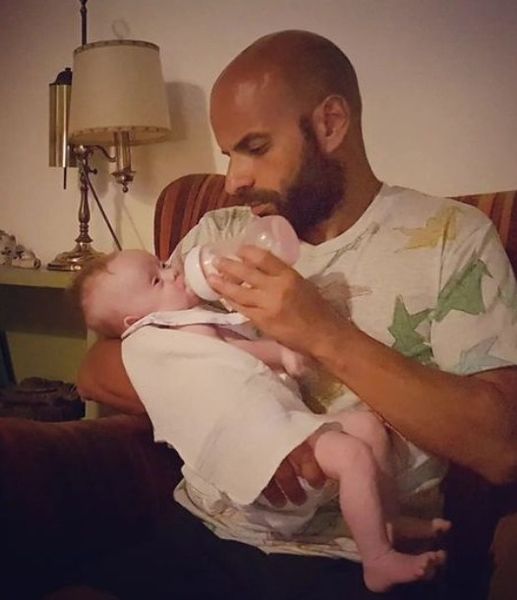
When social services finally called him about Alba, the stakes were high. The child was just 13 days old. Trapanese, despite his years of working with the disabled, had never actually held a newborn.
“It was the first time I’d held a newborn baby. Before that moment, I had always been scared,” Trapanese admitted in an interview with the BBC. “But, when I first held Alba, I knew I was ready to be her dad. I was overcome with joy. I felt she was my daughter straight away.”
With that single embrace, the “unadoptable” child and the “unconventional” father became a family, shattering the bureaucratic and social barriers that had kept them apart.
Dismantling the Blueprint of the “Traditional Family”
Trapanese is acutely aware that his fatherhood is a political act as much as a personal one. By successfully raising Alba as a single gay man, he has challenged the deeply entrenched stereotypes that permeate Italian culture regarding religion, gender, and parenting.
“This case destroys stereotypes about fatherhood, religion, and family,” Trapanese remarked during a radio interview.
His journey argues that the capacity to parent is not found in a marriage certificate or a specific sexual orientation, but in the unwavering commitment to a child’s well-being. He has become an accidental pioneer, opening doors for other marginalized individuals who long to provide a stable home for children the system might otherwise overlook.
A Life in Full Color
Today, Alba is far from the “case study” many feared she would be. Now a spirited and joyful child, she has flourished under Trapanese’s care. He describes her as a “strong-willed” and occasionally “stubborn” young girl—traits he celebrates as signs of her growing independence and resilience.
Her life is a whirlwind of typical childhood milestones:
-
Art and Expression: She spends her days painting and dancing.
-
Social Growth: She is thriving in a nurturing environment filled with friends and music.
-
A Digital Following: Trapanese shares their daily life with over 320,000 Instagram followers, providing a window into a world where Down syndrome is not a tragedy, but simply a different way of experiencing the world.
The Broader Cultural Shift
The impact of Luca and Alba reaches far beyond the borders of Italy. Their story has forced a global conversation about inclusivity and the true meaning of family. Even during the isolation of the COVID-19 pandemic, Trapanese found creative ways to keep Alba’s world large and stimulating, reinforcing the bond that began in a hospital ward years ago.
Through his book and various public platforms, Trapanese continues to advocate for a world where no child is passed over 20 times because of a chromosome. He stands as a reminder that when we stop looking for the “perfect” family, we finally have the space to build a beautiful one.
The saga of Luca Trapanese and his daughter, Alba, is more than a heartwarming viral story; it is a profound case study in the evolution of the modern family. As we look at the trajectory of their lives today, several critical themes emerge that challenge our collective understanding of compassion, legislation, and the human spirit.
The Architecture of Resilience: Key Lessons
The journey of this father-daughter duo offers a roadmap for navigating a more inclusive future. Behind the smiles and the social media posts lie foundational shifts in how we perceive social responsibility:
-
Compassion Beyond Borders: Love and care are not restricted by legal barriers or personal circumstances. Trapanese’s journey proves that the essential qualities of a parent—dedication, empathy, and stability—are not the exclusive domain of traditional couples.
-
The Power of Visible Subversion: By leaning into his identity as a single, homosexual father, Trapanese did more than just adopt a child; he performed a public service by dismantling outdated assumptions. His visibility provides a template for a more expansive definition of the “nuclear family.”
-
The Weight of Persistence: Navigating the Italian adoption system as a single man is a marathon, not a sprint. To do so while seeking to care for a child with special needs requires a rare brand of psychological fortitude. This persistence underscores a universal truth: meaningful goals often require the most grueling effort.
-
The “Nurture” Dividend: Alba’s vibrant development is a living rebuttal to the stigma surrounding special needs. Her happiness illustrates that when a child is moved from a state of uncertainty to a stable, loving environment, their potential for growth is limitless.
-
The Ripple Effect of Service: Long before Alba, Trapanese was a volunteer. His lifelong commitment to caregiving suggests that his adoption of Alba was not an isolated act of heroism, but the natural culmination of a life built on service.
A Future Without Limits
Today, the life shared by Luca and Alba is a masterclass in joy. Their days are not defined by medical appointments or social limitations, but by the same milestones any family cherishes: trips across the Italian countryside, the discovery of new sports, and the messy, beautiful process of artistic expression.
Trapanese continues to document their life with a specific intentionality. He isn’t seeking celebrity; he is seeking to normalize. By showing the mundane, happy reality of their household, he provides a beacon of hope for thousands of children currently languishing in the foster system—children who, like Alba once was, are often overlooked due to their health or disabilities.
Conclusion: Redefining the “Ideal”
The story of Luca Trapanese and Alba is, at its heart, a triumph over rejection. It is the story of a girl rejected twenty-one times who finally found a “yes” that would last a lifetime. In doing so, she found more than just a home; she found a father whose devotion has forced an international audience to rethink the very definition of parenthood.
In a global discourse often dominated by rigid definitions of what a family “should” be, Luca and Alba remind us of what a family can be. Their relationship is a testament to the fact that courage, empathy, and a refusal to accept “no” can create a future where every child—regardless of their chromosomal makeup or their parent’s marital status—has a seat at the table.
As Alba grows, her story will remain a living example of a profound truth: one committed individual has the power to transform a life, and in the process, can inspire the world to be just a little more courageous.