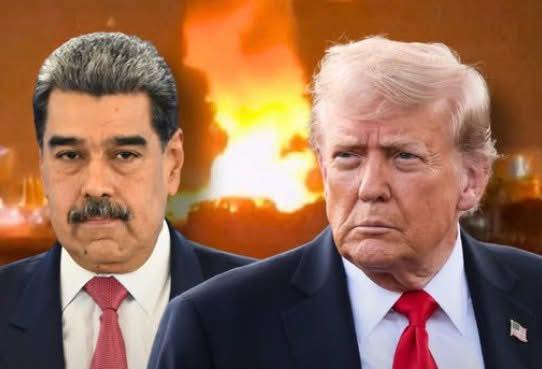
BREAKING NEWS: U.S. Forces Strike Venezuela, Capture Its Leader
In the predawn hours of January 3, 2026, the global information landscape was set ablaze by a narrative that seemed to belong more to a Tom Clancy thriller than modern diplomacy. Claims that Venezuelan President Nicolás Maduro had been forcibly seized from Caracas by U.S. forces and spirited out of the country began to saturate social media, triggering a tidal wave of uncertainty, fear, and speculative fervor. As a journalist who has covered a decade of escalating digital warfare and shifting geopolitical alliances, I recognize this moment as a hallmark of our era: a high-stakes event where the speed of communication outpaces the process of verification, leaving the world to grapple with sensory data before the facts can be fully weighed. What follows is a meticulous reconstruction of the events as they broke—separating the viral noise from the confirmed reality.

The Catalyst: A Digital First Strike
The epicenter of the explosion was a post on Truth Social by President Donald Trump. In the early morning hours, Trump asserted that U.S. forces had executed a “large-scale strike” on Venezuela, successfully capturing both Maduro and his wife, Cilia Flores. He characterized the move as a joint operation with U.S. law enforcement, promising a subsequent press conference.
Within seconds, the post bypassed traditional editorial gatekeepers. It was screenshotted, clipped, and amplified across X, TikTok, and Instagram. The reaction was a polarized frenzy:
-
Shock and Disbelief: Many struggled to reconcile the suddenness of the claim with the gravity of violating a sovereign nation’s borders.
-
Ideological Amplification: Both supporters and detractors of the administration utilized the unverified claims to reinforce existing political narratives.
Chaos on the Ground: The View from Caracas
While the internet debated the claims, residents of the Venezuelan capital were living through the sensory reality of the operation. Early reports from global news agencies corroborated witness accounts of:
-
Loud Explosions: Strategic flashes and percussive blasts were reported near military installations across northern Venezuela.
-
Aerial Activity: Unverified footage showed aircraft operating in the night sky over Caracas—content that spread rapidly despite a lack of immediate geolocation.
This “sensory evidence” created a dangerous vacuum. Because people could see and hear that something was happening, they were more likely to believe the most dramatic explanation available online, even before official confirmations were issued.
Operation Absolute Resolve: What We Now Know
By mid-morning on January 3, the fog began to lift as reputable outlets including the Associated Press, Reuters, and PBS began to confirm the broader strokes of the mission, now identified as Operation Absolute Resolve.
The Verified Scope of the Operation:
-
Airstrikes: U.S. military assets conducted precision strikes against strategic military infrastructure throughout northern Venezuela.
-
The Seizure: U.S. authorities confirmed that Nicolás Maduro and Cilia Flores were indeed taken into custody.
-
The Destination: Reports indicate the pair were transported to New York to face long-standing federal indictments.
The Narrative Duel: U.S. Claims vs. Venezuela’s Response
The initial confusion was exacerbated by starkly different official positions. While the U.S. framed the event as a “law enforcement action” to bring a fugitive to justice for narcotics trafficking, Venezuela’s Vice President, Delcy Rodríguez, countered with a narrative of “criminal aggression.” Demanding a “proof of life” for the presidential couple, Rodríguez condemned the operation as a blatant violation of international law.
The Mechanics of Misinformation
The Maduro capture serves as a case study in why misinformation flourishes during geopolitical shocks.
-
The Speed Factor: Viral claims travel in seconds; verification takes hours.
-
The Context Gap: A video of an explosion is a fact, but the reason for that explosion is an interpretation. In the early hours, interpretations were fueled by bias rather than intelligence.
-
The Presumption of Intent: In the digital age, we must distinguish between misinformation (the unintentional sharing of errors) and disinformation (the deliberate planting of lies). Early on, much of the noise was simply unverified reporting—claims that may eventually prove true but lacked the cross-referencing required for journalistic certainty.
Conclusion: Why the Truth Matters More Than Ever
As of this report, Attorney General Pam Bondi has officially announced the federal indictment of Maduro and Flores on corruption and drug-trafficking charges. Satellite imagery has since confirmed the physical damage to military sites.
However, the “how” and “why” of this operation remain under intense scrutiny. In a world where a single post can move markets and militaries, the capture of Nicolás Maduro highlights a fragile truth: our global stability is increasingly dependent on our ability to wait for the evidence.
The goal of this operation may have been to uphold the law, but the method has left the international community questioning the future of sovereignty. As the story continues to evolve, the distinction between a statement from a leader and a confirmed fact remains the most important tool in a citizen’s arsenal.