How Gifting a Farm to My Daughter Led to a Dispute with Her In-Laws!
I pulled my car beneath the sprawling canopy of the old oak tree, its leaves heavy and dripping from the previous night’s downpour. In my hands, I cradled a jar of homemade blackberry jam, holding it gently as if it were spun glass. Ivy didn’t know I was coming; I had pictured a quiet morning coffee, a small surprise to brighten a week that I suspected had been difficult. She used to live for unexpected moments of joy, but the moment I crossed the threshold into the farmhouse, the atmosphere shifted. The kitchen, usually a sanctuary of open space and light, felt suffocatingly full.

Heavy coats were draped carelessly over the dining chairs, the shrill cry of a toddler echoed from the living room, and the air hung thick with the smell of heavy grease frying on the stovetop. My daughter stood by the kitchen sink. Her eyes were swollen, and her hair was pulled back severely with a rubber band that looked painful against her scalp. She didn’t offer a greeting. She simply stared at me, attempting to forge a smile that never quite reached her eyes, crumbling before it could even begin.
That was when I heard the noise. A sharp, commanding voice cut through the air from behind the stove. “Get your mother out of my kitchen.”
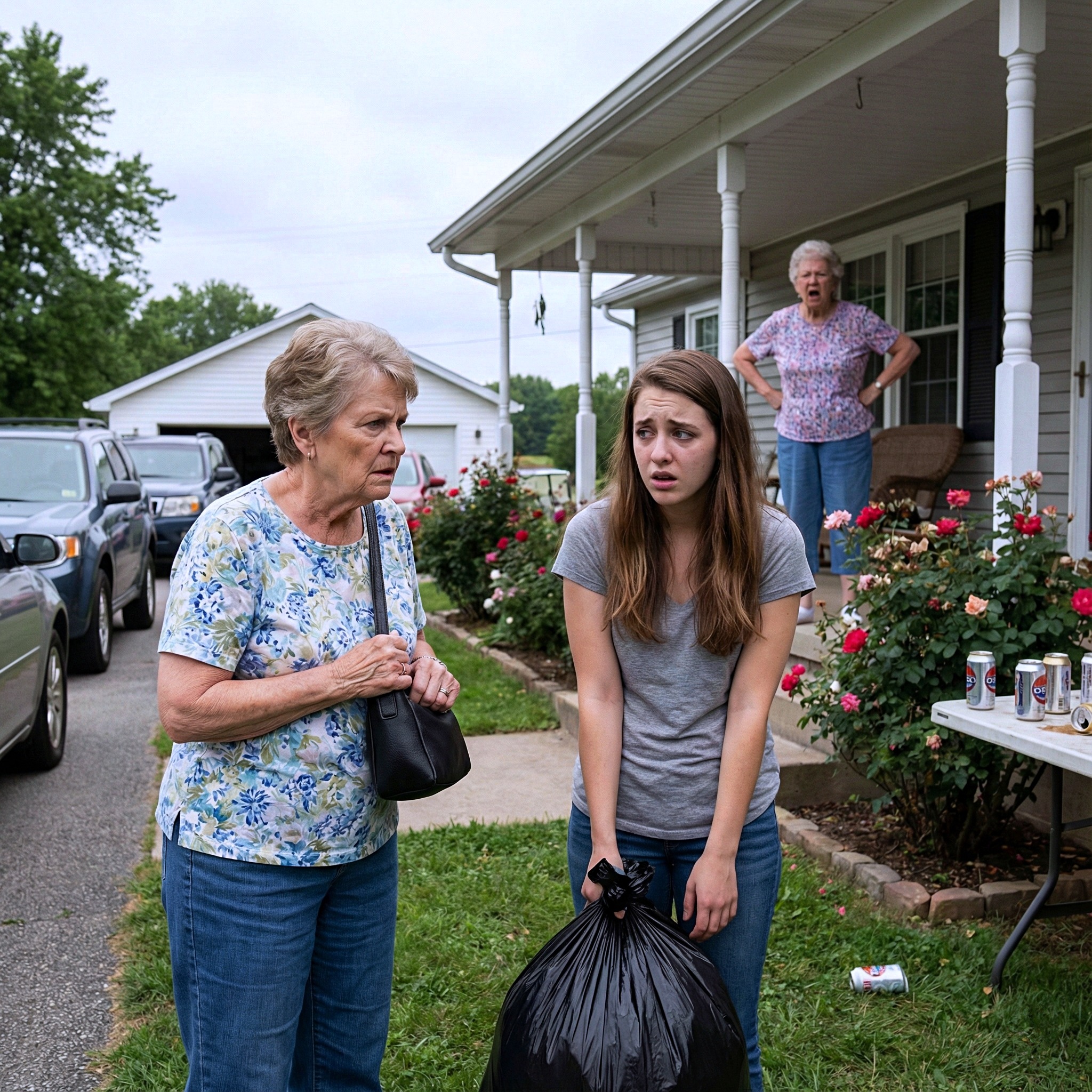
I recognized the woman immediately from photographs; it was Rosalind, Robert’s mother. She was flipping food in a skillet with an aggressive familiarity, acting as though she held the deed to the property and every stick of furniture within it. She didn’t deem me worthy of a glance. Ivy’s face flushed a deep crimson before draining to a ghostly white. Her lips parted, trembling as if she were on the verge of speaking, but silence won out.
“It is fine,” I said, my voice steady and low. It was the specific, unbreakable calm I had honed during years of teaching fifth grade when a dispute would erupt over school supplies. I placed the jar of jam on the counter with a deliberate clink. There was no thank you. A man I assumed to be one of Robert’s brothers brushed past me, a beer bottle in hand, ignoring my presence entirely. I took a step back into the hallway, my heart hammering a steady but deafening rhythm against my ribs.
I scanned the walls and realized the history of the house had been rewritten. The framed photos were different. There was only one small picture of Ivy and Robert remaining; the rest displayed children I didn’t know and a family tree I wasn’t part of. Ivy trailed after me, nervously wiping her damp hands on her jeans. “Sorry, Mama. They have been here a while.”
“How long is a while?” I asked, keeping my voice neutral. She didn’t answer, her gaze darting back toward the kitchen like a frightened animal.
My mind flashed back to six months ago, standing on this very porch, handing Ivy the legal papers as if I were handing her a lifeline. Back then, she and Robert had barely spoken in weeks. There had been long, suffocating silences and tension so thick it traveled through the telephone lines. I had told her that perhaps a new environment would help, a piece of earth that was truly hers.
“I don’t know, Mama,” she had hesitated. “What if the problems just follow us here?”
“They won’t,” I had promised her. “This is yours. You choose what it becomes.”
I had meant every word. The financial burden of the loan was mine, but the house—every floorboard, every window pane, every blade of grass—belonged to her. There were no strings attached, no shared titles. It was just Ivy. I wanted her to feel grounded, to remember the vibrant woman she was before the silence took over. But the reality of this visit shattered that memory.
The house had been colonized. Rosalind had appropriated the master bedroom, while Ivy was relegated to the living room couch, huddled under a throw blanket that was too short to cover her feet. Robert remained invisible behind closed doors, allowing his family to treat his wife like a servant in her own home.
The next morning, Ivy walked with me to the backyard shed. It used to be her sanctuary, a place for her canvases, jars of dried wildflowers, and color swatches taped to the timber. Today, the walls were stripped bare. Her drafting table was buried under a mountain of someone else’s dirty laundry.
“I haven’t painted in a while,” she murmured, her voice hollow.
She explained that Robert’s cousin had passed away unexpectedly, and his family claimed they needed space to grieve—just for a week, they had promised. That was over two months ago. First, folding cots appeared, then coolers, and finally, suitcases that were never unpacked. Rosalind had commandeered the kitchen, the bedrooms, and the very air Ivy breathed.
“Robert said it wouldn’t be long,” Ivy said as she pulled weeds with bare hands. I saw the blisters, fresh and raw, split open at the creases of her palms. When I told her she needed gloves, she whispered that Rosalind had tossed them, claiming they were moldy.
It was a slow, methodical erosion of her identity. That evening, I watched as Rosalind stood by the trash can, holding a mug painted with pale blue flowers that had a faint hairline crack along the handle. “That old thing,” she scoffed. “Ugly and chipped.” She dropped it into the bin. I said nothing, but the moment she turned her back, I retrieved it. I had given that mug to Ivy when she left for college. It was a piece of her history, now considered refuse by a woman who had no right to be there.
The silence in the house wasn’t just a lack of noise; it was a weapon. It was the sound of Ivy shrinking until she was nearly invisible. I sat in the guest room that night, staring at the folded deed in my suitcase. I realized that my gift of a “lifeline” had become a cage because Ivy was too polite to defend the boundaries of her own property.
The next morning, I slipped out before dawn. I drove into town and parked in front of the county office. “Property deed for 218 Larch Hill Road,” I told the clerk. “Owner name, Ivy Monroe.”
I returned to the farmhouse as it was waking up to its usual chaos. Rosalind was barking orders about breakfast, and the house was thick with the entitlement of people who had forgotten they were guests. I walked through the clutter, past the beer bottles and the laundry, until I reached the kitchen table. I laid the document down, smoothing the edges so the legal text was undeniable.
“Ivy owns this house,” I announced, my voice carrying the weight of an ultimate truth.
Rosalind spun around, a spatula in her hand like a scepter. “Excuse me?”
“This property is in my daughter’s name alone,” I said, looking her directly in the eye. “It is not Robert’s. It is not yours. And as of this moment, the ‘week’ you requested for grieving is officially over. You are guests in a home that does not belong to you, and you have overstayed your welcome.”
The room fell completely silent. Robert finally emerged from the bedroom, looking confused and defensive, but the paperwork on the table was a wall he couldn’t climb over. I looked at Ivy. For the first time in months, her shoulders straightened. She looked at the deed, then at the woman who had thrown away her favorite mug, and finally at me.
“Mama’s right,” Ivy said, her voice small but growing stronger with every word. “It’s time for everyone to pack.”
The dispute that followed was loud and ugly, but it was the sound of a house being reclaimed. I stood by my daughter as she watched her in-laws carry their suitcases to their cars. It wasn’t just about the land or the timber; it was about the sovereignty of her own life. As the last car pulled down the driveway, I handed Ivy the blue flowered mug I had rescued from the trash.
“I think we can fix the crack,” I said.
Ivy took the mug, her thumb tracing the blue petals. She didn’t smile yet, but the haunted look in her eyes had begun to fade. The silence that followed wasn’t heavy or suffocating anymore; it was the quiet of a fresh start, a piece of earth that was finally, truly hers.