Public Moments and Private Exchanges: Interpreting a Reported Comment at a Presidential Event
Introduction
Public appearances by presidential families often attract as much attention as the speeches themselves. From body language to facial expressions, every gesture is analyzed, discussed, and sometimes interpreted in ways that extend far beyond the original moment.

During a recent high-profile address in which the president spoke about themes of faith, leadership, and national renewal, cameras also captured members of his family seated nearby. Among them was Barron Trump, making one of his first major public appearances as a young adult.
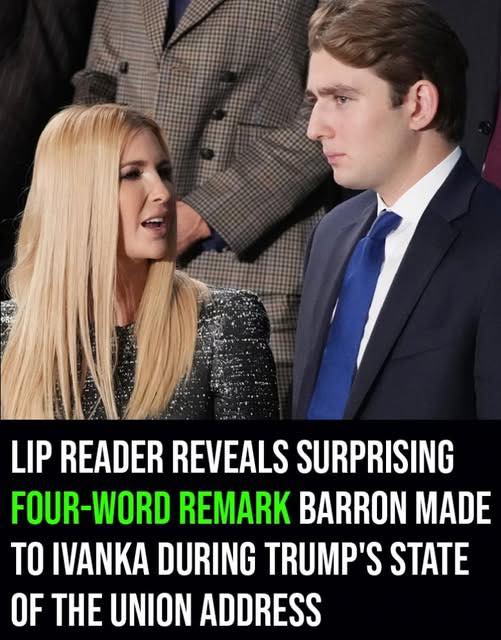
Shortly after the event, a media report citing a lip reader claimed that Barron made a brief, candid remark to his sister Ivanka Trump during the ceremony. The alleged comment—described as casual and understated—quickly drew attention online, sparking conversations about authenticity, family dynamics, and the experience of growing up in a political household.
This article examines the broader context of the moment, the nature of lip-reading claims, and what such episodes reveal about public life under intense scrutiny.
The Setting: A Carefully Staged Political Event
Presidential speeches are typically designed with deliberate precision. From the messaging in the address to the seating arrangement of family members, every element contributes to a visual narrative.
At this particular event, the president addressed themes of unity, faith, strength, and optimism for the nation’s future. Family members were seated in a prominent position, often visible in camera frames that alternated between the speaker and the audience.
Melania Trump was publicly praised during the remarks. Ivanka Trump appeared attentive and composed. Barron Trump, taller and older than in his previous public appearances as a child, sat alongside them, marking what many observers considered a transitional moment in his public presence.
For many viewers, the visual symbolism reinforced themes of continuity and family support. Yet it was a brief, unscripted interaction that captured headlines.
The Reported Exchange
According to a report that cited a professional lip reader, Ivanka Trump leaned toward her younger brother and asked a question that appeared to begin with, “What are you doing on…?”
The lip reader claimed that Barron responded with a short, informal remark suggesting uncertainty or reluctance. The reported wording, partially censored in media coverage, implied a tone of candid honesty rather than political messaging.
It is important to note that lip-reading interpretations are inherently subjective. Without audio confirmation, such analyses remain speculative. Even experienced lip readers acknowledge that context, camera angles, and facial positioning can affect interpretation accuracy.
Nevertheless, the alleged exchange resonated with many observers because of its perceived authenticity. In a room filled with prepared statements and polished presentations, the possibility of an offhand sibling comment felt human and relatable.
Growing Up in the Public Eye
Barron Trump has largely maintained a private profile compared to other members of his family. Since childhood, he has been photographed at official events but has rarely made public statements.
Being the child of a president presents unique challenges. Young people in such positions often navigate a complex mix of privilege, visibility, and expectation. Every movement can become a topic of discussion, and even fleeting expressions may be interpreted as meaningful signals.
Observers noted that Barron’s appearance as a young adult symbolized a transition. With adulthood comes greater autonomy but also increased scrutiny. The attention generated by the lip-reading report underscores how closely public audiences watch presidential families.
For many political families, maintaining personal boundaries while fulfilling ceremonial roles requires careful balance.
The Role of Media in Interpreting Private Moments
Modern political coverage extends far beyond policy analysis. In the age of high-definition broadcasting and social media, private interactions can become viral topics within minutes.
Lip reading, body language analysis, and speculative commentary have become common features of media cycles. While such content can add color to coverage, it also raises questions about privacy and interpretation accuracy.
Experts in communication caution that short, silent clips may lack sufficient context. A brief exchange between siblings could reflect countless possibilities—routine conversation, humor, logistical clarification, or simple distraction.
Without audio confirmation or direct comment from those involved, conclusions remain tentative.
Authenticity in an Era of Scripted Politics
Political events are often carefully choreographed. Speeches are rehearsed, camera angles planned, and messages refined to reinforce specific themes.
In such settings, unscripted moments tend to stand out. Whether a spontaneous smile, an unexpected reaction, or a whispered comment, these fragments of spontaneity can feel more relatable than formal statements.
The reported exchange between Barron and Ivanka was interpreted by some as an example of candid honesty. It suggested a contrast between the grand themes of the speech and the everyday perspective of a young adult navigating a formal setting.
Yet authenticity in public life is complex. Even when moments appear unscripted, their interpretation can be shaped by audience expectations and media framing.
The Challenges of Lip-Reading Analysis
Lip-reading has a legitimate role in certain professional contexts, such as assisting individuals with hearing impairments or supporting law enforcement investigations. However, its application in media commentary requires caution.
Several factors influence lip-reading accuracy:
-
Camera angle and clarity
-
Lighting conditions
-
Facial positioning
-
Presence of obstructing objects
-
Similar visual mouth shapes across different words
Without synchronized audio, even skilled lip readers may disagree on specific phrasing. For this reason, media outlets often describe such interpretations as “reported” or “alleged” rather than confirmed.
Audiences are encouraged to approach such claims thoughtfully and recognize the limits of visual-only analysis.
Public Perception and Youthful Relatability
One reason the reported remark gained traction is that it aligned with a familiar experience: young adults sometimes expressing uncertainty or mild exasperation in formal environments.
Political events can be lengthy and ceremonially structured. For someone not directly involved in policymaking, sitting through speeches may feel routine rather than historic.
If the reported interpretation is accurate, the comment may reflect a relatable sentiment rather than a political statement. That relatability likely contributed to its rapid spread online.
However, it also highlights the pressure faced by young adults in prominent families. A casual comment between siblings can quickly become a national talking point.
Family Dynamics Under Public Scrutiny
Families of political leaders often present a united image at official events. Yet, like any family, they experience ordinary interactions and conversations.
Sibling exchanges are typically private and informal. In this case, cameras happened to capture a brief moment that would ordinarily pass unnoticed.
Observers should consider how unusual it is for everyday familial interactions to receive widespread analysis. While public figures accept a degree of visibility, extended scrutiny of minor moments raises questions about reasonable boundaries.
Maintaining empathy in such situations helps preserve perspective.
Social Media Amplification
Once the lip-reading report surfaced, social media platforms amplified the discussion. Short video clips circulated alongside commentary and interpretations.
In digital spaces, context can be quickly compressed into headlines or captions. Nuance may be lost as users react to perceived meaning rather than confirmed fact.
This pattern reflects a broader trend in modern media: moments that are brief and ambiguous often gain disproportionate attention. Viral content thrives on interpretation, relatability, and debate.
The Importance of Responsible Reporting
Journalists and commentators have a responsibility to clarify when information is speculative. In this case, responsible reporting includes noting that the interpretation originated from a lip-reading analysis rather than direct audio evidence.
Clear labeling helps audiences distinguish between verified statements and informed guesses. Such transparency maintains credibility and prevents misunderstanding.
Readers, in turn, benefit from approaching such stories with balanced curiosity rather than immediate assumption.
Barron Trump’s Emerging Public Identity
As Barron Trump transitions into adulthood, his public presence may evolve. Unlike elected officials, children of political leaders do not choose public roles in the same way. Their visibility often results from family association rather than personal ambition.
Some presidential children later pursue independent careers outside politics. Others remain largely private. How Barron chooses to shape his own path remains to be seen.
What is clear is that increased public appearances will likely continue attracting attention—both supportive and critical.
Broader Reflections on Political Culture
This episode serves as a reminder of how political culture extends beyond policy debates. It encompasses symbolism, personal narratives, and the intersection of public duty with private life.
When audiences focus on small moments, it reflects a desire for authenticity in a highly managed environment. At the same time, it underscores the challenge of preserving normalcy within extraordinary circumstances.
Balancing transparency with respect for personal boundaries remains an ongoing conversation in media ethics.
Conclusion
A brief, reportedly candid remark between Barron Trump and Ivanka Trump during a presidential event sparked widespread discussion. While the interpretation originated from a lip-reading analysis and remains unverified by audio confirmation, it resonated with many observers due to its perceived authenticity.
The incident highlights the intense scrutiny faced by presidential families, the limits of lip-reading analysis, and the modern media environment’s tendency to amplify fleeting moments.
As political events continue to blend formal messaging with personal visibility, maintaining perspective is essential. Public figures—and especially their family members—exist at the intersection of public interest and private humanity. Recognizing that distinction allows for thoughtful engagement without overinterpretation.
Ultimately, the moment serves as a reminder that even in the most carefully staged settings, human interactions remain complex, nuanced, and open to interpretation.