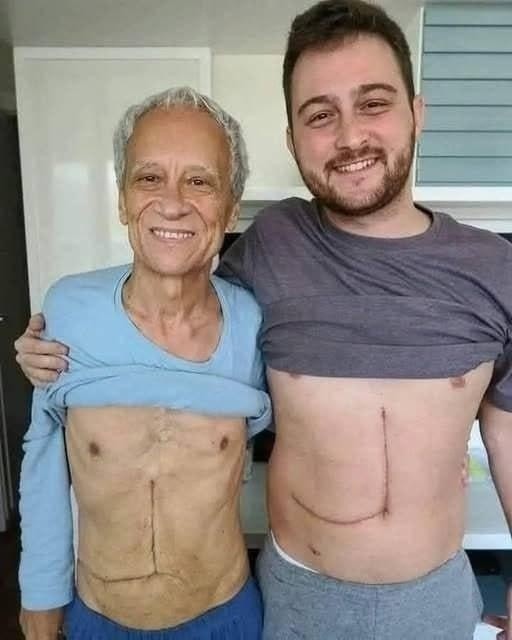
A Son’s Gift of Life: Understanding the Risks and Courage Behind Living Liver Donation
A Son’s Gift of Life: Understanding the Risks and Courage Behind Living Liver Donation
Introduction
Acts of sacrifice within families often demonstrate the depth of human compassion and love. Few examples illustrate this more clearly than living organ donation, where a person willingly undergoes major surgery to help save the life of someone they care about. These decisions are rarely simple, and they involve emotional, physical, and medical considerations.

In one deeply moving story that has drawn attention from many people, a devoted son chose to donate part of his liver to help his father, who was facing a serious liver disease. What began as a powerful example of family commitment and hope later became a difficult journey when unexpected health complications affected the donor.
The story highlights both the extraordinary generosity of living donors and the importance of understanding the medical risks that accompany such procedures. It also provides an opportunity to discuss how liver transplantation works, why donors are so important, and how medical professionals work to protect both recipients and donors throughout the process.
The Growing Importance of Living Organ Donation
Organ transplantation has become one of the most remarkable achievements in modern medicine. For patients with severe organ failure, receiving a transplant can offer a second chance at life.
However, there is a global shortage of organs available for transplant. Many patients spend years on waiting lists hoping that a compatible organ will become available. Because of this shortage, living organ donation has become increasingly important.
In living donation procedures, a healthy individual voluntarily donates an organ or part of an organ to someone in need. Common examples include kidney donation and partial liver donation.
The liver is unique among human organs because it has the ability to regenerate, meaning that both the donor’s remaining liver and the transplanted portion can grow back to functional size over time. This remarkable property makes living liver donation possible and has helped thousands of patients receive life-saving treatment.
A Family Facing a Difficult Decision
When a loved one becomes seriously ill, families often come together to explore every possible option for treatment. In this case, the father had been dealing with a worsening liver condition that significantly affected his health and daily life.
Medical specialists informed the family that a liver transplant could potentially offer the best chance for recovery. However, waiting for a deceased donor organ can sometimes take months or even years, depending on availability and compatibility.
After learning about his father’s condition and the available treatment options, the son reportedly stepped forward to volunteer as a living donor. Such decisions are not made lightly. Before any surgery is approved, potential donors undergo extensive testing to determine whether they are physically and psychologically suitable for the procedure.
These evaluations often include:
-
Blood compatibility testing
-
Imaging scans to examine liver structure
-
General health assessments
-
Psychological evaluations to ensure the decision is voluntary and informed
Only after passing these rigorous evaluations can a donor be approved for surgery.
The Complexity of Liver Transplant Surgery
Living liver donation is considered a highly complex medical procedure. Surgeons remove a portion of the donor’s liver and transplant it into the recipient. Over time, both portions grow and adapt to meet the body’s needs.
The process involves multiple teams of medical professionals, including transplant surgeons, anesthesiologists, nurses, and specialized coordinators. Careful planning is essential to ensure that both donor and recipient receive the best possible care.
Typically, the procedure involves:
-
Donor surgery, where a portion of the liver is removed.
-
Recipient surgery, where the donated portion is transplanted into the patient.
-
Post-operative monitoring, where both individuals are carefully observed during recovery.
Most donors remain in the hospital for several days to a week after surgery, followed by a recovery period that can last several weeks or months.
Early Signs of Success
According to people familiar with the situation, the transplant surgery initially appeared successful. Doctors were encouraged by early signs that the father’s body was accepting the new liver tissue.
Recovery after a transplant can be gradual, and patients are closely monitored for any signs of complications. Nevertheless, early positive indicators often bring relief and optimism to families who have been facing months or years of medical uncertainty.
For relatives and friends observing the situation, the son’s decision was widely praised as a profound example of devotion and courage. Many described his action as an expression of unconditional love for his father.
Stories like this often inspire broader conversations about the importance of organ donation and the impact that one individual’s decision can have on another person’s life.
When Unexpected Complications Arise
Despite the careful preparation and advanced medical care involved in transplant procedures, complications can sometimes occur. Surgery always carries risks, particularly when it involves major organs.
In the weeks following the operation, reports suggested that the son began experiencing serious health challenges related to the procedure. Medical teams continued to monitor and treat him as they worked to manage the complications.
Situations like this are extremely difficult for families. While the original goal of the transplant is to save a life, complications affecting the donor can create an emotional and medical crisis that requires immediate attention.
Doctors involved in transplant medicine emphasize that living donors are closely monitored and provided with extensive care to address any health issues that may develop during recovery.
Understanding the Risks of Living Liver Donation
While many living liver donors recover successfully and return to normal activities, the procedure is still a major surgery. As with any complex medical intervention, certain risks exist.
Potential complications can include:
-
Infection following surgery
-
Blood clotting issues
-
Bile duct complications
-
Temporary liver function problems
-
Extended recovery periods
Transplant centers work hard to minimize these risks by carefully screening donors and using advanced surgical techniques. Donor safety remains a top priority throughout the process.