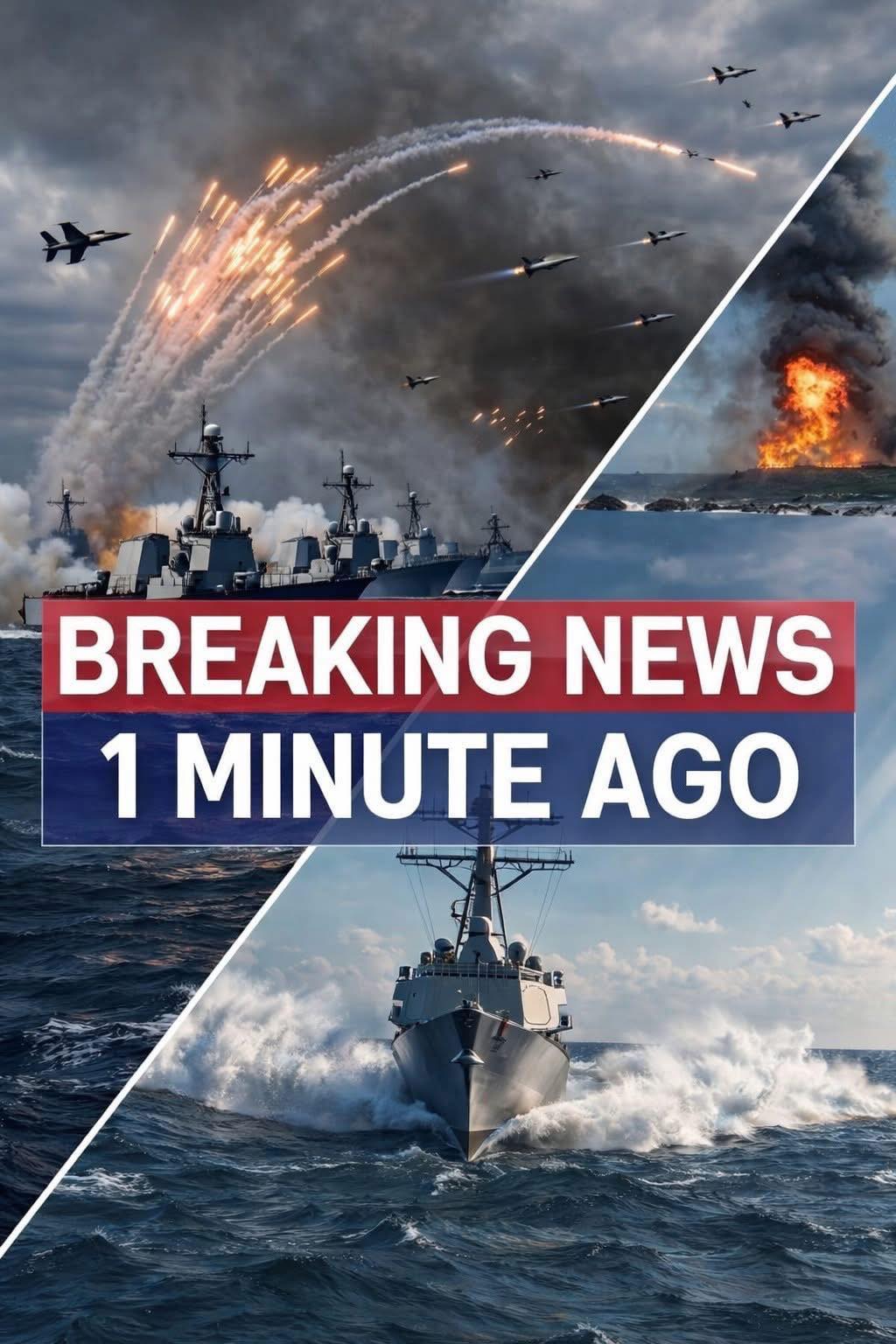
36 Missiles in 22 Minutes! Red Sea Clash Signals Dangerous Escalation in Middle East
The Red Sea, a narrow yet vital ribbon of water that has facilitated global commerce for millennia, has recently transformed into a theater of high-velocity kinetic warfare. In a harrowing confrontation that unfolded in March 2026, a U.S. Navy destroyer navigating these strategic waters faced a barrage of 36 missiles in a span of just 22 minutes. This engagement represents a significant escalation in the ongoing friction between Western naval forces and the Houthi movement, illustrating a shift from sporadic harassment to sophisticated, high-volume “saturation attacks” designed to test the absolute limits of modern maritime defense.

Military analysts define a saturation attack as a tactical maneuver where an adversary launches a massive quantity of munitions simultaneously or in rapid succession. The goal is not merely to hit the target, but to overwhelm the target’s Aegis Combat System—the complex integration of radar, computers, and missiles that serves as a shield for American warships. By flooding the airspace with 36 projectiles, the attackers aimed to create a “sensor overload,” forcing the ship’s defensive computers to prioritize targets in a split-second hierarchy of lethality. In this digital and physical chaos, the hope of the attacker is that even a single missile might slip through the “leaky” defense, dealing a catastrophic blow to a vessel worth billions of dollars.
The encounter was a masterclass in the terrifying speed of 21st-century naval combat. As the first wave of missiles appeared on the radar horizon, the destroyer’s crew was thrust into a battle where decisions are measured in milliseconds. The ship’s layered defense architecture immediately sprang into action. At the outermost layer, Standard Missiles (SM-2 or SM-6) were likely launched to intercept the threats at long range. As the remaining missiles closed the distance, the Evolved SeaSparrow Missiles (ESSM) would have taken over for medium-range engagement. Finally, for any projectile that breached those two perimeters, the Phalanx Close-In Weapon System (CIWS)—a radar-guided, rapid-fire gatling gun—would have served as the last line of defense, filling the air with a wall of tungsten armor-piercing bullets.
This 22-minute window was not a one-sided affair. Reports indicate that the U.S. response was as swift as the attack was aggressive. Within that same narrow timeframe, the destroyer and supporting assets allegedly initiated a series of rapid countermeasures. While the specific nature of these “retaliatory actions” remains classified or subject to conflicting accounts, the tactical objective in such scenarios is usually the “destruction of the archer rather than just the arrow.” This involves utilizing real-time sensor data to trace the missiles’ trajectories back to their launch points—often mobile coastal batteries or hidden inland sites—and neutralizing them before a second barrage can be organized.
The implications of this clash extend far beyond the immediate tactical outcome. The Red Sea is a critical artery for the global economy, acting as the primary gateway to the Suez Canal. Approximately 12% of total global trade, including vast quantities of oil and liquefied natural gas, passes through these waters. When a saturation attack of this magnitude occurs, it sends a shockwave through the global shipping industry. Insurance premiums for cargo vessels skyrocket, and major shipping lines are forced to consider the costly and time-consuming detour around the Cape of Good Hope. By demonstrating the ability to launch 36 missiles in a coordinated strike, the Houthi movement is signaling that it possesses the technical proficiency to effectively close a global chokepoint, regardless of the presence of advanced Western navies.
Furthermore, this incident underscores a dangerous evolution in the regional balance of power. The sheer volume of munitions used suggests a robust and resilient supply chain, raising questions about the continued proliferation of missile technology in the Middle East. It also highlights a strategic paradox: while the U.S. Navy’s defensive systems are incredibly effective, they are also expensive. Launching a multimillion-dollar interceptor missile to destroy a much cheaper, indigenously produced Houthi drone or cruise missile creates an “economic attrition” that is difficult to sustain over a long-term conflict.
From a geopolitical perspective, the 22-minute clash is a harbinger of a new era of “gray zone” warfare—conflicts that exist in the space between total war and uneasy peace. In this environment, localized skirmishes can escalate into regional catastrophes with little to no warning. The use of saturation attacks suggests a willingness to inflict high casualties and sink major capital ships, a threshold that was rarely crossed in previous decades of maritime tension. It forces NATO allies to rethink their force posture in the region, shifting from a mission of general presence and deterrence to one of active, high-intensity defense.
As the smoke clears over the Red Sea, the operational environment remains volatile. Independent confirmation of the total damage to hostile infrastructure is limited, as the fog of war in modern maritime conflicts is compounded by electronic warfare and information suppression. However, the message delivered by the 36 missiles is clear: the Red Sea is no longer a permissive environment for global trade. It is a contested zone where the margin for error is nonexistent.
In the coming months, the international community will likely face a difficult choice. Continued reliance on defensive escorting may prove insufficient if the volume of attacks continues to increase. The alternative—more aggressive, preemptive strikes on launch sites—carries the risk of a broader regional conflagration. As military planners review the data from those 22 minutes of chaos, they are forced to confront a reality where maritime security is no longer guaranteed by the size of a fleet, but by the speed of a processor and the replenishment rate of a missile magazine.
Ultimately, the Red Sea clash is a reminder that the ocean remains the world’s most significant strategic frontier. The ability to move goods and project power across the seas is the foundation of modern civilization. When 36 missiles can be fired in the time it takes to have a short lunch, the world is reminded that the distance between global stability and systemic collapse is sometimes only as wide as a narrow strait in the Middle East.