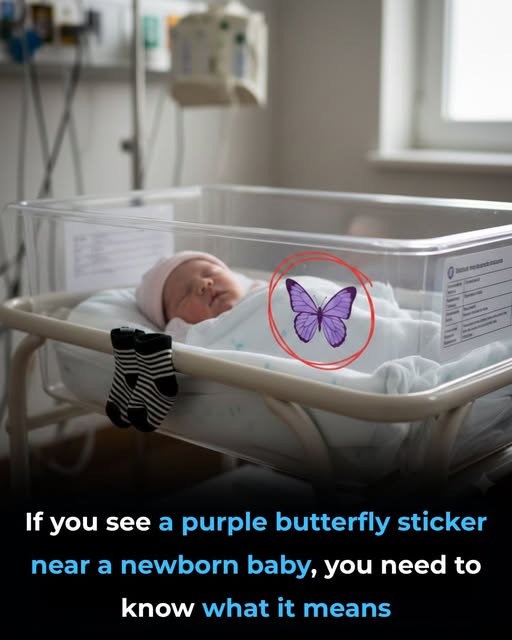
What a Purple Butterfly Sticker Near a Newborn Quietly Represents

In hospitals around the world, small symbols can carry deep meaning. One such symbol—the purple butterfly sticker placed near a newborn—may go unnoticed by many, yet for some families, it represents a powerful and emotional story.

The meaning behind this symbol began with a personal experience. A mother named Millie Smith, along with her partner Lewis Cann, was expecting twins. Like many parents, they were filled with excitement and anticipation, imagining a future with two children growing side by side. However, during a routine scan, they received difficult news: one of their babies had a serious medical condition and was unlikely to survive long after birth.


Despite the heartbreaking prognosis, they chose to continue the pregnancy and cherish every moment with both babies. They named their daughters Callie and Skye, ensuring that each child was recognized, loved, and included as part of their family story.

When the babies were born prematurely, both were alive, even if only briefly. Skye lived for a short time, giving her parents precious moments to hold her and say goodbye. Callie, meanwhile, required ongoing care in the neonatal intensive care unit.

During their time in the hospital, Millie experienced a moment that stayed with her. Another parent, unaware of her situation, made a casual comment about how fortunate she was not to have twins. While not intended to cause harm, the remark highlighted something important—how invisible certain kinds of grief can be.

This experience inspired a simple yet meaningful idea. Millie wanted a way to communicate, without words, that a baby in the neonatal unit was part of a multiple birth where one sibling had passed away. The goal was to help others understand, while sparing families from having to repeatedly explain a painful loss.

The result was the purple butterfly symbol.

Placed near a baby’s incubator, the sticker gently indicates that the child had a sibling who is no longer present. It allows medical staff and other parents to approach the situation with greater awareness and sensitivity.

Over time, this idea spread beyond a single hospital. Healthcare professionals recognized its value, and it has since been adopted in many neonatal units. What began as one family’s response to loss has become a quiet, universal signal of empathy.

Today, the purple butterfly stands as more than just a sticker. It represents compassion, awareness, and respect for experiences that are not always visible. For families who have faced this kind of loss, it offers a sense of recognition and understanding during an incredibly difficult time.

It also serves as a gentle reminder: behind every hospital crib or incubator, there may be a story that others cannot immediately see. Small gestures of awareness can make a meaningful difference, helping create an environment where all families feel supported.

In the end, the purple butterfly is a symbol of both remembrance and kindness—a way to honor lives that were brief, while supporting those who continue forward carrying both love and loss.

The impact of the purple butterfly symbol extends far beyond its small physical presence. In environments like neonatal intensive care units, where emotions run high and every moment feels significant, even the smallest details can shape how families experience their time there. For parents navigating both hope and grief, the presence of a simple symbol can provide a quiet sense of comfort and acknowledgment.

One of the most meaningful aspects of the purple butterfly is that it removes the pressure of explanation. In a hospital setting, parents often interact with many different people—nurses, doctors, specialists, and other families. Each new interaction can bring well-meaning questions, such as “Is this your first child?” or “Do you have other children?” For most people, these are harmless conversation starters. But for someone who has lost a baby, answering those questions can be emotionally exhausting.

The symbol helps bridge that gap. It gently informs others that there is more to the story, encouraging sensitivity without requiring the parent to revisit painful memories repeatedly. This can make a significant difference in preserving emotional energy during an already overwhelming time.

Healthcare professionals have also found the symbol valuable. In busy medical environments, staff rotate frequently, and it is not always possible for every caregiver to be fully aware of each family’s background. The purple butterfly acts as a visual cue, reminding staff to approach with extra care and understanding. It supports more compassionate communication, helping ensure that families are treated with the empathy they deserve.

Beyond its practical use, the symbol carries a deeper emotional significance. For many parents, one of the most difficult aspects of loss is the fear that their baby will be forgotten. When a child lives only briefly, there may be few outward signs of their existence. The purple butterfly helps counter that feeling. It acknowledges that the baby was here, that they mattered, and that they are still part of the family’s story.

This recognition can be incredibly meaningful. Grief is not only about loss—it is also about memory and connection. Having a visible sign that honors that connection can help parents feel less alone in their experience.

Over time, the idea behind the purple butterfly has inspired broader conversations about how society understands and responds to grief, especially in situations involving infants. Many people are unsure of what to say or how to act when someone experiences loss. As a result, they may avoid the topic altogether or unintentionally say something that feels dismissive.

The presence of the symbol encourages a different approach. It invites quiet awareness rather than forced conversation. It reminds people that sometimes the most supportive response is not to ask questions or offer advice, but simply to be gentle, patient, and respectful.

In addition to its use in hospitals, the story behind the purple butterfly has reached communities through awareness campaigns, support groups, and online platforms. Families who have gone through similar experiences often share their stories, helping others feel seen and understood. This sense of shared experience can be a powerful source of healing.

Support networks play a crucial role in helping families navigate life after loss. Whether through counseling, peer groups, or informal connections, having a space to talk openly about grief can make a meaningful difference. The purple butterfly has become one of many tools that contribute to these supportive environments, offering both recognition and connection.

It’s also important to recognize that grief does not follow a predictable timeline. For some parents, the loss remains as vivid years later as it was in the beginning. For others, it may gradually soften over time. There is no “right” way to process such an experience. Symbols like the purple butterfly respect that individuality by offering quiet acknowledgment without expectation.

For siblings who grow up after such a loss, the symbol can also play a role in understanding family history. Parents often find ways to talk about the baby who is no longer present, sharing their story in ways that are appropriate for the child’s age. This helps create a sense of continuity and inclusion, ensuring that the memory of the lost sibling remains part of the family’s identity.

In many cases, children raised with this awareness develop a deep sense of empathy. They learn early on that life can be complex, and that joy and sadness can exist together. This understanding can shape how they relate to others and how they approach difficult situations throughout their lives.

The broader message of the purple butterfly extends beyond any single family or hospital. It speaks to the importance of compassion in everyday interactions. Not all struggles are visible, and not all stories are immediately apparent. By approaching others with kindness and awareness, we create space for understanding, even when we don’t know the full picture.

In a fast-paced world, it can be easy to overlook small details. But sometimes, those details carry the most meaning. A small sticker, a quiet symbol, or a simple gesture can have a lasting impact on someone’s experience.

The story behind the purple butterfly also highlights how personal experiences can lead to meaningful change. What began as one family’s way of coping with loss has grown into a practice that supports countless others. It shows that even in difficult circumstances, it is possible to create something that brings comfort and understanding to others.

Today, hospitals that use the purple butterfly symbol are not just acknowledging loss—they are actively fostering a culture of empathy. They are recognizing that medical care is not only about physical treatment, but also about emotional support.

For families entering these environments, knowing that such awareness exists can be reassuring. It signals that their experiences will be respected and that they will be met with compassion during one of the most vulnerable times in their lives.

As awareness continues to grow, the hope is that more institutions will adopt similar practices, ensuring that no family feels unseen or misunderstood. Small changes can lead to significant improvements in how care is delivered and experienced.

Ultimately, the purple butterfly is a reminder of something deeply human: the need to be acknowledged, to be understood, and to have our experiences recognized. It reflects the idea that every life, no matter how brief, has meaning.

For those who know its significance, the symbol carries a quiet but powerful message. It speaks of love that continues beyond loss, of memories that remain, and of the importance of compassion in shared spaces.

And for anyone who encounters it, even without fully understanding its meaning, it serves as a gentle invitation—to pause, to be kind, and to remember that every person around us may be carrying a story we cannot see.

Similar Posts