My 12‑Year‑Old Built a Ramp So a Boy Could Play… Then a Neighbor Destroyed It—But Karma Arrived Faster Than She
It began as an ordinary afternoon until my son noticed something no one else had. By the next day, everything on our street had changed.

Ethan, my 12‑year‑old, is the kind of kid who refuses to walk past something that feels wrong—even when it isn’t his problem. Across the street lives Caleb, a quiet nine‑year‑old who spends most of his time on the porch in his wheelchair, watching the world as if it were a play he couldn’t join.
At first, I didn’t think much of it. Kids play where they can. But Ethan noticed.

One afternoon, while we were unloading groceries, Ethan looked across the street. Caleb sat there again, hands resting on his wheels, watching other kids ride bikes.
Ethan frowned. “Mom… why does Caleb never come down?”
I saw the sadness in Caleb’s face. “I don’t really know,” I said. “But we can go and find out later if you want.”
That seemed to lift Ethan’s spirits.
That evening, we walked over. For the first time, I saw the problem clearly. Four steep steps. No railing. No ramp. No way down.
We knocked, and Caleb’s mom, Renee, answered. She looked tired. “Hi, Miss Renee. I live across the road. We’re sorry to bother you, but is there a reason Caleb never comes outside to play?” I asked.
Renee gave a soft smile. “He would love to, but… we don’t have a way to get him down safely without carrying him up and down all the time.”
Ethan’s face fell.
“We’ve been trying to save for a ramp for over a year,” she explained. “It’s just… slow going. Insurance won’t cover it.”
I apologized, wished her the best, and we walked home in silence. But Ethan wasn’t finished.
That night, he didn’t touch his games or phone. Instead, he sat at the kitchen table with a pencil and paper, sketching. His dad—who had passed away three months earlier—had taught him how to build things. Birdhouses, shelves, bigger projects. Ethan loved it.
“What’re you doing?” I asked.
Without looking up, he said, “I think I can build a ramp.”
The next day after school, Ethan emptied his savings jar onto the table—coins, bills, everything.
“That’s for your new bicycle,” I reminded him.
“I know.”
“You sure about this?”
“He can’t even get off his porch, Mom.”
I didn’t argue after that.

We went to the hardware store. Ethan picked out wood, screws, sandpaper, and tools we didn’t already have. He asked questions, took notes, double‑checked measurements. He wasn’t playing around. He had a plan.
For three days, Ethan worked after school until dark. Measuring, cutting, adjusting angles, sanding. His hands were scraped, but when he stepped back on the third evening, he smiled.
“It’s not perfect, but it will work.”
I smiled proudly.
We carried it across the street. Renee came outside, confused, then froze when she realized what we were doing.
“You… you built this?” she asked.
Ethan nodded, suddenly shy.
We installed it together. Then Renee turned to Caleb. “Do you want to try?”
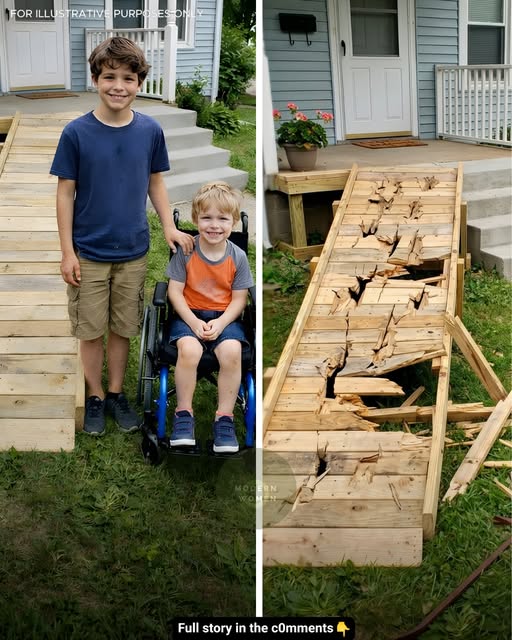
Caleb hesitated, then rolled forward. His wheels touched the ramp, and he rolled down onto the sidewalk—on his own—for the first time. The joy on his face was unforgettable.
Soon, neighborhood kids gathered. One asked if he wanted to race. Caleb laughed, finally belonging. Ethan stood beside me, quiet but proud.
The next morning, shouting woke me. I ran outside barefoot. Mrs. Harlow, a woman from down the street, stood in front of Caleb’s house, furious.
“This is an eyesore!” she snapped.
Before anyone could react, she grabbed a metal bar and swung. The ramp cracked. Caleb screamed. Ethan froze. Mrs. Harlow didn’t stop until the ramp collapsed.
“Fix your mess,” she said coldly, dropping the bar before walking away.
Silence fell. Caleb sat at the top of the steps again, watching—just like before.
Back inside, Ethan sat on his bed, staring at his hands. “I should’ve made it stronger,” he muttered.
I sat beside him. “No. You did something good. That’s what matters.”
“But it didn’t last.”
I had no answer.

The following morning, several black SUVs pulled up in front of Mrs. Harlow’s house. Men in suits stepped out. One knocked on her door. She looked surprised, then smiled as if expecting someone important.
The man spoke. Her smile faded. She began shaking.
“We need to discuss your application,” he said.
Application?
Mrs. Harlow stammered, “I… I think there’s been a mistake. We had dinner scheduled—”
“There’s no mistake,” the man cut in.
He pulled out a folder. “We’re here representing the Board of Directors of the Foundation for Global Kindness.”
I’d heard of them—an influential organization with nationwide programs.
Mrs. Harlow straightened. “Yes, of course. I’ve been in the final interview stages for the CEO position.”
“We know,” the man said. “You presented yourself as someone who values inclusion, compassion, and community.”
She nodded quickly. “Exactly. That’s why I—”
The man raised a hand. She stopped.
“Part of our final evaluation includes observing how candidates behave in their everyday environment. Not staged. Real.”
Her face tightened. “I don’t understand.”
He pulled out his phone, pressed play. The crack of wood. Caleb’s scream. Mrs. Harlow’s voice: “This is an eyesore!”
Her hand flew to her mouth. “No…”
“That footage was sent directly to the Founder last night,” he said.
Mrs. Harlow shook her head. “You don’t understand. I was just trying to… the neighborhood has standards—”
“Thought what?”
“You destroyed a wheelchair ramp built for a child,” another man said firmly. “We don’t want a CEO who destroys a child’s freedom to save her ‘view.’”
Mrs. Harlow trembled. “Please. I’ve worked for this. You can’t base everything on one misunderstanding—”
“It wasn’t a misunderstanding,” the older man said. “It was a choice. We are rescinding your offer, effective immediately.”
She stumbled back. “You can’t—” But her voice broke.

The men turned to leave, then paused. “There’s one more thing,” the first man said. He gestured toward the empty lot behind her property.
“We’ve been looking for a site for a new community project. We will be developing a Permanent Community Inclusion Park. Adaptive playground equipment, accessible pathways, and a permanent ramp system.”
Mrs. Harlow’s eyes widened. “No—”
“Yes,” he said simply.
Renee stepped forward. Mrs. Harlow glared. “You… you sent that video.”
Renee didn’t deny it. “You destroyed something my son needed. I showed the evidence to someone who could actually do something about it.”
The man nodded. “Is Ethan here? The boy who built the ramp?”
Ethan stepped forward. “I am here.”
“In your father’s honor, there will be a dedication. A permanent installation for his bravery as a firefighter. And a new ramp for Caleb.”
Tears filled my eyes. Ethan’s father had died fighting a blaze downtown. I never thought anyone would care that much.
Mrs. Harlow slid down against her door, pale and shaken. The men shook Renee’s hand, then left. Neighbors gathered in small groups, whispering.
I walked to Renee. “Did you really have a hand in this?”
She smiled. “I used to work for the Foundation years ago. I was the Executive Assistant to the Founder. A few weeks ago, I received an email by mistake—someone forwarded a candidate profile to my old address instead of his assistant’s. It was Mrs. Harlow’s application. They were planning a final home‑visit dinner today.”
“And the video…” I began.
“I still had the Founder’s private contact. When I saw what happened, I couldn’t ignore it. Not after what your son did.”
Her eyes flicked toward Ethan.
“Thank you,” I whispered.
“No, thank you,” she replied.
Caleb was still on the porch. But this time, he wasn’t just watching. He was smiling.
And for the first time since the ramp was destroyed, it felt like something better was already on its way.
Note: This story is a work of fiction inspired by real events. Names, characters, and details have been altered. Any resemblance is coincidental. The author and publisher disclaim accuracy, liability, and responsibility for interpretations or reliance. All images are for illustration purposes only.