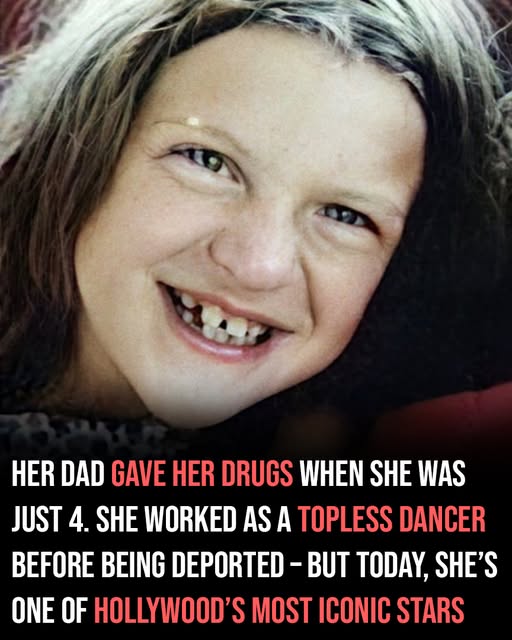
From a terrible a childhood to global fame! The rise of a rock legend
Some people are born into chaos, and the odds say they won’t make it out. But every once in a while, someone claws their way through the wreckage and ends up becoming a global icon. Courtney Love is one of those rare cases — a woman who went from a scattered, traumatic childhood to shaping the sound and attitude of an entire generation.
Her story begins long before she found a microphone. Born on July 9, 1964, in San Francisco, her life was rooted in music and eccentricity from the start. Her mother was a psychotherapist; her father managed the Grateful Dead. Her godfather was Phil Lesh, the band’s legendary bassist. Even her name had literary origins, taken from a character in a 1950s novel. Her family tree blended Cuban, Irish, English, German, and Jewish heritage, sprinkled with novelists and screenwriters — a background that set the stage for her uniquely turbulent trajectory.
Her parents met at a Dizzy Gillespie party. You can’t get more offbeat than that. But what followed was far less whimsical. After her parents separated, Love’s childhood dissolved into instability and danger. Disturbing allegations later surfaced that her father exposed her to drugs at three or four years old. She spoke openly as an adult about being given substances as a toddler — memories she couldn’t fully recall but knew were part of her early exposure to neglect.
Her mother later said, “Her childhood was horrible. It was tragic. I couldn’t protect her from any of it.” And you can see why. Love was shuttled back and forth between the U.S. and New Zealand, bouncing between parental figures and unstable environments. At age nine, a psychologist noted signs of autism and sensory defensiveness. “I was diagnosed autistic,” she said in 1995. “I would not speak.”
Therapy dominated her early years. “I began seeing psychiatrists at like age three,” she once said. “Observational therapy. TM for tots. You name it, I’ve been there.”
But even in the middle of the chaos, there were flashes of brilliance. Her mother described a child bursting with imagination — constantly acting, storytelling, writing plays. Love herself admitted she wanted to be both an actress and a rock musician long before she was old enough to understand either industry.
The chaos kept coming. In 1973, her mother uprooted the family and moved to New Zealand for a “back-to-the-land” life on a sheep farm, splitting Love from her stepfather in Oregon. Love hated it. She was eventually expelled from school, then sent back to the U.S. Her behavior spiraled, and by fourteen she ended up in a juvenile correctional facility — reportedly after shoplifting.
Oddly enough, that confinement exposed her to the music that would change her life. Patti Smith. The Runaways. The Pretenders. A spark lit inside her that never went out.
The late ’70s and early ’80s were a revolving door of foster care, instability, and reinvention. She gained legal emancipation at fifteen. Afterward, she severed ties with her mother. For a while, she worked as a topless dancer in Japan before being deported. Back in the States, she DJ’d in clubs, danced, hustled, and adopted a new surname — Love — to symbolically bury the past she was desperate to escape.
She had no social skills, no safety net, and no roadmap. But she had an electric, relentless drive to create.
Her first major break came through acting. She landed small roles in Alex Cox’s Sid and Nancy (1986) and Straight to Hell (1987). Her performances didn’t launch her career immediately, but they planted her firmly in the underground art and punk scenes of the time.
Then in 1989, everything shifted. Love co-founded Hole with guitarist Eric Erlandson, stepping into the role of lead vocalist and rhythm guitarist. Their ferocious stage presence, unapologetic lyrics, and raw aesthetic captured critics’ attention. The band’s early releases earned praise from alternative press outlets and growing respect in the grunge-era underground.
But nothing — absolutely nothing — thrust Love into the spotlight like her relationship with Kurt Cobain.
The two married in 1992, forming one of the most infamous couples of that decade. She would later tell Sassy magazine she had pursued him deliberately: “I really pursued him. Not too aggressive, but aggressive enough. I’m direct. That can scare a lot of boys.” She added that Cobain initially admitted he didn’t have the energy to “deal with her,” but she knew their connection was inevitable.
With Cobain, Love became a household name — a lightning rod in the middle of a cultural explosion. But that fame came with a brutal price. When Cobain died in 1994, the tragedy eclipsed her musical achievements and marked a devastating turning point in her life.
After his death, Love retreated from the public eye. Cobain’s ashes were divided — some placed in a teddy bear, some in an urn. She traveled to a Buddhist monastery in Ithaca, New York, where monks performed a ceremonial blessing, one of many attempts to find peace in the aftermath.
Then, in 1995, she made a stunning artistic comeback. Her performance in Miloš Forman’s The People vs. Larry Flynt earned her a Golden Globe nomination, proving she wasn’t just a rock star — she could act, and she could do it exceptionally well. Around this time, she began dating her co-star Edward Norton, and the relationship lasted several years.
Hole’s third album, Celebrity Skin, pushed the band to new heights, snagging three Grammy nominations and cementing its place in rock history. Love continued balancing film and music throughout the early 2000s, appearing in Man on the Moon and Trapped before releasing her first solo album, America’s Sweetheart, in 2004.
But the chaos of her early life resurfaced. Legal troubles, lawsuits, and a relapse led to a court-ordered rehab stay in 2005. Still, she kept creating. Between 2014 and 2015, she released new singles, returned to television in Sons of Anarchy and Empire, and co-created the manga series Princess A. She also completed Dirty Blonde, a memoir that offered a brutally honest look at her chaotic life.
In 2022, she announced that her long-awaited memoir, The Girl with the Most Cake, was finally finished after nearly a decade of work.
Love never remarried after Cobain’s death, though she’s spoken openly about honoring his memory through the years. She and Cobain share one daughter, Frances Bean, born in 1992. Over the years, Love had short relationships, including one with director Nicholas Jarecki in 2015.
In 2024, she surprised fans by expressing admiration — and even a “mad crush” — on Kendrick Lamar, saying she’d love to collaborate with him and calling him a genius. Later, she told the Daily Mail she’s currently in a “friends with benefits” relationship, hinting that she’s no longer interested in traditional labels.
Courtney Love’s life could have easily ended in obscurity, addiction, homelessness, or tragedy — the fate of many children who endure what she survived. Instead, she became one of the most iconic, polarizing, and influential artists of her generation.
Her journey from juvenile detention centers to global fame is messy, flawed, and undeniably powerful. She’s proof that surviving chaos doesn’t just shape you — sometimes it turns you into a legend.