I Saved a Hungry Newborn Left Next to His Collapsed Mom — Years Later, He Gave Me a Medal in Front of Everyone
The call came in at 2:17 a.m., and I expected it to be another routine welfare check in a building I already knew too well. I had no way of knowing that opening that cold apartment door and hearing a baby cry with everything he had left would quietly change the course of my life for the next sixteen years.
My name is Everett. I’m forty-eight now, but that night I was thirty-two and still carrying grief everywhere I went. Two years earlier, I had lost my wife and infant daughter in a house fire. It was the kind of loss that doesn’t fade or soften. It empties you and leaves you moving through the world on instinct alone.
I believed I had already faced the worst life could offer. That belief didn’t last long.
My partner and I arrived at a run-down apartment building on Seventh Street. The stairwell was cold and damp, and cutting through the silence was the sound of a baby crying—raw, desperate, and unrelenting. It was the kind of cry that tells you something is very wrong.
The door on the third floor was partly open. Inside, a woman lay barely conscious on a thin mattress, clearly exhausted and unwell. In the corner of the room, on the bare floor, was a baby boy no more than a few months old. He wore only a soaked diaper, his tiny body trembling from the cold, his face red from crying until his voice was nearly gone.
I didn’t stop to think. I took off my jacket, lifted him up, and held him against my chest. He was freezing and far too light. The moment his small hand curled into my shirt, something inside me broke open—something I thought had been gone forever.
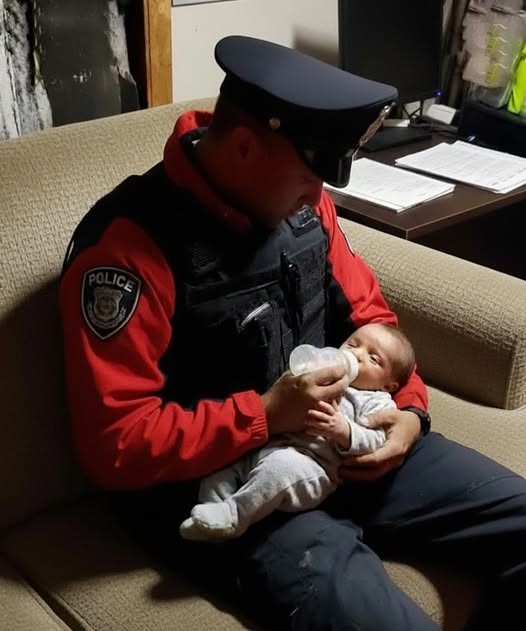
I whispered to him that he was safe now, even as my voice shook. I found a bottle nearby and fed him the way I remembered feeding my own child years before. He drank eagerly, clinging to my fingers as if afraid I might disappear.
Paramedics arrived for the mother, and social services was called for the baby. They explained he would need emergency foster placement. I looked down at him, finally asleep against me, trusting in a way that felt overwhelming.
I told them I would stay until help arrived. I never left.
Within a week, I began the adoption process. There were months of paperwork, interviews, and home visits, but every time I held that child, the answer felt inevitable. I named him Beau. He became my son.
Raising him wasn’t easy. I still worked long shifts and still carried memories that surfaced at night. I had help during the hours I couldn’t be there, but every evening when Beau ran toward me smiling, the heaviness I carried loosened its grip a little more.
He grew into a curious, fearless kid who believed the world could be kind because someone had shown him kindness first. When he discovered gymnastics, it became his passion, and watching him grow stronger and more confident became the highlight of my life.
Sixteen years passed in a blur of milestones, scraped knees, competitions, and quiet moments together. Then one afternoon, my phone rang.
The voice on the other end asked if I was the officer who had responded to a call on Seventh Street sixteen years earlier. She introduced herself as Ophelia, Beau’s biological mother.
She told me she had survived, rebuilt her life slowly and deliberately, and watched her son from a distance as he grew. She said she never stopped loving him, but she wanted to become someone stable and worthy before asking to be part of his life again.
When she came to the house, she looked nervous but strong. Beau listened as she explained everything—her fear, her struggle, her hope that he might one day understand.
When she finished, Beau looked at me, then back at her, and told her he forgave her. He made it clear that I was his father and always would be, but that he was willing to let her into his life too.
She accepted that with gratitude and tears.
Not long after, at a school awards ceremony, Beau was called up for a special recognition. Instead of keeping the moment for himself, he spoke about the night his life changed and the man who chose to raise him.
He called me up to the stage and placed the medal around my neck as the room filled with applause. I could barely see through the tears.
Later that night, he hugged me and told me that everything good in his life began the moment I picked him up and refused to let go.
Some calls are just part of the job. Others quietly shape your entire life.
That freezing night, I thought I was answering a routine request. Instead, I answered the call that gave me my family back, one small, trusting grip at a time.