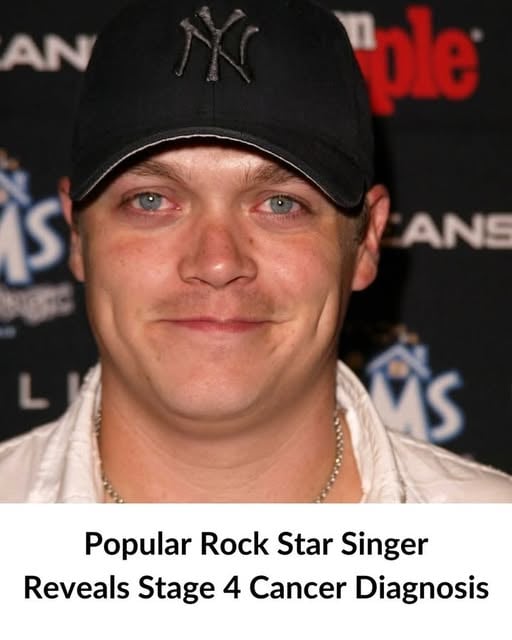
Popular Rock Band Singer Reveals Stage 4 Cancer Diagnosis!
The resonance of a gravelly voice and the driving rhythm of a post-grunge anthem have defined the career of Brad Arnold for over two decades. As the frontman of 3 Doors Down, his lyrics often touched on themes of isolation, resilience, and the search for a “Kryptonite” to fend off the world’s pressures. However, in a stunning turn of events that has left the music industry and fans alike in a state of suspended disbelief, Arnold recently delivered a message that no melody could soften. With a voice that betrayed a rare, human tremor, he announced a diagnosis of Stage 4 clear cell renal carcinoma—a form of kidney cancer that has already advanced to his lungs.
The announcement acted as a sudden, jarring chord that brought the band’s scheduled tour to an immediate halt. For fans who had already purchased tickets and marked their calendars for nights of shared nostalgia, the news was a visceral shock. The bright lights of the stage were replaced by the clinical, sterile glow of oncology wards, and the setlist was swapped for a terrifying new vocabulary of scans, biopsies, and systemic therapies. Yet, in the face of a diagnosis that traditionally invites despair, Brad Arnold’s response has been nothing short of transcendent. He looked into the lens of his camera and declared that, despite the shadow looming over his health, he felt no fear.
To understand the weight of this moment, one must understand the specific medical challenge Arnold now faces. Clear cell renal carcinoma is the most common form of kidney cancer, but when it reaches Stage 4, it means the primary tumor has moved beyond the original organ to distant sites—in this case, the lungs. This diagnosis represents an uphill climb against a formidable biological adversary. However, the narrative Arnold is crafting is not one of a victim succumbing to an inevitable tide, but of a man leaning into the bedrock of his faith and the strength of his spirit.
Speaking with a transparency that has made him more relatable than ever, Arnold explained that his calm is not a product of denial, but of a deep, spiritual anchoring. He described a sense of being “held” by a power greater than himself, insisting that while his body may be under siege, his soul remains untouchable. This vulnerability has stripped away the rock-star persona, revealing the man beneath the music. For twenty years, he was the voice that helped fans through their own dark nights; now, those fans find themselves in a collective vigil, hoping to reflect that same light back toward him.
The cancellation of the tour, while a logistical necessity, serves as a poignant metaphor for the fragility of the “show.” In the entertainment world, there is an unspoken rule that the performance must go on at all costs. By stepping away, Arnold has reminded his audience that there are battles more significant than the maintenance of a public image. The spotlight, which once followed his movements across arenas, has now shifted focus to a private arena where the stakes are existential. This fight is no longer measured in ticket sales, radio airplay, or chart positions; it is measured in the quiet victories of a successful treatment session, a day of diminished pain, and the enduring power of hope.
The medical community often speaks of the “long reach” of Stage 4 diagnoses, focusing on the rigorous toll of immunotherapy and targeted treatments. Yet, there is a growing recognition of the role that mental and spiritual fortitude plays in the clinical journey. Arnold’s openness about his lack of fear is a psychological masterclass in resilience. By refusing to let fear write the next verse of his story, he is actively reclaiming agency over his life. He is showing his followers that while we cannot always control the cards we are dealt, we have absolute authority over how we play the hand.Image of the human renal system and lungs
Shutterstock
As the band enters an indefinite hiatus, the silence from the stage is filled by a digital roar of support. From social media tributes to prayer chains, the global community has rallied around the man who gave them “Here Without You.” This outpouring of love is a testament to the emotional currency Arnold has built over his career. His songs were never just about catchy hooks; they were about the human condition, about being “away from the sun” and finding a way back to the light. Now, he is living out the very themes he once sang about, proving that the strength he projected in his music was not just an act, but a core component of his identity.
The road ahead for Brad Arnold will undoubtedly be difficult. Stage 4 cancer requires a level of physical and emotional endurance that is hard to fathom for those who have not walked that path. It involves a fundamental restructuring of one’s life, where the pursuit of health becomes a full-time occupation. Yet, the narrative coming out of the Arnold camp is one of “calm in the storm.” His family and close friends have echoed his sentiments, describing a household that is focused on the present moment and the “small miracles” that occur when a community stands together.
In many ways, Arnold’s journey is becoming a beacon for others facing similar diagnoses. In a culture that often treats cancer as a “battle” to be won through sheer aggression, his approach of peaceful surrender to faith offers a different, perhaps more sustainable, model of coping. He is demonstrating that it is possible to be realistic about the severity of a situation without being consumed by the terror of it. He is teaching his fans that strength is not the absence of weakness, but the ability to remain anchored when the ground beneath you begins to shift.
The future of 3 Doors Down remains an open question, but in the grander scheme of Arnold’s life, the music is currently a secondary concern. The priority is the man, the husband, and the friend. As he navigates the complexities of renal carcinoma, he does so with the knowledge that he is not fighting in a vacuum. He is surrounded by a global family that is holding its breath, waiting for the day when he can step back into the light—not necessarily to sing, but simply to be.
Until that day, the music he has already given the world continues to play, taking on new and deeper meanings. Lines about being a “Superman” or needing a “Kryptonite” now resonate with the weight of real-world struggle. Brad Arnold has shown the world that he may not be a man of steel, but he is a man of incredible, unshakable spirit. The tour may be canceled, and the future may be blurred, but the story of Brad Arnold is far from over. It is merely entering a more profound, more significant chapter—one where hope is the melody and faith is the rhythm that keeps him moving forward.