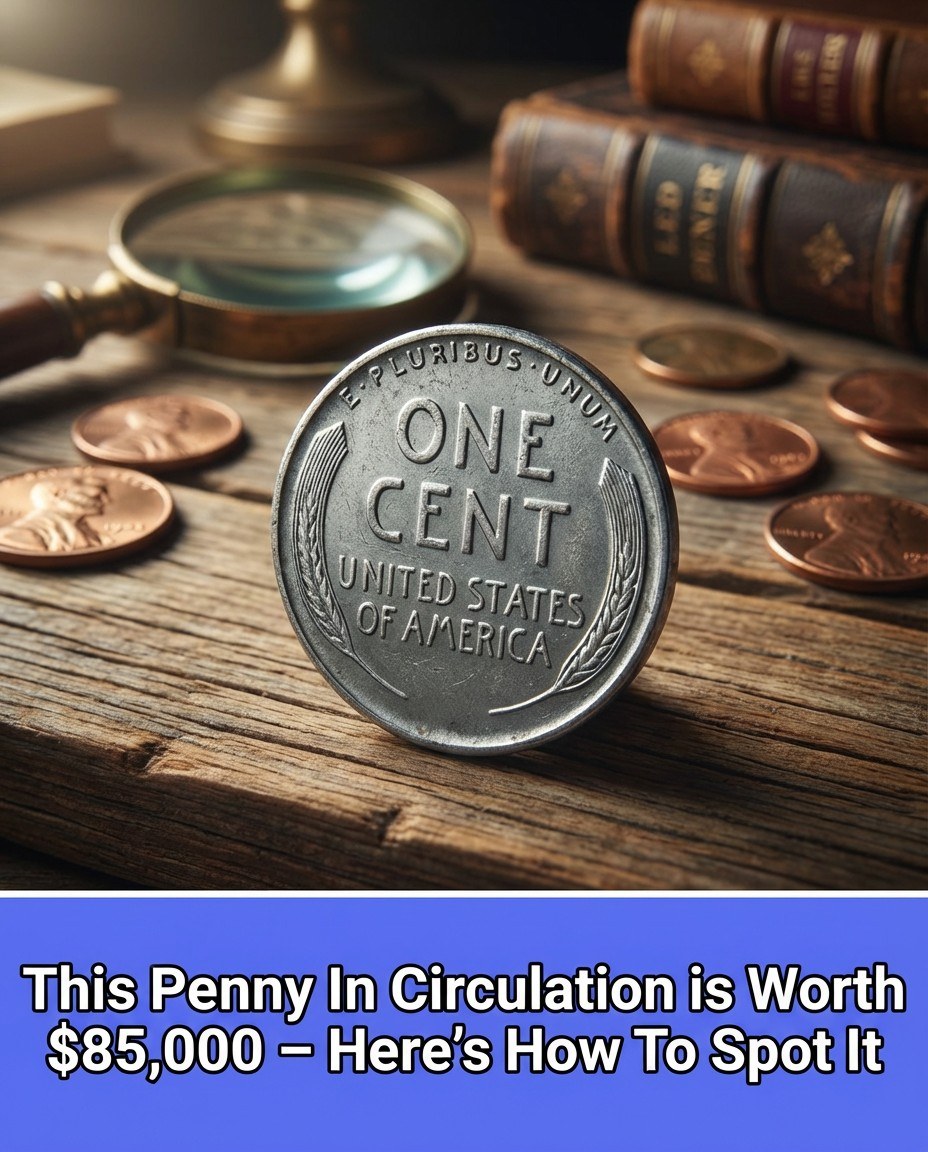
You Could Have a Penny Worth a Fortune—Here’s How to Identify It
In the frantic exchange of daily commerce, the humble penny is often treated as little more than a nuisance—a low-value relic that jangles in pockets or gathers dust in forgotten jars. Most people rarely spare a glance for the copper-hued discs, assuming their worth is fixed at exactly one cent. Yet, for the seasoned numismatist, a single, unassuming penny can represent a life-changing windfall, potentially commanding a price tag upwards of tens of thousands of dollars. At the center of this hobby’s most enduring legend sits the 1943 copper penny. This coin, never intended for public hands, stands as a premier example of how a manufacturing oversight can transform a common object into one of the most coveted artifacts in American history.
A Nation at War: The Origin of the “Steelie”
To appreciate the rarity of this coin, one must look back to the logistical pressures of the early 1940s. With the United States fully embroiled in World War II, every ounce of strategic metal was earmarked for the front lines. Copper was a critical resource, essential for the production of shell casings, electrical wiring, and radio equipment.
In 1943, the U.S. government made a radical pivot to conserve the red metal. The U.S. Mint transitioned the penny’s composition from its traditional 95% copper blend to a zinc-coated steel. These “steelies” possessed a distinct, silvery-gray luster, making them easily distinguishable from their predecessors. Intended as a temporary wartime measure, these magnetic coins became the standard for the year.
The Million-Dollar Mistake
The legend of the 1943 copper penny was born from an accidental overlap in production. A handful of copper “planchets”—the blank metal discs fed into coin presses—from the 1942 production cycle remained lodged in the minting machinery. When the presses began striking the 1943 steel design, these stray copper blanks were caught in the mix.
These “error” coins slipped past quality control and entered general circulation unnoticed, mingling with millions of steel pennies. Today, experts estimate that fewer than two dozen authentic 1943 copper pennies exist. This extreme scarcity has turned the hunt for the coin into the ultimate “needle in a haystack” scenario for collectors.
Market Value: From Pocket Change to Real Estate
The valuation of these coins is staggering. Even a worn, circulated example can command tens of thousands of dollars, with high-grade specimens often exceeding $80,000. In one of the most famous private transactions in 2010, a 1943-D copper penny (struck at the Denver Mint) sold for a record-breaking $1.7 million.
Collectors are not merely paying for the weight of the metal; they are investing in a tangible piece of wartime Americana. The price reflects the intersection of rarity, historical narrative, and the sheer thrill of owning a “major mint error” that survived the chaos of the 1940s.
The Home Inspection: Is Your Penny Genuine?
Given the value involved, the market is rife with counterfeits—often steel pennies that have been copper-plated to deceive the unwary. If you find a 1943 penny that looks copper, numismatists recommend four key tests:
-
The Magnet Test: This is the most vital step. Genuine copper is non-magnetic. If the coin sticks to a magnet, it is either a standard steel penny or a copper-plated fraud.
-
Date Verification: The date must clearly read 1943.
-
Visual Appraisal: A genuine error will have the warm, reddish-brown hue of a traditional penny, though it will often show signs of age-appropriate patina.
-
Design Features: The coin must feature the “Wheat Ear” reverse design, which was the standard until 1958.
Even if a coin passes these initial checks, professional authentication is mandatory. Experts utilize microscopic analysis and X-ray fluorescence to confirm the metallic composition and rule out sophisticated alterations.
Why the Value Endures
The 1943 copper penny remains the “Holy Grail” of American pocket change for several reasons:
-
Historical Context: It is a direct link to the wartime economy and the sacrifices made by the domestic front.
-
The Error Status: “Off-metal” strikes are highly prized in the numismatic world as they represent a failure of an otherwise rigid industrial process.
-
The “Find” Factor: The idea that a life-changing treasure could still be sitting in a grandfather’s cigar box keeps the public’s imagination fired.
The Professional’s Take: Tips for the Casual Finder
For those inspired to sift through their spare change, experts suggest a few rules of thumb. First, never clean a coin. Using chemicals or abrasives to “shine up” an old penny can instantly strip away 90% of its market value. Second, store potential finds in acid-free holders to prevent environmental damage.
The story of the 1943 copper penny serves as a profound reminder that history and value are often hidden in plain sight. It underscores the core appeal of numismatics: the ability to hold a piece of the past in the palm of your hand and the hope that, with a little curiosity, the mundane might just become extraordinary.