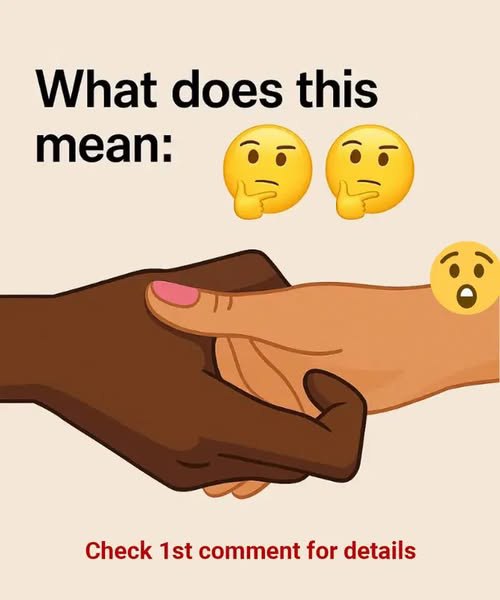
What It Really Means When a Man Scratches Your Palm — And How to Respond With Confidence
In the intricate world of human interaction, body language often serves as the lead investigator, revealing truths that spoken words might attempt to obscure. Most of us are familiar with the standard cues—the lingering eye contact, the slight lean toward a conversation partner—but occasionally, a gesture occurs that is so specific and unexpected it demands a closer look. One such gesture is the light scratching of the palm. To the uninitiated, it might seem like a fleeting, perhaps accidental movement. However, in the nuanced vocabulary of subtle romantic cues and cross-cultural flirtation, this small act can carry a profound subtext. For the modern woman—particularly those who have cultivated the wisdom to trust their instincts—understanding the intent behind such a gesture is essential for maintaining control over one’s personal boundaries. Whether you are navigating the complexities of new dating, re-entering the social sphere after a long absence, or simply engaging in a friendly exchange, the ability to read and respond to physical cues is a vital tool for staying true to oneself.
A Quiet Signal of Interest?
When a man scratches the palm of a woman’s hand, it is rarely a random occurrence. In several cultural contexts—stretching from the American South to the Mediterranean and Latin America—this specific movement during a handshake or a shared moment is often a covert way of signaling sexual interest. This is not to be confused with a standard firm handshake or a supportive touch on the arm. A palm scratch is inherently intimate and personal. It is a “quiet” signal, and as a self-assured woman, the way you choose to interpret and respond to it sets the trajectory for the entire interaction.
The Response: If the Spark is Mutual
If you find yourself in a situation where the chemistry is evident—perhaps over a long dinner or a walk—and this gesture occurs, it may be a welcome development. Here is how to navigate that interest with confidence:
-
The Non-Verbal Return: A soft smile or sustained eye contact can serve as a “green light,” signaling that the gesture was received and appreciated without the need for an immediate explanation.
-
Mirroring the Touch: Lightly brushing or touching his hand in return is a sophisticated way of communicating mutual interest.
-
The Playful Inquiry: Using humor allows you to address the gesture directly while keeping the mood light. Questions like, “Now, what was that about?” or “Are you trying to tell me something?” force him to own the gesture while maintaining your position of power.
-
Deepening the Connection: If you are comfortable, use the moment to invite further closeness, allowing your actions to reflect your curiosity.
The Boundary: If the Gesture is Unwelcome
It is a fundamental truth of social interaction: your comfort is the priority. No gesture, regardless of its cultural history or subtle execution, constitutes permission to invade your personal space. If a palm scratch feels intrusive, forward, or simply “off,” your instincts are your most reliable guide.
-
The Immediate Withdrawal: Removing your hand instantly is a clear, non-negotiable message. It requires no apology and no explanation.
-
Direct Communication: Clarity is often the best defense. A simple, “Please don’t do that,” or “That made me uncomfortable,” establishes a firm boundary.
-
The Energy Shift: Do not feel obligated to maintain the conversation for the sake of politeness. Changing the subject or physically moving away are appropriate responses to a breach of comfort.
-
The Right of Refusal: You owe no one—friend or stranger—the tolerance of behavior that feels inappropriate.
Navigating the “Gray Area”
In some instances, you may not be offended, but you may be confused. When a gesture falls into a gray area, seek clarity through direct observation. Ask calmly: “Why did you do that?” Then, “read the room.” Does his subsequent body language match the gesture? Is he respectful, or does he seem smug? In these moments, your gut feeling—honed by decades of life experience—will tell you whether to lean in or walk away.
Reclaiming Your Voice
For many women, especially those in the prime of their lives, this stage is defined by reclaiming time, joy, and voice. After years of caring for others, you are the sole arbiter of what feels right in your personal space. If a suggestive gesture is charming and welcomed, embrace the moment. But if it feels like a lack of respect, speak up. Real connection—the kind worth pursuing—is never built solely on charm; it is built on a foundation of mutual respect. You have earned the right to expect nothing less.