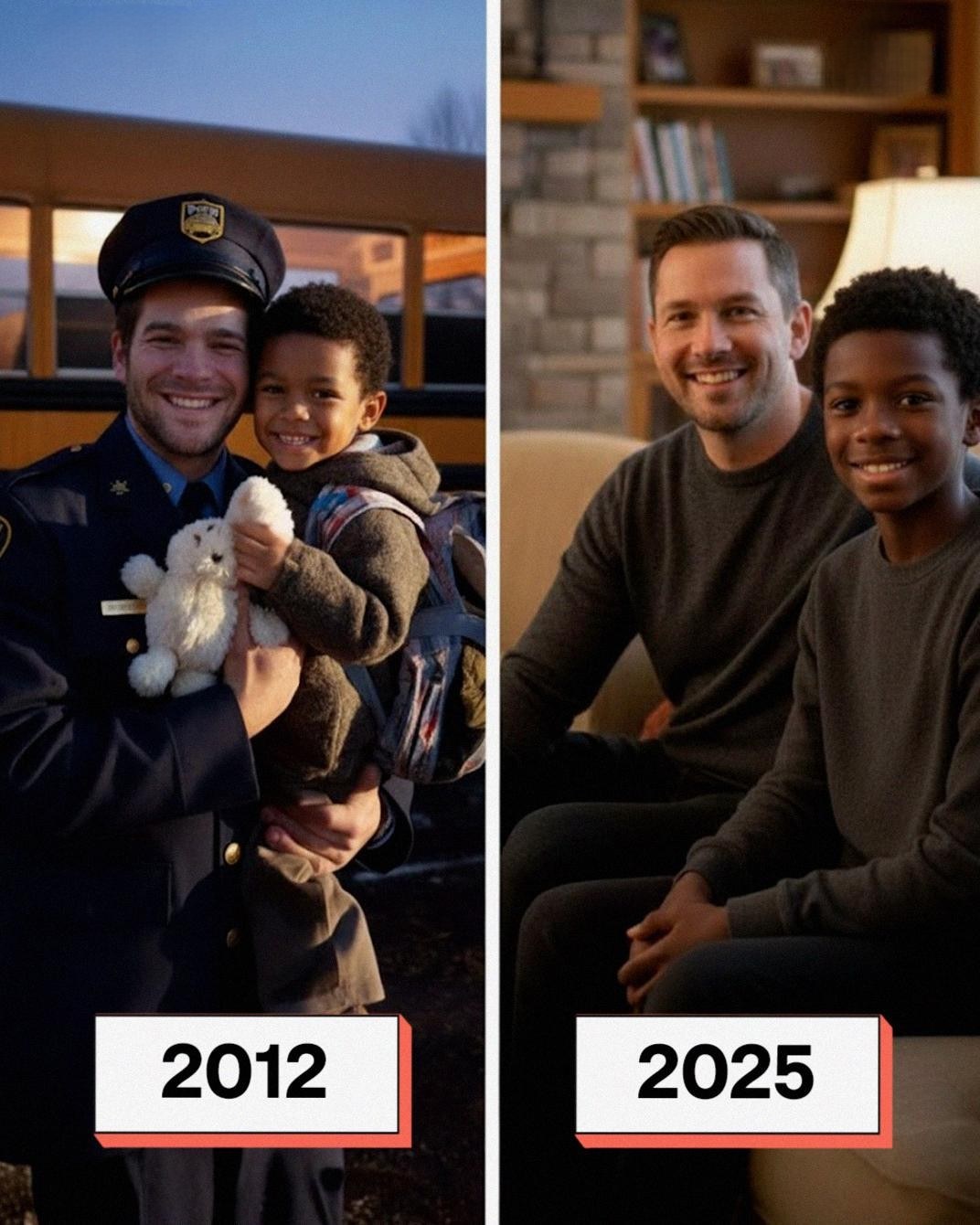
That’s when I noticed him.
A small figure beneath a flickering streetlamp, moving slowly, weighed down by a backpack far too large for his body. My instincts kicked in immediately. Children shouldn’t be out that late. Not alone. Not in freezing weather.
I pulled over and opened the door.
“Hey there,” I said softly. “Are you okay?”
He looked up at me, eyes tired and red, like he’d already cried as much as he could.
“My mom died today,” he said.
No tears. No drama. Just exhaustion. He hugged a worn stuffed bunny like it was the only solid thing left in the world.
He explained that adults had tried to take him somewhere, but he ran. He didn’t trust strangers. I told him the bus was warm and that I could help him find somewhere safe. After a long pause, he nodded.
I sat him near the front, turned up the heat, and called dispatch. His name was Gabriel. He barely spoke, just clutched the toy tighter as we waited for instructions.
Eventually, I was told to take him to an emergency foster intake center. By the time we arrived, he had fallen asleep. I carried him inside.
A woman greeted us with practiced urgency. I stayed while forms were filled out and calls were made. Gabriel leaned against me, quiet but trembling.
That’s when I learned the full story.
His mother had passed away suddenly at work. No warning. No family available to take him. When officials came to place him temporarily, he panicked and ran. He’d been walking for nearly two hours before I found him.
When it was time for me to leave, I promised I’d come back. He didn’t believe me.
But I did.
The next day, when he saw me walk through the door, he ran straight into my arms.
I told myself I was just checking in. But the truth ran deeper. Gabriel reminded me of my twin brother—the way he observed people, the way he tried to take up as little space as possible.
I lost my brother when we were young. One moment he was there, the next he wasn’t. I’d lived with that loss for years, always wondering if I could’ve reached him sooner.
I wasn’t going to lose Gabriel.
Before Christmas, I started the adoption process. It moved faster than I expected—quiet, uncomplicated.
Gabriel moved into my small apartment and followed me everywhere. He barely spoke at first. He slept with his backpack next to his bed, like he might need to leave at any moment.
I worked constantly—bus routes by day, side jobs at night. I was exhausted, but he was safe, cared for, and loved. That felt like success.
What I didn’t realize was how carefully he was protecting me in return.
Thirteen years went by.
One evening, I came home early and found Gabriel sitting on the couch, crying. A woman in professional attire sat beside him, a folder in her hands.
“Dad,” he said quietly. “I have to go. I love you.”
My heart stopped.
The woman introduced herself as his school counselor. She explained what I hadn’t known.
Gabriel was exceptional academically. At the top of his class. Teachers had encouraged him to apply for advanced programs and scholarships. He had refused every time.
Because he was afraid of leaving me alone.
He had learned early how deeply I feared loss.
Then she told me the rest.
He had received a full scholarship. Tuition, housing, everything covered. And he was planning to turn it down.
I looked at my son—the child who once wandered alone in the cold—and realized I had raised someone who knew how to sacrifice himself too well.
I pulled him into my arms.
“You’re going,” I said. “That’s not leaving. That’s living.”
He cried harder than I’d ever seen—not from fear, but relief.
“I’ll come home,” he said. “This will always be home.”
That night, I learned the hardest lesson of parenthood.