A City Reopened: The Killing of Renee Nicole Good and the Crisis of Federal Oversight
In the heart of South Minneapolis, a city whose sidewalks have long been etched with the weight of historic social movements, a new tragedy has unfolded that threatens to sever the already frayed thread of trust between the community and federal law enforcement.
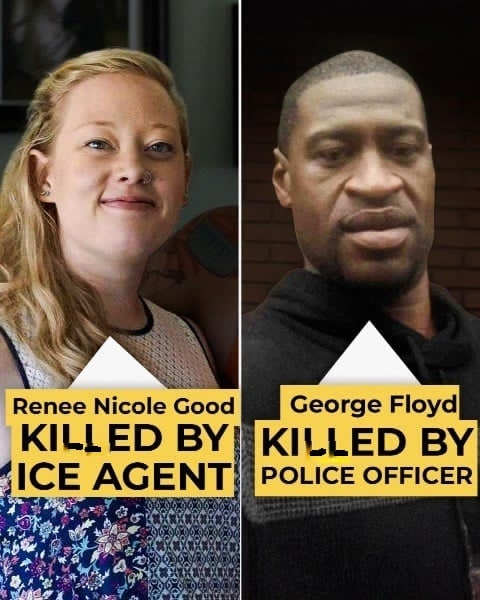
The fatal shooting of Renee Nicole Good, a 37-year-old mother, poet, and United States citizen, by an officer with U.S. Immigration and Customs Enforcement (ICE) on January 7, 2026, has done more than just take a life; it has ignited a fierce constitutional and humanitarian debate that reaches from the snowy streets of Portland Avenue to the highest offices in Washington, D.C.
A City Reopened: The Killing of Renee Nicole Good and the Crisis of Federal Oversight
Minneapolis is no stranger to the global spotlight when it involves the use of force. However, the incident involving Renee Nicole Good introduces a complex new variable: the role of federal agencies operating within a “Sanctuary City” during a period of heightened immigration enforcement.
Part I: The Timeline of a Tragedy
The events of Wednesday, January 7, began not with a high-speed chase, but in a quiet residential neighborhood near East 34th Street and Portland Avenue. Renee Good, a woman described by her family as a “compassionate soul” who had recently moved to Minneapolis to rebuild her life after being widowed, was driving her maroon Honda Pilot.
The Encounter
According to witness accounts and bystander video, Good was in her vehicle when she encountered a team of ICE agents conducting a targeted enforcement operation. While Good was not the subject of the warrant, she was present in the vicinity—some reports suggest she was acting as a legal observer, a role she took seriously as a member of the community.
Video footage, which has since gone viral, shows an ICE officer approaching Good’s vehicle. As the car began to move—eyewitnesses claim she was attempting to navigate away from the congestion—another officer positioned near the front of the vehicle drew his weapon. At approximately 9:30 a.m., at least two shots were fired through the windshield at close range.
The Immediate Aftermath
The vehicle drifted and crashed into a nearby parked car. Despite the efforts of emergency medical technicians, Good was pronounced dead shortly after arriving at the hospital. The shock was instantaneous. Within hours, a makeshift memorial of flowers and candles appeared near the site, less than a mile from the intersection now known as George Floyd Square.
Part II: The Clash of Narratives
As is common in high-profile shootings, two starkly different versions of the event emerged within hours of the first shot.
The Federal Position: “Domestic Terrorism”
The Department of Homeland Security (DHS), led by Secretary Kristi Noem, quickly released a statement characterizing the incident as an act of self-defense. Federal officials alleged that Good “weaponized her vehicle” and attempted to ram officers during a violent riot. Vice President JD Vance later echoed these sentiments, suggesting the officer involved—identified as 10-year veteran Jonathan Ross—was protected by “absolute immunity.”
The Local Rebuttal: “A Garbage Narrative”
Minneapolis Mayor Jacob Frey did not mince words in his response. After reviewing the available video footage, Frey held a press conference where he labeled the DHS account “bullsh*t.”
“They are already trying to spin this as an action of self-defense,” Frey stated. “This was an agent recklessly using power that resulted in somebody dying. We will not allow the federal government to hide behind a false narrative while our residents are being killed in the streets.”
Minnesota Governor Tim Walz similarly called for an “expeditious and fair” investigation, expressing concern over the FBI’s decision to take sole control of the evidence, effectively cutting out the Minnesota Bureau of Criminal Apprehension (BCA).
Part III: Who Was Renee Nicole Good?
Beyond the political firestorm, there is the story of a woman whose life was cut short. Renee Nicole Good was more than a headline; she was a vibrant part of her community.
-
A Mother and Widow: Good was a mother of three. Her youngest, a six-year-old son, had just been dropped off at school shortly before the shooting. She was still grieving the sudden death of her husband in 2023.
-
An Artist and Scholar: A graduate of Old Dominion University, Good was an award-winning poet and a former teacher. Her work often focused on themes of kindness, resilience, and the human spirit.
-
A “Kindness Radiator”: Her wife, Becca Good—who was in the vehicle during the shooting—described Renee as someone who lived by the belief that kindness must be nurtured wherever it resides.
Part IV: The Broader Context of Federal Overreach
The shooting of Renee Good has sparked a wider conversation about the presence of federal “tactical teams” in American cities. Critics argue that the deployment of ICE agents into residential neighborhoods for non-violent administrative tasks creates a “powder keg” environment.
The Militarization of Civil Service
When federal agents utilize “no-knock” style tactics for administrative immigration warrants, the risk of miscommunication and escalation skyrockets. In the case of Renee Good, the “split-second decision” to fire into a moving vehicle is being scrutinized as a violation of standard law enforcement protocols, which generally discourage shooting at moving vehicles unless there is an immediate threat of lethal force that cannot be avoided.
The Immunity Debate
The assertion by federal officials that agents enjoy “absolute immunity” is a significant legal point of contention. While “qualified immunity” often protects officers from civil liability, Mayor Frey and Attorney General Keith Ellison have argued that no officer is above the law if their actions fall outside the scope of their constitutional duties.
Part V: A City in Mourning and the Path Forward
As of January 10, 2026, thousands have gathered in Minneapolis to demand justice. The city council has called for the immediate removal of ICE tactical units from the city limits, and many are calling for a federal civil rights investigation into the Department of Homeland Security’s tactics.
The tragedy of Renee Nicole Good is a reminder of the fragility of the peace in urban America. It is a story of a woman who sought to “experience Minneapolis” with love and poetry, only to become a symbol of a nation’s deepest divisions.