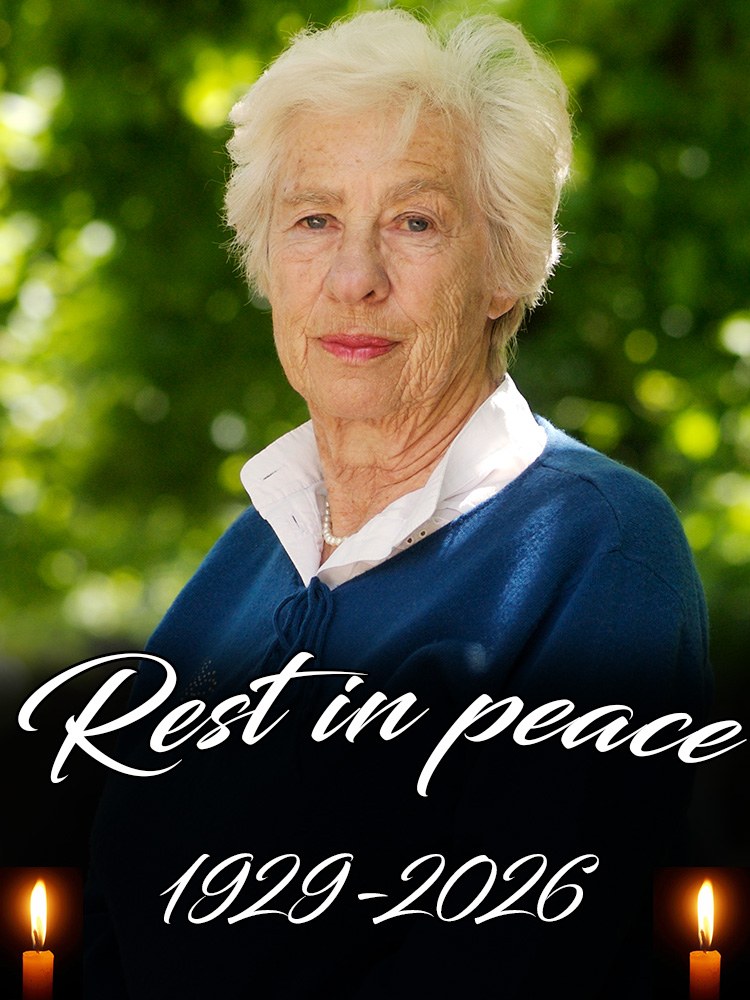
Eva Schloss, Holocaust Survivor and Stepsister of Anne Frank, Passes Away at 96
Eva Schloss, the stepsister of Anne Frank and a woman who stood as one of the final direct witnesses to the atrocities of the Holocaust, died this week at the age of 96. Her passing marks the silencing of a formidable moral voice—one that spent nearly a century navigating the chasm between unimaginable loss and a defiant, lifelong commitment to the truth. Schloss did not merely survive history; she became its custodian. For decades, she transformed her personal trauma into a global curriculum, tirelessly educating the public on the lethal trajectory of hatred and the catastrophic cost of historical amnesia.
A Childhood Interrupted by the Anschluss
Born Eva Geiringer on May 11, 1929, in Vienna, she began her life in a world of middle-class stability and cultural richness. That world was abruptly liquidated in March 1938, when Nazi Germany annexed Austria. The Anschluss turned Jewish citizens into pariahs overnight. Stripped of their rights and safety, the Geiringer family fled to Amsterdam, seeking sanctuary in a city they hoped remained beyond the reach of the Third Reich.
It was in the Rivierenbuurt neighborhood of Amsterdam that Eva’s life first intersected with that of Anne Frank. The two girls, displaced by the same machinery of hate, played together in Merwedeplein Square—sharing the fleeting, ordinary joys of childhood, unaware that they would one day be posthumously linked as symbols of a lost generation.
Betrayal and the Gates of Auschwitz
The Nazi invasion of the Netherlands in 1940 ended the illusion of safety. As anti-Jewish laws intensified and deportations to the East began, the Geiringers followed the path of the Franks, disappearing into hiding. They remained undiscovered for two years until a devastating betrayal by a collaborating nurse led authorities to their door.
On May 11, 1944—her fifteenth birthday—Eva was arrested alongside her parents and her brother, Heinz. They were deported to Auschwitz-Birkenau. It was there that the family was severed; while Eva and her mother, Elfriede, were forced into the brutal machinery of slave labor, her father and brother were murdered. According to historical records, they were among the approximately 6 million Jews and millions of others systematically exterminated by the Nazi regime. In Auschwitz alone, it is estimated that 1.1 million people were killed, approximately 90% of whom were Jewish.
Eva and her mother survived until the camp’s liberation by Soviet forces in January 1945. They emerged into a world where they were free, but profoundly alone.
The Frank Connection and the Breaking of Silence
The post-war years brought a singular twist of fate. Eva’s mother eventually married Otto Frank, the sole survivor of his family. This union made Eva the posthumous stepsister of Anne Frank, tethering her personal grief to the most famous diary in history.
For forty years, Schloss maintained a stoic silence. Like many survivors of the Shoah, the trauma was too immense to articulate, and the post-war world seemed ill-equipped to process the depth of the horror. However, in the late 1980s, prompted by a London exhibition on Anne Frank, Schloss realized that the lessons of her youth were fading.
Watching the persistence of racism, the resurgence of antisemitism, and the continuation of global conflict, she decided that silence was no longer an option. She began to speak, not out of a desire for fame, but out of a dire sense of necessity.
A Legacy of Testimony
For the remainder of her life, Eva Schloss became a global itinerant for the truth. Her testimony was characterized by a calm, unflinching clarity. She chose to repeatedly relive the darkest moments of her life to ensure that the “never again” mantra remained a call to action rather than a hollow cliché.
By the time of her death, Schloss had reached millions. She leaves behind a world that is undeniably poorer for the loss of her physical presence, but one that remains equipped with the testimonies she fought so hard to provide. Her life stands as a testament to the fact that while hatred is powerful, the will to remember and to teach is ultimately more enduring.
When Eva Schloss finally broke her forty-year silence, she didn’t just tell a story; she launched a new, formidable chapter of a life defined by the transformation of trauma into a global educational mission. What began as an intimate decision to speak grew into a decades-long campaign dedicated to Holocaust education, human rights, and a fierce, unwavering opposition to hatred in all its manifestations.
Schloss operated on the fundamental belief that memory is not a passive artifact but a living shield that must be protected and renewed by every successive generation.
The Global Classroom: From Prisons to Parliaments
Throughout the 1990s and 2000s, Schloss became a relentless traveler, crossing Europe and North America to share her testimony in schools, universities, community centers, and even prisons. Her message was consistently sobering: the Holocaust did not begin with the gas chambers of Auschwitz—where approximately 1.1 million people were murdered—but with the subtle erosion of civil rights through words, exclusion, and a collective, deadly silence.
Her delivery was famously calm and factual, a stark contrast to the gravity of her subject matter. She specialized in highlighting the moral agency of “ordinary” people—the teachers, neighbors, and nurses who either resisted or enabled the machinery of genocide. She frequently used the painful memory of her own betrayal by a collaborating nurse to illustrate that moral choices, even in small, private moments, carry historical weight.
Securing the Record: The Digital Legacy
Recognizing that the era of living witnesses was drawing to a close, Schloss worked feverishly to digitize the truth.
-
1996: She contributed her testimony to the USC Shoah Foundation’s Visual History Archive, which currently houses over 55,000 testimonies in 45 languages.
-
The Anne Frank House: She recorded her life story for the institution, ensuring her perspective remained a cornerstone of the historical record.
While her connection to Anne Frank was her most famous attribute, Schloss handled the association with a characteristic, clear-eyed grace. She often reminded the public that while Anne’s diary offered a vital entry point into history, it was only one voice among the 6 million Jews lost. For Schloss, it was essential that the conversation expanded to include the total reality of genocide and the terrifying responsibility of survival.
Knighthood, Restoration, and Royal Tributes
The international community responded to her moral leadership with high honors. Schloss was awarded an Honorary Doctorate in Civil Law from the University of Northumbria and was appointed a Member of the Order of the British Empire (MBE) for her profound impact on Holocaust education.
In 2021, eighty years after being forced into exile, her Austrian citizenship was formally restored. It was a symbolic gesture of repair that Schloss accepted as a belated acknowledgment of the injustice served upon her family.
Following her passing on January 3 in London at age 96, tributes emerged from the highest levels of government. King Charles III issued a poignant statement reflecting on her character:
“The horrors that she endured as a young woman are impossible to comprehend, and yet she devoted the rest of her life to overcoming hatred and prejudice, promoting kindness, courage, understanding and resilience.”
A Legacy of Purpose over Victimhood
To those who knew her privately, Schloss was more than a survivor; she was a devoted mother, grandmother, and great-grandmother who built a life of warmth and purpose atop a foundation of ash. She frequently noted that she didn’t speak to relive the past, but because she feared a future where the past was forgotten. She warned that antisemitism and racism—which currently see fluctuating but persistent spikes in global hate crime statistics—only return when society stops paying attention.
Eva Schloss’s legacy now resides in her books, her recorded voice, and the co-founding of the Anne Frank Trust UK. As the world loses the final direct witnesses to the 20th century’s greatest horror, her life stands as definitive proof that survival is not just about enduring tragedy—it is about the courage to transform that pain into a permanent guidepost for humanity.