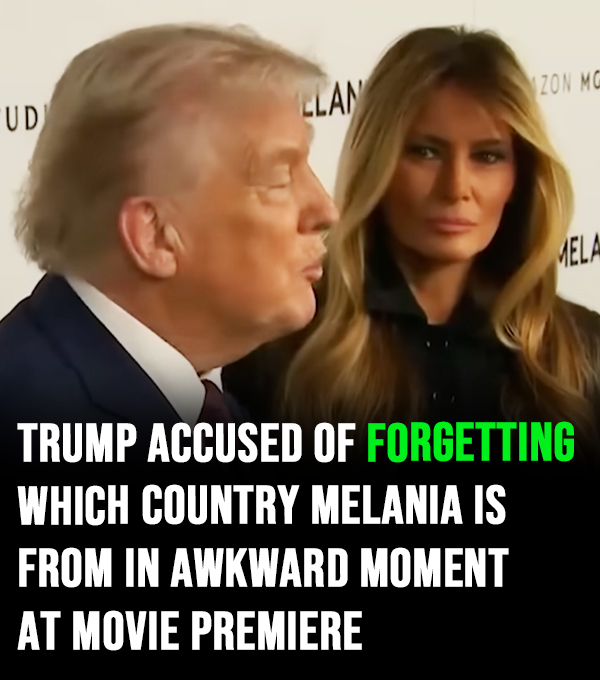
Trump accused of forgetting which country Melania is from in awkward moment at movie premiere!
The premiere was intended to be a night of cinematic triumph, a carefully orchestrated event designed to burnish the legacy of Melania Trump through the lens of a new documentary. Instead, the evening became a flashpoint for a much different narrative, as the spotlight shifted from the screen to a jarring verbal lapse by the former president. What should have been a celebration of Melania’s journey from Slovenia to the world stage was overshadowed by a description of her origins so vague and disconnected that it ignited a firestorm of speculation regarding Donald Trump’s cognitive clarity.
The documentary, titled simply Melania, had already been navigating a difficult rollout. Behind the scenes, the production was reportedly struggling with tepid ticket sales and theaters that remained stubbornly empty. To mitigate the potential humiliation of a quiet opening, reports surfaced that Republican organizations and private clubs had engaged in bulk-buying tickets to artificially inflate attendance figures. This manufactured enthusiasm was meant to provide a buffer for the former First Lady, yet even these efforts could not insulate the event from the fallout of her husband’s public remarks.
During the promotional exchanges that evening, Trump was asked about the international roots of his wife’s story. Rather than speaking with the specificity and pride one might expect of a spouse, he offered a meandering and ambiguous description of her homeland that left listeners confused. For critics who have long tracked his geographical and historical missteps—including past instances where he appeared to conflate Greenland and Iceland or misattribute the histories of European nations—this was not a minor slip. It was seen as a significant indicator of a deeper, more troubling disconnect. Clips of the interaction surged across social media platforms, with users and political analysts alike pointing out that he seemed incapable of naming Slovenia, the country where his wife was born and raised.
The mockery that followed was swift and relentless, but beneath the surface of the internet’s humor was a more somber and unsettling undercurrent. For many observers, this was no longer a matter of “Trump being Trump” or a simple case of a politician misspeaking. It contributed to a growing, bipartisan unease regarding the frequency and nature of his public lapses. As he navigates the high-pressure environment of a second term, the ability to dismiss these moments as mere gaffes has begun to erode. The question being asked in the halls of power and on the streets is no longer if he made a mistake, but rather what that mistake says about his fundamental fitness for office.
Beside him, Melania remained a study in stoicism. Throughout the night, she projected an image of unwavering resolve, describing herself as “mission and action-oriented.” She spoke of her commitment to her projects and her role, seemingly attempting to pull the narrative back to the film’s central themes of strength and elegance. However, the contrast between her poised delivery and her husband’s disjointed rhetoric created a palpable tension. It was a visual and auditory dissonance that was impossible to ignore: a wife trying to solidify a legacy while her husband appeared to be losing the thread of her history.
The event, which was supposed to be a cornerstone of the Trump family’s cultural influence, instead deepened the most uncomfortable inquiry of the current political era. It raised the specter of a silent crisis within the inner circle—a question of how long those closest to the president can maintain a facade of normalcy in the face of increasingly frequent cognitive stumbles. In political circles, the debate has shifted from policy to pathology, with experts and laypeople alike scrutinizing every speech and every off-the-cuff remark for signs of decline.
For the Slovenian people and those who value the specific heritage Melania represents, the omission felt like a erasure of identity. To forget or obscure the origins of a partner of twenty years is a lapse that transcends political theater; it touches on the personal and the psychological. The documentary’s failure to capture the public’s imagination was perhaps a secondary concern compared to the realization that the man at the center of the movement might no longer be a reliable narrator of his own life, let alone the life of his wife.
The fallout of the premiere has lingered far longer than the film’s run in theaters. It has become a reference point for those arguing that the demands of the presidency require a level of mental acuity that is being increasingly called into question. While the administration and its supporters have dismissed the incident as a non-event or a media-driven exaggeration, the video evidence has provided a permanent record that is difficult to argue away. It has fueled a demand for transparency regarding the health and cognitive status of the executive branch, a demand that grows louder with every misplaced word and every forgotten fact.
As the political landscape continues to shift, the memory of that awkward movie premiere remains a potent symbol. It represents the intersection of public image and private reality, and the moment when the two began to visibly pull apart. Melania’s documentary may have sought to define who she is, but her husband’s vague words ultimately defined the uncertainty surrounding who he has become. In the end, the night was not a celebration of where the First Lady came from, but a stark, public interrogation of where the President is going.
The incident serves as a reminder that in the theater of modern politics, the unscripted moments are often the most revealing. While the documentary attempted to present a polished, curated version of the truth, the reality of the human condition—with all its vulnerabilities and declines—found its way into the light. It is a reality that the world is now watching with a mixture of partisan fervor and genuine, non-partisan concern for the stability of the leadership at the helm of the nation.