Macaulay Culkin shares emotional tribute after Home Alone star Catherine O Hara dies aged 71
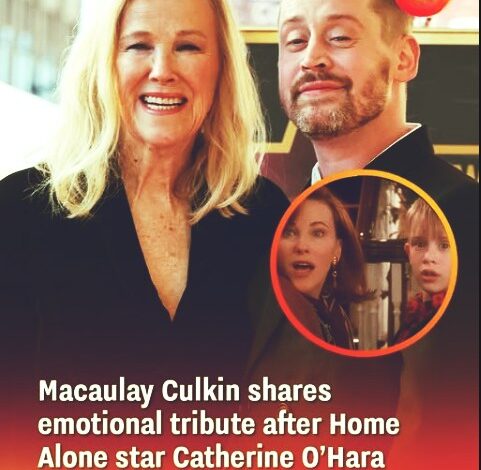
The entertainment world stands in a rare, hushed moment of collective grief following the news that Catherine O’Hara, the legendary actress and comedic visionary, has passed away at the age of 71. In a career that spanned more than five decades, O’Hara didn’t just perform; she redefined the very architecture of character acting, moving from the avant-garde improv rooms of Toronto to the global stage with a grace that few could emulate. Among the many voices rising to honor her legacy, none has been as poignant as that of Macaulay Culkin, who famously played her son, Kevin, in the holiday classic Home Alone.
In a heartfelt statement, Culkin reflected on the woman who was his “movie mom” during the most formative years of his life. “Catherine didn’t just play a mother; she possessed a kindness and a brilliance that made a nervous ten-year-old boy feel like he belonged on a movie set,” Culkin shared. “The world knows her as a comedic genius, but I knew her as a woman who taught me that you can be the most talented person in the room and still be the most generous. To my mother, my mentor, and a true icon: the world is a little less bright without your laughter.”
O’Hara’s journey to becoming a cultural touchstone was a masterclass in patience and cumulative craft. Long before she was a household name, she was honing a discipline that rarely announces itself. In the crowded ensembles of Second City Television (SCTV), she learned the vital importance of listening—of vanishing so completely into a character that the audience forgot they were watching a performance. Her rise was never sudden or manufactured; it was built on a foundation of trust earned through years of fearless, specific, and emotionally coherent work.
On SCTV, O’Hara developed a style that favored psychological depth over mere display. Her gallery of characters—from the eccentric Lola Heatherton to her biting impressions of Hollywood starlets—were funny not because they reached desperately for attention, but because they were fully inhabited. She understood that comedy is most effective when it is grounded in a recognizable human truth. This foundational skill made her indispensable to filmmakers, allowing her to navigate the anarchic, gothic energy of Tim Burton’s Beetlejuice or ground the satirical, mockumentary worlds of Christopher Guest in films like Best in Show and A Mighty Wind.
In Home Alone, O’Hara accomplished something quietly difficult: she anchored a broad, slapstick family comedy with genuine emotional stakes. As Kate McCallister, her performance carried a palpable weight of guilt, urgency, and maternal love. Amid the chaos of the film’s antics, O’Hara’s desperate race across the country to reach her son gave the movie a beating heart. It is the reason audiences continue to feel a deep, visceral connection to the film decades later; beneath the booby traps and the laughs, there was a mother’s soul that felt entirely real.+1
Years after those early successes, O’Hara reintroduced herself to a new generation in a way that few actors ever manage. As Moira Rose in Schitt’s Creek, she created a character that could have easily been a one-note caricature of fallen wealth. Instead, O’Hara transformed Moira into something layered, absurdly tender, and utterly unforgettable. Moira’s extravagant wardrobe and impossible-to-place accent masked a deep vulnerability; her apparent detachment from reality often concealed a fierce devotion to her family. The performance was a culmination of O’Hara’s lifelong discipline—absurd on the surface, yet precise and human underneath.
Across genres and decades, O’Hara’s reputation remained remarkably consistent. Her colleagues frequently described her as an exacting and deeply collaborative partner. She was the kind of actor who made everyone else in the scene better, believing that the success of the ensemble was far more important than any individual spotlight. Her work showed that comedy can hold the weight of heartache without losing its sense of joy, and that the performances which seem the most effortless are often the result of the most sustained, careful attention.
O’Hara’s legacy is not built on reinvention for its own sake, but on a relentless continuity of craft. She proved that there is immense power in being specific—that the more strangely a character behaved, the more room there was for empathy if the actor played them with sincerity. Whether she was playing a desperate mother, a neurotic dog owner, or a washed-up soap opera star, she invited the audience to see the recognizably human traits within the madness.
The loss of Catherine O’Hara marks the end of an era for the “Second City” generation that changed the face of comedy. Yet, as Culkin’s tribute suggests, her influence lives on in the actors she inspired and the millions of fans who found a piece of themselves in her characters. She leaves behind a body of work that lingers in the mind—reminding us that even in our most absurd moments, we are quietly familiar to one another.
As the industry mourns, the final words often return to that enduring image from Home Alone: a mother shouting her son’s name into the wind, refusing to give up until she finds her way back to him. Catherine O’Hara found her way into the hearts of audiences across the globe, and like the classic characters she inhabited, she will never truly be forgotten.