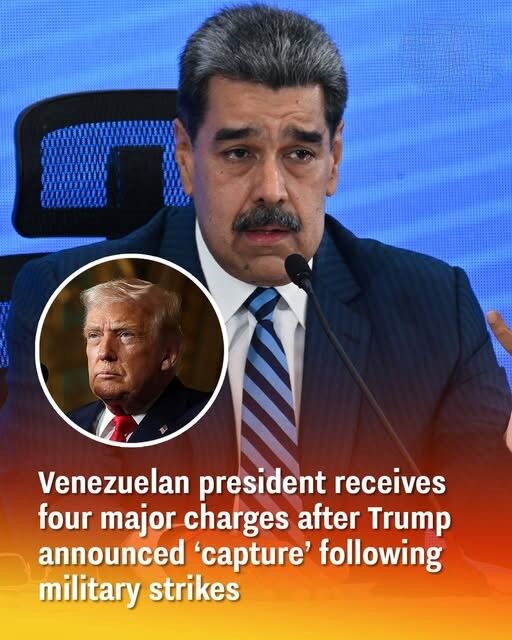
After Trump Declares ‘Capture’ Post-Military Strikes, Venezuelan Leader Charged on Four Counts
In a staggering escalation of hemispheric tension, the United States military executed a sophisticated, large-scale operation in the early hours of January 3, 2026, resulting in the reported capture of Venezuelan President Nicolás Maduro and his wife, Cilia Flores. The assault, codenamed Operation Absolute Resolve, involved a massive deployment of air assets and elite special operations forces. The mission has not only decapitated the Venezuelan leadership but has also ignited a firestorm of global debate over international law, American interventionism, and the volatile future of a nation already teetering on the brink of collapse.
The Assault: 150 Aircraft and a Midnight Extraction
According to Department of Defense briefings and corroborating international reports, the mission commenced around 2:00 a.m. local time on Saturday. The objective was two-fold: neutralize Venezuela’s Integrated Air Defense System (IADS) and apprehend Maduro, who has long been under U.S. indictment for narco-terrorism.
The operation was a textbook display of “Joint Force” synergy:
Air Superiority: More than 150 aircraft, including F-22 Raptors, F-35 Lightning IIs, and B-1B Lancer bombers, conducted coordinated strikes to dismantle radar and defense installations at the Fuerte Tiuna military complex and La Carlota airbase.
The Extraction: Under the cover of an intentional city-wide blackout, helicopters from the Army’s 160th Special Operations Aviation Regiment (Night Stalkers) inserted Delta Force operators and FBI Hostage Rescue Team (HRT) personnel directly into Maduro’s compound.
Capture: Despite coming under ground fire, U.S. forces secured Maduro and Flores within 30 minutes. President Donald Trump later released a photograph on social media showing a blindfolded Maduro aboard the USS Iwo Jima, an amphibious assault ship stationed off the coast.
By Saturday afternoon, the captured couple had been flown to Stewart Air National Guard Base in New York and transported via armored convoy to federal custody in Manhattan.
The Legal War: “The Full Wrath of American Justice”
Shortly after the operation, U.S. Attorney General Pam Bondi unsealed a sweeping indictment in the Southern District of New York. The new charges supersede a 2020 indictment and expand the scope of the case to include Cilia Flores and other members of the inner circle.
The primary charges against Maduro include:
Narco-terrorism conspiracy
Cocaine importation conspiracy
Possession of machine guns and destructive devices
Conspiracy to possess weapons against the United States
“Nicolás Maduro will soon face the full wrath of American justice on American soil in American courts,” Bondi declared, characterizing the deposed leader as the head of the “Cartel de los Soles,” a syndicate allegedly responsible for flooding the U.S. with thousands of tons of cocaine.
A Region in Shock: Global Reactions
The international response has been a study in polarization, reflecting the deep ideological fissures of the 21st century.
The Condemnation:
Venezuela: Acting President Delcy Rodríguez denounced the mission as “naked imperialism” and a “kidnapping,” demanding proof of life for the Maduros.
Global Powers: Russia and China issued blistering statements, with Beijing describing the act as a “blatant use of force against a sovereign state.”
The UN: Secretary-General António Guterres expressed deep alarm, stating the operation sets a “dangerous precedent” that bypasses the UN Charter and the rule of law.
The Support:
Regional Allies: Leaders such as Argentina’s Javier Milei celebrated the move, with Milei posting “Liberty advances!” on social media.
The Diaspora: In Miami and Doral, thousands of Venezuelan exiles took to the streets in celebration, waving flags and chanting for the “liberation” of their homeland.
The Power Vacuum: What Happens Next?
The removal of Maduro has left Venezuela in a state of geopolitical limbo. President Trump has stated that the U.S. will assist in “running” the country until a “proper transition” occurs, specifically suggesting that U.S. energy firms will play a major role in rehabilitating Venezuela’s nationalized oil industry.
However, with the Maduro-aligned military still largely in place and the international community divided on the legality of the strike, the path toward a “safe and judicious transition” remains fraught with the risk of civil unrest and regional destabilization.
As the smoke clears over the Fuerte Tiuna military complex, Venezuela finds itself in a state of unprecedented constitutional and geopolitical vertigo. While President Donald Trump hails the capture of Nicolás Maduro and Cilia Flores as a “brilliant” victory over narco-terrorism, the shockwaves are only beginning to be felt across the international legal and diplomatic landscape.
Beneath the tactical success of “Operation Absolute Resolve” lies a fractured region and a global community grappling with the implications of a superpower forcibly removing a sitting head of state.
A Contested Succession and Call to Arms
In Caracas, the leadership situation is defined by chaos. Vice President Delcy Rodríguez has asserted her constitutional role as acting president, though her actual reach remains hindered by widespread communication breakdowns and a city reeling from targeted strikes.
The military response, however, has been one of fierce defiance. Defense Minister Vladimir Padrino López has branded the U.S. operation a “criminal military aggression,” calling for a total national mobilization. His rhetoric underscores the reality that while Maduro may be in a New York jail cell, the institutional and military machinery he led for over a decade remains—for now—largely intact and hostile.
A World Divided: The Diplomatic Fallout
The global response has carved a deep ideological chasm, reminiscent of the Cold War.
The Axis of Condemnation: Russia, Iran, and Cuba have led a chorus of allied states in denouncing the mission as a flagrant breach of international law. Moscow characterized the operation as “armed aggression,” accusing Washington of a total disregard for territorial integrity.
Regional Alarm: Across Latin America, the reaction has been one of profound unease. Even governments long critical of Maduro have expressed concern. Colombia’s leadership described the strike as an assault on regional sovereignty, warning that the precedent of unilateral intervention could destabilize the entire Western Hemisphere.
Calls for Restraint: The European Union and the United Nations have avoided celebratory rhetoric, instead emphasizing that any transition must adhere to the U.N. Charter. A Security Council meeting has been fast-tracked to address what many see as a dangerous shift in international norms.
The Legal Question: Sovereignty vs. Statutes
The operation has ignited a firestorm among legal scholars and constitutional experts. Under the U.N. Charter, the use of force against a sovereign state typically requires Security Council authorization—a hurdle the Trump administration bypassed.
Critics argue that narcotics trafficking indictments, while serious, do not traditionally provide a statutory basis for a full-scale military invasion. Domestically, the White House faces a burgeoning debate over the lack of congressional notification. Constitutionalists point out that the power to authorize such an escalation rests with Congress, yet “Operation Absolute Resolve” was executed with zero advance warning to Capitol Hill.
Impact on the Ground: A City in the Dark
While the U.S. military reports a “clean” extraction, independent verification of the human cost is difficult. Satellite imagery confirms that strikes on Fuerte Tiuna and La Carlota airfield caused massive structural damage, which in turn contributed to rolling blackouts and the disruption of essential public services.
The Venezuelan government has declared a “state of external disturbance,” and the atmosphere in Caracas is one of high-tension waiting. Explosions and low-flying aircraft have left the civilian population in a state of profound uncertainty, while the U.S. Embassy has issued an urgent “shelter in place” advisory for any Americans remaining in the country.
The Manhattan Arraignment: What Comes Next
As of this morning, Maduro and Flores are being held in federal custody in New York. They are expected to make their initial court appearance in the Southern District of New York as early as Monday evening to face charges that could carry life sentences.
While the legal proceedings begin in Manhattan, the real trial will take place in the streets of Venezuela and the halls of the United Nations. The Trump administration’s assertion that the U.S. will “run” Venezuela until a transition is finalized marks a return to a more interventionist era of American foreign policy—one that will likely shape geopolitical discourse for years to come.