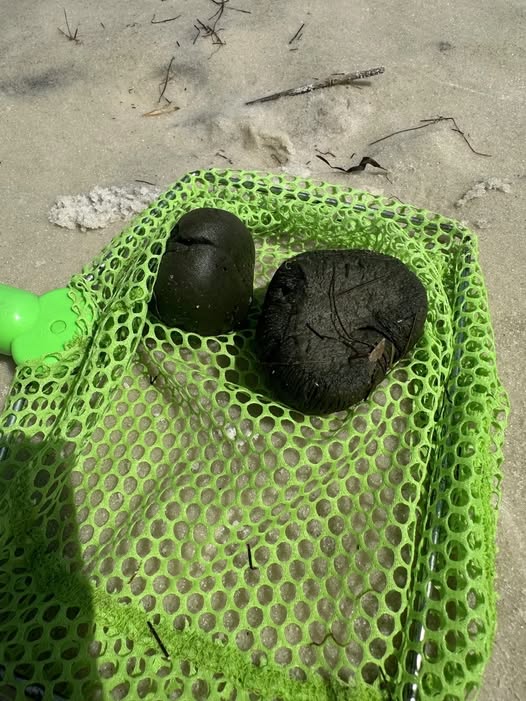
Uncovering the Beach Mystery: What Are These Strange Balls Kids Discover?
If you’ve spent a lingering afternoon along the shallows of Pensacola Bay with a child in tow, you’ve likely experienced the moment: a sudden, triumphant shout from the water’s edge, followed by a dramatic presentation of a dark, oblong object. “Look!” the child exclaims with equal parts glee and disgust. “I found a sea turd!” While the nickname is enough to send a ripple of laughter—or a shudder of concern—through a group of nearby adults, these peculiar finds are far from the biological waste their moniker suggests. In reality, they are a fascinating coastal phenomenon known as mudballs. To the uninitiated, they are strange anomalies; to the local beachcomber, they are the tangible fingerprints of the bay’s own rhythmic architecture.
Nature’s Alluvial Architecture
Mudballs are most frequently discovered where the bay’s energy meets its softest boundaries—along shallow flats and near the swaying reaches of grassy marshes. Here, the floor of the bay isn’t just sand; it is a rich, complex composite of clay and fine sediment.
Despite the unceremonious local name, these objects are entirely natural. They are not man-made, nor are they the byproduct of marine life. Instead, they represent a masterclass in hydraulic engineering. The floor of Pensacola Bay is carpeted with thick layers of fine mud, heavily infused with organic matter from decaying plant life and microscopic marine organisms.
The birth of a mudball begins when this sediment is disturbed. Whether by the persistent tug of a tide, the wake of a passing boat, or even the heavy footfall of a human explorer, small chunks of this cohesive clay are occasionally torn free from the seabed.
The Art of the Tumble
Once a fragment is liberated, the water takes over as the primary sculptor. Pushed by the relentless, gentle hand of the current, the lump begins a journey of transformation. As it rolls across the bay floor, the friction of sand and silt acts like sandpaper, meticulously polishing the surface.
The physics are strikingly similar to the way jagged glass becomes frosted “sea glass” or how mountain rocks are ground into smooth river pebbles. Over time, the irregular edges are softened, and the corners are worn away until what remains is a smooth, compact, and remarkably firm sphere.
The resulting “treasure” is a dense, squeezable ball of mud that holds its shape with the consistency of modeling clay. Their color—often a deep, midnight green or a stark, silty black—is a direct reflection of the nutrient-dense organic material trapped within. It is this dark hue that frequently leads concerned parents to mistake them for tar balls or oil residue. However, in the vast majority of cases, these are simply concentrated capsules of the bay’s own fertile earth.
A Guide for the Curious Explorer
For those who encounter these objects, a few simple observations can distinguish a healthy mudball from something more concerning:
-
Texture: A typical mudball is firm yet pliable, leaving little to no residue on the skin.
-
Scent: Natural mudballs are generally odorless or carry a faint, earthy scent of the sea.
-
The Safety Check: If an object feels excessively sticky, leaves an oily film on the hands, or emits a chemical odor, it should be discarded immediately, and hands should be thoroughly washed.
The Legacy of the “Sea Turd”
For generations of Gulf Coast families, the hunt for these mudballs has evolved into an informal rite of passage. On any given weekend, you can find children lining them up like trophies along the shoreline, comparing diameters and textures with the intensity of gem collectors.
In this play, there is a hidden curriculum. Without realizing it, these young explorers are engaging with the fundamentals of marine biology and geology. They are learning about the power of erosion, the movement of tides, and the way a body of water constantly reshapes itself.
Long after the sand has been shaken from the floorboards of the car and the shells have been tucked away in jars, it is often the story of the “biggest sea turd” that survives the trip home. These mudballs may not be destined for museum shelves, but they remain a vital part of the coastal experience. They serve as a muddy, tactile reminder that nature is full of surprises, and that the best lessons are often found rolling quietly in the surf, waiting to be discovered.
So, the next time a muddy treasure is thrust toward you with a wide-eyed grin, you can rest easy. It isn’t waste—it’s a piece of the bay itself, shaped by time and tide into a perfect souvenir of a Florida childhood.