Donald Trump Outlines Changes Coming to the U.S.
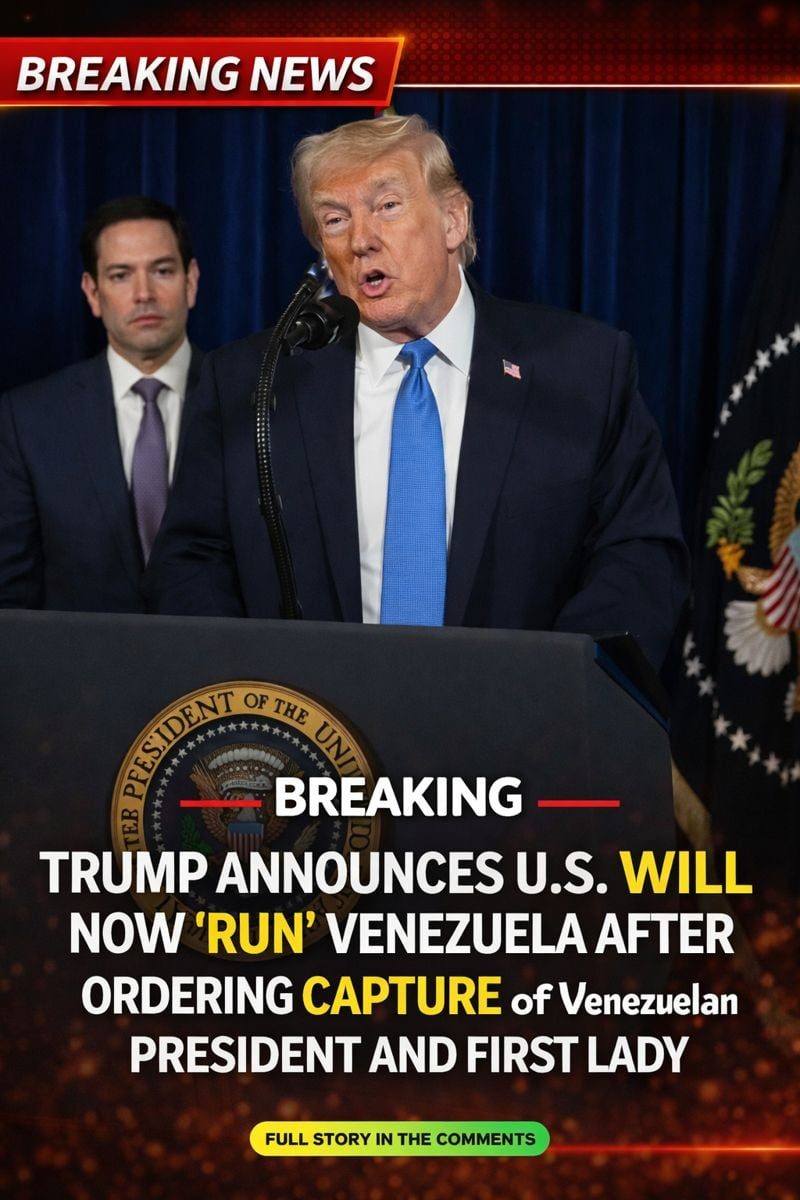
In the predawn hours of January 3, 2026, the geopolitical landscape of the Americas was fundamentally altered by a military operation of extraordinary scale and audacity. In a lightning strike into the heart of Caracas, United States forces conducted a coordinated campaign that culminated in the capture of Venezuelan President Nicolás Maduro and his wife, Cilia Flores, marking the first time in decades that a foreign power has forcibly removed a sitting head of state in the region. The mission, code-named “Operation Absolute Resolve,” involved a massive display of American military reach. Early reports confirm extensive air, sea, and ground strikes targeting military installations, strategic communication hubs, and critical infrastructure across the country. According to U.S. officials, the operation was designed to dismantle the command-and-control capabilities of the Maduro administration before elite special operations teams seized the couple at a safe house in the capital.
Maduro and Flores were immediately extracted via military aircraft and transported to the United States, where they were arraigned in a federal courthouse in New York City. Both have pleaded not guilty to a litany of federal charges, including narco-terrorism and large-scale drug trafficking offenses.
The Human and Tactical Toll
Despite the clinical language of “precision strikes” often used by the Pentagon, independent reporting and official statements from Caracas reveal a far more chaotic and lethal reality on the ground.
-
Venezuelan Casualties: Authorities report at least 24 security personnel killed.
-
International Presence: Reports indicate 32 Cuban military personnel were killed during the initial strikes.
-
Civilian Impact: Numerous civilian casualties have been reported in the densely populated areas of Caracas, where residents described a night of communications blackouts and terrifying explosions.
-
U.S. Losses: Seven American service members were reportedly wounded in the firefight during the extraction.
A Leadership Vacuum and a Sovereign Rebuttal
The removal of Maduro did not lead to the immediate collapse of the Venezuelan state. Within hours, the Supreme Tribunal of Justice moved to fill the power vacuum, swearing in Vice President Delcy Rodríguez as interim president amid a declaration of national mourning.
In her first address to the nation, Rodríguez denounced the operation as an “illegal act of aggression” and a violation of Venezuelan sovereignty. She has demanded “proof of life” for the detained couple and maintains that her government remains the sole legitimate authority in the country.
Geopolitical Aftershocks and Legal Scrutiny
The international community has reacted with a mix of shock, condemnation, and cautious silence.
-
The Allies: Russia and Cuba have characterized the assault as a blatant violation of international norms.
-
The United Nations: At the UN, several nations have raised formal objections, arguing that the unilateral intervention violates Article 2(4) of the UN Charter, which prohibits the use of force against the territorial integrity of any state without Security Council authorization.
-
The U.S. Capitol: Even in Washington, the operation has ignited a constitutional firestorm. Lawmakers are questioning the administration’s authority under the War Powers Resolution, noting the lack of explicit legislative approval for an act of war against a sovereign nation.
The “Oil Oversight” Controversy
Adding a layer of economic complexity to the military action, President Trump suggested that the United States would temporarily oversee Venezuelan affairs, specifically its vast petroleum reserves. He claimed that up to 50 million barrels of oil could be supplied to the U.S. at market rates—a statement that drew domestic praise from those seeking energy independence but sparked international alarm over “resource sovereignty.”
U.S. officials have since attempted to soften this rhetoric, clarifying that the U.S. role is intended to “support a transition” rather than to formally administer the country under international law, a move likely aimed at mitigating accusations of modern-day colonialism.
Uncertainty on the Streets
In Caracas, the atmosphere remains volatile. Pro-government paramilitary groups, known as colectivos, have reportedly mobilized, leading to sporadic outbreaks of violence and deep uncertainty among the civilian population. Meanwhile, press freedom organizations have raised alarms over the detention of journalists and a tightening grip on independent reporting within the country.
As the legal proceedings against Maduro and Flores begin in Manhattan, the world is left to grapple with the precedent set by Operation Absolute Resolve. Can the interim government in Caracas solidify its power? Will regional diplomacy be enough to prevent a wider conflict? These questions loom over a night that has undoubtedly reshaped the future of the Americas.
In the aftermath of the most audacious U.S. military intervention in the Western Hemisphere in decades, allies and adversaries alike are scrambling to decipher a new world order. The capture of Nicolás Maduro and Cilia Flores has not only decapitated the Venezuelan state but has also ignited a global debate over the limits of sovereignty and the reach of American executive power.
Across the Americas, the reaction has been a fractured mirror of regional ideologies. The Organization of American States (OAS) has issued a tenuous call for calm, pivoting to the delicate language of non-intervention while emphasizing the desperate need for a peaceful transition. Historically allied with the Maduro administration, several Latin American nations have slammed the incursion as a “blatant violation” of international law. Conversely, a handful of regional neighbors have maintained a cautious silence, privately weighing the potential for economic stability against the “imperialist” optics of a U.S.-led regime change.
The Constitutional Firestorm in Washington
In Washington, the shockwaves have moved from the Pentagon to the halls of Congress. A fierce debate is currently raging over the legality and oversight of Operation Absolute Resolve.
-
The Critics: Lawmakers have pointed to the War Powers Resolution, arguing that President Trump’s unilateral decision to strike a sovereign nation bypassed the constitutional requirement for congressional authorization.
-
The Supporters: Administration allies counter that the operation was a law-enforcement action intended to execute existing criminal indictments. They argue the President acted within his inherent authority as Commander-in-Chief to neutralize a narco-terrorism threat that posed a direct risk to U.S. national security.
This dispute has effectively reopened the perennial debate over executive overreach, testing the checks and balances designed to prevent a single branch of government from initiating a foreign war.
Federal Court: The Next Battlefield
While the military phase of the operation may be concluded, the legal theater is just beginning. Maduro and Flores are now facing a complex trial in New York federal court on charges of narco-terrorism, cocaine importation, and money laundering.
U.S. attorneys are reportedly sitting on a mountain of evidence gathered over years of investigation, but the defense team has already launched a aggressive counter-offensive. Labeling the arrest an “illegal kidnapping,” Maduro’s lawyers contend that the detention violated international conventions protecting foreign leaders. Legal scholars suggest this case will be a landmark test of U.S. jurisdiction, exploring whether the American justice system can—or should—be used as a tool for extra-territorial regime change.
Humanitarian Crisis and Economic Uncertainty
On the ground in Venezuela, the “liberation” has brought immediate hardship. The initial strikes on strategic infrastructure have left significant portions of the country—including southern Caracas—grappling with shortages of power, water, and food. International aid organizations have issued urgent warnings, noting that the political vacuum has created a “humanitarian tinderbox.”
The interim government, led by Delcy Rodríguez, is struggling to maintain a grip on the country. While she was sworn in to ensure administrative continuity, her authority is being challenged by street-level clashes between pro-government colectivos and those celebrating Maduro’s removal.
The “Oil for Stability” Gambit
Strategic analysts are focused heavily on the economic dimensions of the strike. Venezuela sits atop the world’s largest proven oil reserves, and President Trump’s recent announcement that the U.S. would manage the sale of up to 50 million barrels of Venezuelan oil has sent ripples through energy markets.
While the administration claims the proceeds will benefit both nations, experts warn that the optics of the U.S. controlling another country’s natural resources—even in an acting capacity—carries immense geopolitical risk. Critics argue this move could provoke retaliation from major international buyers like China and Russia, potentially leading to further regional destabilization.
A New Precedent for the 21st Century
The fallout of January 2026 extends far beyond the borders of Venezuela. Russia and China have viewed the operation as a direct threat to the principle of state sovereignty, while neighboring Colombia and Brazil have urged a diplomatic “off-ramp” to prevent the crisis from spilling over their borders.
Inside the United States, public opinion remains deeply polarized. Many see a decisive blow against a corrupt dictator; others see a dangerous precedent that could lead to open-ended interventions elsewhere. As the legal and diplomatic battles unfold, the capture of Nicolás Maduro remains a historical hinge point—a night that proved American military reach can reshape a nation in an instant, but left the much harder work of building a lasting peace to an uncertain future.