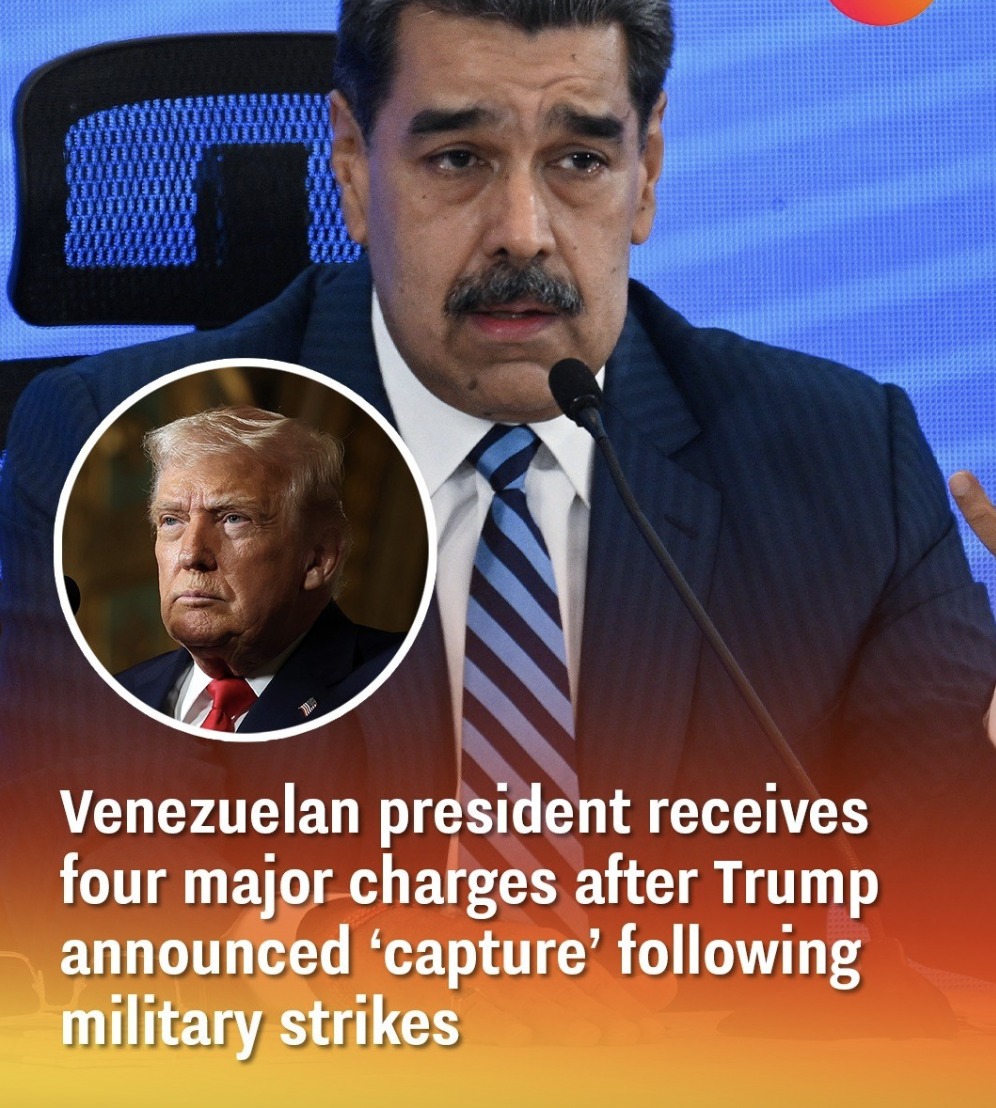
Four Charges Filed Against Venezuelan President After Trump Announces Military Operation
In a military operation without modern precedent, United States forces launched a coordinated strike on the Venezuelan capital of Caracas in the early hours of January 3, resulting in the capture of President Nicolás Maduro and his wife, Cilia Flores. The high-risk mission, which has sent shockwaves through the global diplomatic community, concluded with the Venezuelan leader being transported in shackles to American soil to face a litany of federal criminal charges. The operation, executed by a sophisticated blend of aerial and ground assets, caught the Venezuelan government off guard. As dawn broke over Caracas, social media was flooded with chaotic footage of low-flying helicopters, explosions near government installations, and rapid troop movements. While initial reports were muddled by the fog of war, the geopolitical reality was soon clarified not by a formal briefing, but via social media. President Donald Trump broke the news on Truth Social, confirming the mission was a joint effort between the U.S. military and federal law enforcement. Trump, who characterized the raid as a decisive blow against “international lawlessness,” signaled that more details would follow in a formal press conference.
The Charges: “Operation Absolute Resolve”
The legal architecture behind the raid was unveiled later that day by U.S. Attorney General Pam Bondi. In a statement released through the Department of Justice, Bondi confirmed that Maduro and Flores had been indicted in the Southern District of New York.
The unsealed indictment paints a portrait of a “narco-state” led by Maduro, alleging decades of criminal activity. The primary charges include:
-
Narco-terrorism conspiracy
-
Cocaine importation conspiracy
-
Possession and conspiracy to possess machine guns and destructive devices
Bondi, who dubbed the mission Operation Absolute Resolve, lauded the precision of the U.S. military. She framed the intervention not as an act of traditional warfare, but as an extraordinary law enforcement action necessitated by national security threats.
“Nicolás Maduro and Cilia Flores will now face the full wrath of American justice on American soil,” Bondi stated, emphasizing the allegation that Maduro’s administration functioned as a protection racket for violent drug cartels moving multi-ton shipments of cocaine into the United States.
A Defiant Day in Court
On January 5, the world received visual confirmation of the capture. Footage released by the Department of Justice showed Maduro and Flores aboard a military transport plane, flanked by federal agents.
Their subsequent appearance in a Manhattan federal courtroom was brief but electric. Amidst stifling security, Maduro remained defiant. Pleading not guilty to all counts, he addressed the court not as a criminal defendant, but as a “prisoner of war.” He insisted his detention was an illegal kidnapping and maintained that he remains the legitimate constitutional head of Venezuela. Cilia Flores also entered a plea of not guilty.
Defense attorneys for the couple have already signaled a massive legal counter-offensive. They are expected to argue that the U.S. lacks jurisdiction to try a sitting head of state, citing principles of diplomatic immunity and international sovereignty.
“This was not an arrest; it was a seizure in violation of every established international norm,” one member of the defense team noted following the hearing.
Caracas in Crisis and Global Fallout
In Venezuela, the vacuum left by Maduro’s sudden removal has sparked immediate political volatility. Vice President Delcy Rodríguez has assumed leadership of the government, fiercely condemning the operation as a “cowardly kidnapping.” Alongside Defense Minister Vladimir Padrino López, who labeled the raid the “worst aggression in the nation’s history,” the administration has demanded proof of life and the immediate release of the couple.
The international community is sharply divided. While some U.S. allies have offered measured support for the pursuit of alleged narco-traffickers, the backlash from others has been swift.
-
China and the United Nations Human Rights Office have issued stern condemnations, arguing that the unilateral military action undermines the UN Charter and sets a “dangerous precedent” for state sovereignty.
-
Legal scholars are debating whether the pursuit of criminal justice objectives justifies the use of military force to depose a foreign leader.
The Road Ahead
As Maduro and Flores await trial, the fallout is only beginning. In Washington, lawmakers are grappling with the constitutional implications of using “War Powers” for law enforcement ends. Critics warn that this could fundamentally alter global diplomacy, creating a world where heads of state can be snatched from their capitals to face foreign courts.
Proponents, however, argue that the gravity of the narco-terrorism charges justified the move, asserting that sovereignty cannot be used as a shield for international criminality. For now, the “Trial of the Century” beckons, with the stability of the region and the future of international law hanging in the balance.
While the Southern District of New York now holds jurisdiction over the criminal proceedings against Nicolás Maduro, the seismic waves of his capture continue to batter the foundations of international law, state sovereignty, and executive authority. In Washington, Caracas, and across the globe, the conversation has shifted from the tactical success of the raid to the profound legal and geopolitical questions it has unearthed.
The Legal Gauntlet in Manhattan
The unsealed federal indictment against Maduro sets in motion a formal, high-stakes adjudication of allegations that have dogged his administration for years. The charges—including narco-terrorism, cocaine importation conspiracy, and the possession of destructive weapons—are as severe as they are expansive.
Federal prosecutors are reportedly preparing a massive evidentiary haul. Sources suggest the government will lean on a parade of cooperating witnesses, intercepted communications with international cartels, and financial records intended to prove a decades-long nexus between the Venezuelan state and global trafficking networks. The prosecution aims to link Maduro directly to the authorization of violent enforcement mechanisms used to secure these illicit routes.
Legal scholars describe this as the most complex prosecution of a sitting head of state in U.S. history. A central flashpoint is already emerging: diplomatic immunity. While Maduro’s defense team argues that he is shielded by international protocols governing sovereign leaders, U.S. authorities contend that the specific nature of the alleged crimes—conspiracy to commit violence and drug trafficking on American soil—strips away those traditional protections. This tension is expected to fuel a protracted legal battle that will likely redefine the limits of extraterritorial jurisdiction.
Given the explosive political nature of the case, the proceedings in New York are being held under unprecedented security. Officials are bracing for potential international retaliation or civil unrest within the Venezuelan diaspora and at home.
Instability and Defiance in Caracas
In Caracas, the sudden removal of Maduro has plunged the nation into a volatile state of uncertainty. In his absence, Vice President Delcy Rodríguez has emerged as the voice of the state, demanding immediate proof of life for both Maduro and his wife, Cilia Flores. She has repeatedly emphasized that the Venezuelan government views the operation as an illegal “kidnapping” conducted without consent.
Simultaneously, Defense Minister Vladimir Padrino López has placed the armed forces on a “nationwide state of alert,” signaling that the military remains loyal to the existing administration and is prepared to resist further escalation. These moves are seen by many as an attempt to project internal strength and prevent a total collapse of the Chavista power structure during the leadership vacuum.
On the ground, Venezuela is a portrait of polarization. While some opposition groups have expressed cautious optimism that Maduro’s departure could lead to a transition, his supporters have taken to the streets in organized and spontaneous protests, framing the raid as an intolerable act of foreign imperialism.
A Divided Global Stage
The international response to the operation has been swift and starkly divided. A handful of U.S. allies in Europe and Latin America have offered measured support, viewing the move as a necessary—if extreme—step toward dismantling a criminal enterprise masquerading as a government.
However, the backlash from major global players and multilateral bodies has been severe:
-
The United Nations and China have both condemned the unilateral strike, labeling it a breach of international norms and a dangerous precedent that could encourage other nations to bypass diplomatic protocols.
-
The UN Human Rights Office issued a stern reminder that state sovereignty and the peaceful resolution of disputes are the bedrock of the UN Charter, calling for full transparency and the protection of the defendants’ legal rights.
-
Regional organizations, including the OAS and UNASUR, have convened emergency sessions to address the humanitarian and political instability that could spill across borders.
Geopolitical and Economic Fallout
The seizure of a sitting president through military force has long-term ramifications for U.S. foreign policy. Domestically, the White House faces a looming confrontation with Congress over the scope of executive power. Lawmakers are questioning the legality of authorizing cross-border military operations for law enforcement purposes without prior legislative approval.
Internationally, there are concerns that this “watershed moment” could erode the United States’ standing as a diplomatic partner. Analysts suggest that other Latin American nations may now recalibrate their security strategies, increasingly wary of unilateral American interventions in the hemisphere.
The economic impact is equally immediate. As the world’s most oil-dependent economy, Venezuela faces a total disruption of its production and shipping capabilities. Reports that U.S. forces secured key oil facilities during the raid have sent ripples through global energy markets. While Washington maintains that strategic reserves are stable, the long-term future of Venezuela’s oil industry—and its impact on regional trade—remains a giant question mark.
The Road Ahead
As the legal teams for Maduro and Flores prepare their defense, the mission is being scrutinized as a defining event in the history of international relations. The core tension remains: the U.S. frames this as a necessary strike against a global criminal threat, while critics see a dismantling of the international order.
In the coming months, the world will be watching to see how the U.S. courts navigate the uncharted waters of immunity and whether this operation marks the beginning of a new era of global law enforcement—or the start of a deep and dangerous geopolitical rift.