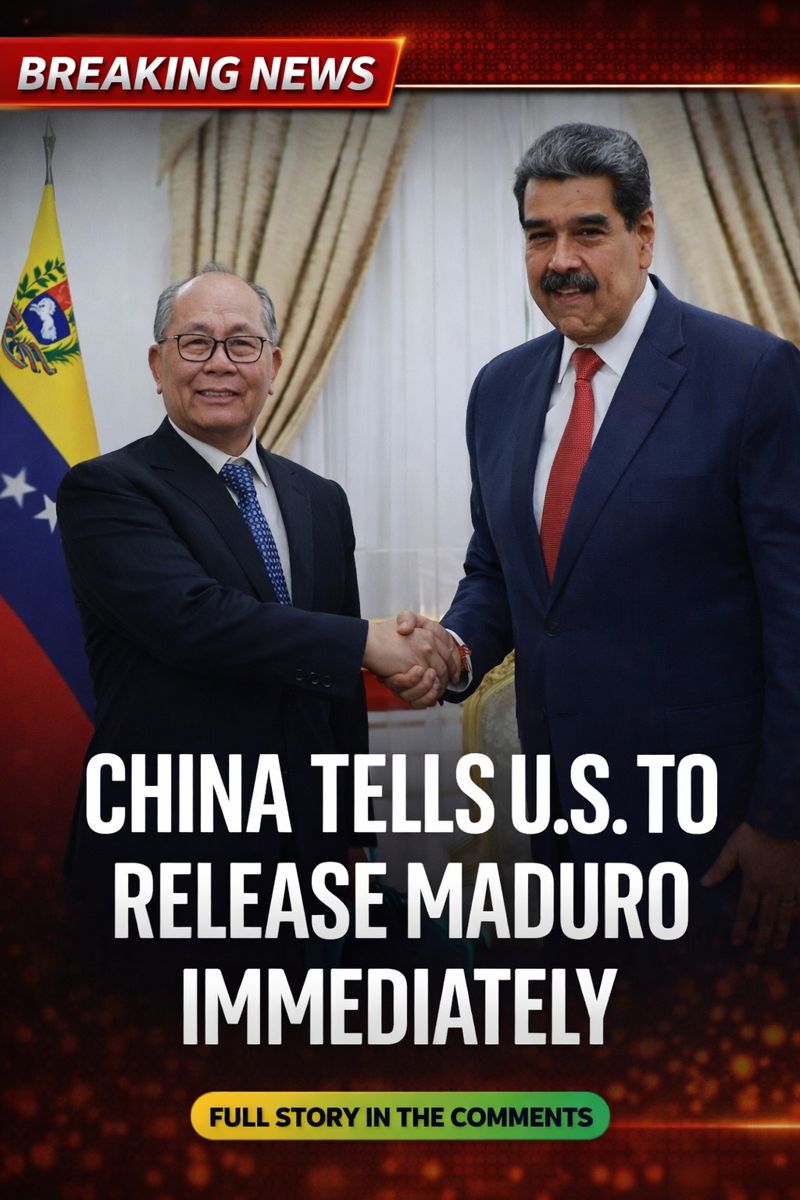
Latest from Venezuela: China demands Maduro’s release and Trump highlights military pressure.
The fragile architecture of global diplomacy shifted violently this week as a series of high-stakes provocations from Beijing and Washington thrust international tensions into a dangerous new gear. In a move that signaled a direct challenge to American hegemony, China’s Ministry of Foreign Affairs issued a blunt public demand for the immediate release of Venezuelan President Nicolás Maduro from U.S. custody—a statement calculated for maximum impact just hours before Maduro’s high-profile arraignment in a New York federal court. The Chinese denunciation was unequivocal, framing the U.S. operation as a flagrant violation of international law, a total disregard for Venezuelan sovereignty, and a betrayal of the foundational principles of the United Nations Charter. By moving beyond mere diplomatic concern, Beijing has staged a calculated pushback against U.S. authority, asserting that domestic legal procedures should never supersede established global norms. Simultaneously, President Donald Trump escalated regional anxieties with a series of inflammatory remarks aimed at another South American neighbor. Speaking to reporters aboard Air Force One, the President turned his sights on Colombian President Gustavo Petro, disparaging him as a “very sick man” and alleging that Petro “likes making cocaine and selling it to the United States.” When pressed on whether a military intervention similar to the one in Venezuela could be directed at Colombia, Trump replied, “It sounds good to me.” The convergence of China’s stern diplomatic ultimatum and Trump’s unfiltered rhetoric has signaled a deepening pattern of geopolitical strain. What is emerging is a pervasive sense of instability defined by fractured alliances, heightened brinkmanship, and a growing fear among world leaders that a single misstep could ignite a broader, uncontrollable confrontation.
Beijing’s Strategic Defiance
China’s position has been both forceful and public. Through its foreign ministry, Beijing accused Washington of “disregarding President Maduro’s status as head of state” and warned that prosecuting a foreign leader in a domestic U.S. court “seriously destabilizes international relations,” setting a perilous precedent for global interactions. This stance is more than just a defense of a partner; it is the cornerstone of a broader diplomatic strategy. Over the last decade, China has woven deep political and economic fibers into Venezuela, ranging from massive oil exports to infrastructure investment. By confronting the United States in its own hemisphere—a region historically considered under the umbrella of the Monroe Doctrine—China is testing its capacity to act as a definitive counterweight to American power in global crisis resolution.
Rhetoric vs. Sovereignty: The Colombian Alarm
While China’s communiqués were delivered in the measured cadences of traditional diplomacy, President Trump’s comments regarding the Colombian government were striking for their bluntness. By questioning Petro’s fitness to lead and suggesting potential military action, Trump has revived long-standing anxieties regarding U.S. interventionism in Latin America. For Bogotá and its neighbors, the rhetoric is destabilizing. In a region where historical memories of U.S. military and diplomatic overreach remain vivid, even a rhetorical threat from a U.S. President carries the weight of a potential policy shift. Regional observers warn that such language, delivered during an active crisis in neighboring Venezuela, threatens to undermine already fragile democratic institutions and long-term cooperation on security and trade.
A Shifting Global Landscape: What Is at Stake?
The current friction reveals a world where the rules of engagement are being rewritten in real-time. This isn’t just about Venezuela or Colombia; it is a symptom of a profound shift in 21st-century power dynamics:
-
Sovereignty vs. Intervention: The international community is grappling with how to balance the sacred principle of state sovereignty against the perceived necessity of responding to alleged criminality or humanitarian collapse.
-
Great Power Competition: Beijing is demonstrating an unprecedented willingness to confront U.S. policy directly on the world stage, particularly as relations are already frayed over trade, technology, and the South China Sea.
-
Regional Volatility: The shockwaves from these superpower tensions are being felt acutely in Latin American capitals, where domestic economic recoveries are now complicated by the looming threat of external intervention.
[Table of Key Geopolitical Tensions – January 2026]
| Nation | Current Stance | Primary Concern |
| China | Demanding Maduro’s Release | Global Norms & Western Influence |
| United States | Asserting Judicial Authority | Narco-terrorism & National Security |
| Colombia | Under Rhetorical Pressure | Sovereign Integrity & U.S. Relations |
| Venezuela | Power Vacuum / Interim Rule | Stability & Resource Control |
The diplomatic shock of the past 48 hours highlights a central, uncomfortable truth: the abstract language of geopolitics and “great power competition” has very real, human consequences. These developments affect trade negotiations, security collaborations, and the daily lives of millions. As Maduro’s legal team prepares for a lengthy battle in Manhattan and diplomats in Beijing and Washington trade barbs, the world remains riveted. The events of this week have proved that unilateral actions and Provocative rhetoric do not exist in a vacuum; they reshape the world in an instant, leaving global leaders to navigate a future where the old rules may no longer apply. Local analysts and veteran diplomats are warning that President Trump’s recent broadsides against the Colombian government, while framed as offhand critiques, carry the heavy historical echoes of Cold War-era interventions. In a region where the memory of external interference is often associated with the exacerbation of internal conflict rather than its resolution, the President’s rhetoric has revived deep-seated anxieties across Latin America. The escalating friction has thrust multilateral organizations into a desperate role. The Organization of American States (OAS) has issued an urgent plea for restraint, invoking the sacred principles of sovereignty and non-intervention. Similarly, the United Nations has underscored the fragility of international law, warning that unilateral strikes or inflammatory language from a superpower can trigger a “cascading effect” of instability that may rapidly spill beyond Venezuela’s borders and across the entire hemisphere.
China’s Strategic Test in the West
Amidst this volatility, Beijing has significantly sharpened its diplomatic teeth. By explicitly linking itself to the protection of the Maduro legacy, China is signaling a transformative shift in its foreign policy. No longer content with traditional flashpoints like the South China Sea or trade tariffs, Beijing is now demonstrating a willingness to confront Washington directly within the Western Hemisphere.
Analysts describe this as a sophisticated strategic test. China is effectively measuring the U.S. response, assessing how far Washington is willing to push unilateral actions while signaling to the “Global South” that Beijing is ready to serve as a formidable counterweight to American power. In an era of nuclear-armed powers and hyper-interconnected economies, this interplay illustrates a shrinking margin for error where a single tactical miscalculation could ignite a global crisis.
Regional Reassessment: Between Two Giants
From Brasília to Mexico City, governments are being forced to conduct an immediate and sober reassessment of their security strategies. Caught between a United States asserting its military will and a China positioning itself as the defender of sovereign integrity, regional leaders face a dual-pressure cooker.
In Colombia, the administration of President Gustavo Petro has responded with a calculated, cautious diplomacy. While reiterating ongoing cooperation with the U.S. on counternarcotics, Petro’s office emphasized that “reckless rhetoric” risks inflaming domestic tensions and regional volatility. The economic stakes are equally immediate: markets have responded with heightened volatility, and investors are closely monitoring the status of Venezuelan oil—a resource that remains the ultimate prize in this geopolitical tug-of-war.
The Human Cost and the Credibility Gap
The human dimension of this crisis remains the most critical, yet often the most overlooked, element. Reports from Caracas indicate a city under siege: heightened military presence, restricted movement, and a breakdown in essential services. Humanitarian organizations are warning that civilians are being caught in the crossfire of this unprecedented power struggle.
Furthermore, the operation has triggered a crisis of credibility for U.S. foreign policy. While the strike demonstrated unrivaled military capability, diplomats warn that long-term influence is built on predictability and adherence to legal frameworks, not just force projection. By bypassing congressional oversight and international norms, Washington risks alienating traditional allies who view consistent, multilateral engagement as the only path to global stability.
A New Era of Multipolar Volatility
The events of the day underscore a new and dangerous era in global politics—one where power is contested in the open and rhetoric is as consequential as a kinetic strike. The simultaneous pressure from China and the provocative stance toward Colombia illustrate the multidimensional challenges now facing U.S. policymakers:
-
Navigating Great Power Competition: Managing a rising China that is no longer afraid to play in America’s “backyard.”
-
Regional Partnership Management: Balancing security objectives without alienating democratic partners in Latin America.
-
Domestic Accountability: Addressing the internal U.S. debate over executive authority and the precedent of unauthorized military interventions.
Ultimately, these developments are more than isolated incidents; they are a blueprint for power in a multipolar world. The era of delayed responses and predictable patterns has ended, replaced by a stage where decisions made in Washington resonate in Beijing and Bogotá within hours.
As the world watches, the lesson is clear: in contemporary geopolitics, the margin for error has never been slimmer. The delicate balance of power demands not just military strength, but a nuanced diplomacy and a recognition that in an interconnected world, symbolic statements carry material—and often permanent—consequences.