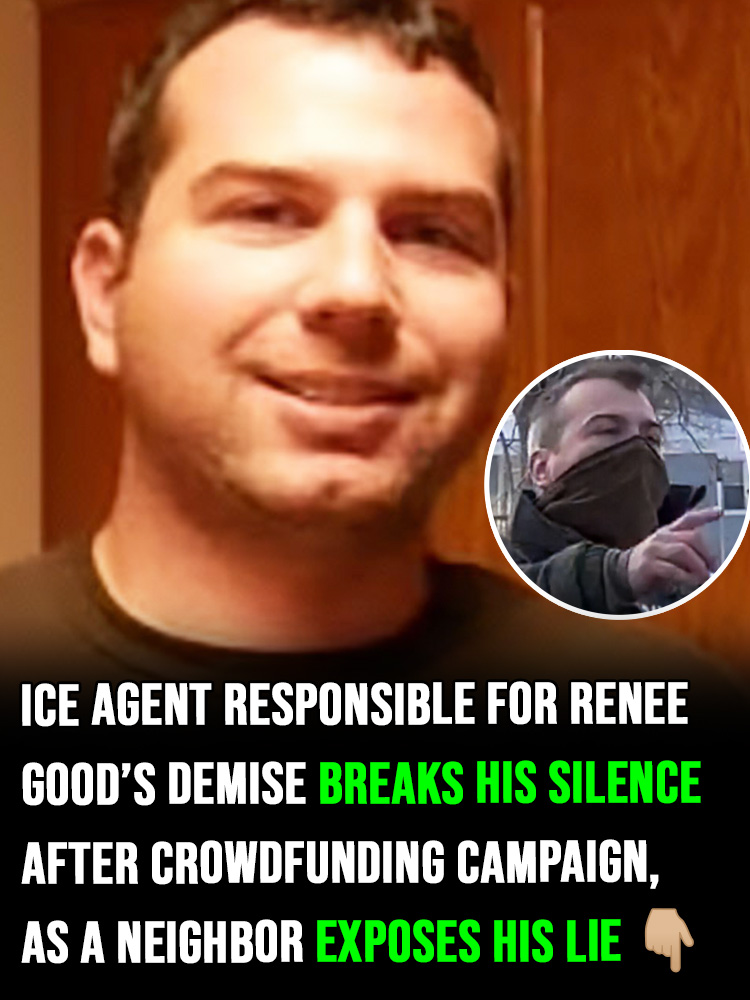
Minneapolis ICE agent breaks silence after crowdfunding as his neighbor says he lied
Jonathan Ross, the ICE agent at the center of the fatal January 7 shooting of Renee Nicole Good, has broken his silence for the first time since the incident sparked a national firestorm. As the embattled officer receives a staggering surge of financial support from across the country, a new and jarring portrait of his life in the Minneapolis suburbs is beginning to emerge—one built on a carefully maintained facade of anonymity. The death of Good, a 37-year-old mother of three, has effectively split the nation into two camps. While the Minneapolis community continues to mourn a life cut short, a powerful counter-narrative has formed in support of Ross. This movement, championed by figures as high-profile as President Donald Trump, maintains that Ross’s use of lethal force was a justified response to a perceived threat. Now, as nearly a million dollars in donations flow into the agent’s accounts, those who lived alongside him are revealing that they had no idea who he truly was.
A $862,000 War Chest
In the wake of the shooting, two primary fundraising streams have transformed Ross’s legal and personal defense into a massive financial operation. At the time of this reporting, a GoFundMe campaign has amassed $614,000, while a parallel effort on the Christian crowdfunding site GiveSendGo has reached $248,000.
On Monday, the silence surrounding Ross’s personal reaction was finally punctured. Jacob Wells, co-founder of GiveSendGo, took to social media to relay a direct message from the agent.
“I just got off the phone with the ICE agent involved in this horrible situation. He is extremely appreciative of the support from all of you,” Wells wrote. He added a logistical update for donors, stating, “We will be releasing funds soon to him so he doesn’t have to worry about his family’s or his safety.”
The Veteran’s Resume
The public record of Jonathan Ross suggests a man whose life has been defined by the front lines. A war veteran who served in Iraq, Ross returned to the United States in 2005. By 2007, he was entrenched in border enforcement, serving as a field intelligence agent for the Border Patrol in El Paso, Texas. He maintained that role until 2015, the year he relocated to Minnesota to join ICE as a deportation officer.
The Neighbor’s Account: “He Lied About What He Did”
While Ross’s professional resume is etched in government records, his life in a quiet Minneapolis neighborhood was apparently a fiction. Residents described a household that seemed unremarkable: a polite, outgoing wife and a pair of children living alongside a “very reserved” father.
However, in an anonymous interview with People Magazine, a female neighbor revealed that Ross allegedly went to great lengths to hide his true profession from those living just feet away. The neighbor recalled meeting Ross at a socially distanced garage party during the height of the pandemic, where she asked him what he did for a living.
“He said he worked with plants, as a botanist, so he lied about what he did,” the neighbor claimed. She noted that while he kept to himself, he had mentioned in passing that he “enjoyed border control,” but quickly pivoted to his supposed passion for botany.
The revelation that the quiet “botanist” next door was actually the ICE agent involved in a high-profile fatal shooting has left the cul-de-sac in a state of shock. “When I found out he was the one on the news, I said, ‘What! That’s so crazy!’ I had no idea he was an ICE agent,” she told the magazine.
A Community in Turmoil
The aftermath of the shooting saw federal agents quickly clearing Ross’s belongings out of his suburban home, a sight that left many on the street feeling unsettled. For the neighbor who spoke out, the proximity to the agent now feels “creepy” and deeply “upsetting.”
“I think it impacted a lot of our neighbors that way,” she concluded. “People really haven’t been talking about it because you just want to maintain some peace on the road—you don’t want to start fights. But it’s just really hard to process. And then every day, you hear about more people getting detained.”
As the investigation into the death of Renee Nicole Good continues, the man at its center remains a figure of intense polarization: a decorated veteran and father to his supporters, and a deceptive stranger to those who once called him a neighbor.